Review
. 2022 Jan;38(1):59-72.
doi: 10.1016/j.tig.2021.06.016. Epub 2021 Jul 20.

Retention of duplicated genes in evolution

Affiliations
Review

Retention of duplicated genes in evolution

Elena Kuzmin et al. Trends Genet. 2022 Jan.

Erratum in

Abstract

Gene duplication is a prevalent phenomenon across the tree of life. The processes that lead to the retention of duplicated genes are not well understood. Functional genomics approaches in model organisms, such as yeast, provide useful tools to test the mechanisms underlying retention with functional redundancy and divergence of duplicated genes, including fates associated with neofunctionalization, subfunctionalization, back-up compensation, and dosage amplification. Duplicated genes may also be retained as a consequence of structural and functional entanglement. Advances in human gene editing have enabled the interrogation of duplicated genes in the human genome, providing new tools to evaluate the relative contributions of each of these factors to duplicate gene retention and the evolution of genome structure.

Keywords: Gene duplication; evolution; functional divergence; genetic redundancy; paralogs; whole-genome duplication.


Figures

Figure 1.
Figure 1.
Summary of mechanisms of gene duplication. Small scale duplication are thought to result from (a) tandem duplication, which can result from unequal exchange either between sister chromatids in mitosis or homologous chromosomes in meiosis I or non-allelic homologous recombination resulting from a misalignment of repetitive sequences; and transposition, which carries a locus from one position to another via RNA or DNA intermediates. (b) Duplication of the entire genome happens through autoploidy or alloploidy. Black arrows represent a duplication event. Grey rods represent a chromosome. Coloured blocks depict a locus.
Figure 2.
Figure 2.
Duplicate gene divergence by subfunctionalization or neofunctionalization. Duplicated gene divergence may proceed by subfunctionalization, which refers to the retention of partitioned complementary subfunctions of an ancestral gene (duplicates undergo ‘division of labor’) or by neofunctionalization, whereby over time one duplicate accumulates mutations and evolves a novel function which is not performed by the ancestral gene. Hypothetical different functions are illustrated in different colours.
Figure 3.
Figure 3.
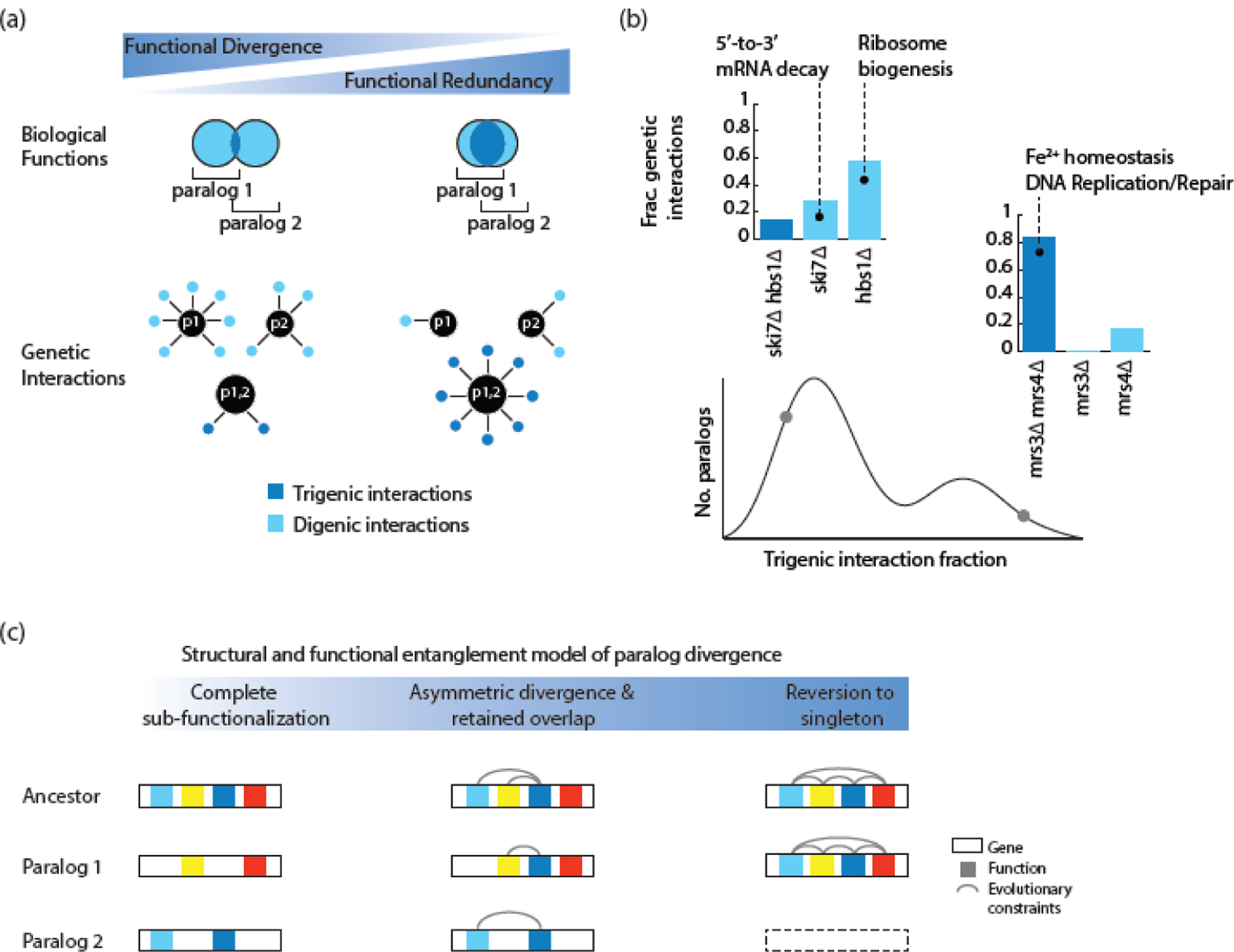
The structural and functional entanglement model of paralog divergence. (a) Digenic and trigenic interactions reveal paralog-specific and redundant functions as denoted by light blue and dark blue colours, respectively. (b) Distribution of negative trigenic interaction fraction obtained from screening 240 double mutants and 480 single mutants involving dispensable duplicated genes for digenic and trigenic interactions [27]. Examples of functionally divergent (SKI7-HBS1) and redundant (MRS3-MRS4) paralog pairs are depicted. Their respective trigenic interaction fractions are shown using a grey circle. (c) Members of a duplicated gene pair will diverge by subfunctionalization if their structure and function are modular and are composed of partitionable functions (left). A duplicated gene pair that is highly structurally and functionally entangled will tend to revert to a singleton state because one of its paralogs will rapidly degenerate by accumulating intrinsically deleterious mutations (right). Duplicated genes that are characterized by an intermediate level of structural entanglement at the time of duplication will tend to partition some and retain some overlapping functions, allowing for both specialization and retention of a common activity (center). This figure was adapted from a previous publication [27].

References

    1. Vosseberg J, van Hooff JJE, Marcet-Houben M, van Vlimmeren A, van Wijk LM, Gabaldon T, et al. Timing the origin of eukaryotic cellular complexity with ancient duplications. Nat Ecol Evol. 2021;5(1):92–100. - PMC - PubMed
    1. Carvalho CM, Zhang F, Lupski JR. Evolution in health and medicine Sackler colloquium: Genomic disorders: a window into human gene and genome evolution. Proc Natl Acad Sci U S A. 2010;107 Suppl 1:1765–71. - PMC - PubMed
    1. Conrad B, Antonarakis SE. Gene duplication: a drive for phenotypic diversity and cause of human disease. Annu Rev Genomics Hum Genet. 2007;8:17–35. - PubMed
    1. Makino T, McLysaght A. Ohnologs in the human genome are dosage balanced and frequently associated with disease. Proc Natl Acad Sci U S A. 2010;107(20):9270–4. - PMC - PubMed
    1. Saitou M, Gokcumen O. An Evolutionary Perspective on the Impact of Genomic Copy Number Variation on Human Health. J Mol Evol. 2020;88(1):104–19. - PubMed

Publication types