


Surgical Versus Medical Management of Necrotizing Enterocolitis With and Without Intestinal Perforation: A Retrospective Chart Review
- PMID: 34295576
- PMCID: PMC8290905
- DOI: 10.7759/cureus.15722
Surgical Versus Medical Management of Necrotizing Enterocolitis With and Without Intestinal Perforation: A Retrospective Chart Review
Abstract
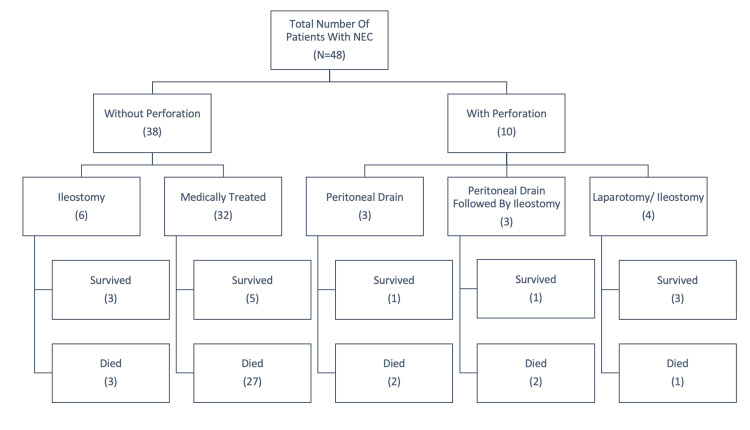
Background Necrotizing enterocolitis (NEC) is a debilitating disease that predominantly afflicts premature neonates, although it can also affect term neonates. The clinical features of the ailment vary widely and range from transient feed intolerance to life-threatening complications such as septicemia and disseminated intravascular coagulation. While surgery is usually only reserved for severe cases, such as those presenting with intestinal perforation, the role of surgical management in cases of NEC without perforation remains elusive. Methods A retrospective chart review of patients, three years in duration, was conducted and studied confirmed cases of NEC. The clinical presentations studied included cases of NEC with pneumatosis intestinalis, fixed bowel loop, pneumoperitoneum, and abdominal wall erythema. The patients were divided with regards to their intestinal perforation status and with pertinence to the treatment modality employed (medical or surgical). The results in either group were eventually analyzed in terms of the overall survival rate. Results A total of 48 patients were included in the study, of which 79.16% presented without perforation and 20.83% with perforation. Of the study participants included, 26 were females and 22 were males. Pertinently, no gender predominance was appreciated. In patients without perforation, medical management was noted to boast a lower mortality rate when compared with surgical intervention (15.6% vs 50.0%, respectively). In patients with perforation, the overall mortality was noted to hover at 50.0%, which was higher than that encountered in the non-perforation group. Conclusion In patients with NEC without perforation, surgical treatment confers no comparative therapeutic advantage when compared with medical management alone. Conservative management with broad-spectrum antibiotics including metronidazole yields equally favorable outcomes in such cases.
Keywords: abdominal sepsis; intestinal perforation; metronidazole; necrotizing enterocolitis; pediatric ileostomy.
Copyright © 2021, Syed et al.
Conflict of interest statement
The authors have declared that no competing interests exist.
Figures


References
-
- The surgical management of necrotising enterocolitis. Pierro A. Early Hum Dev. 2005;81:79–85. - PubMed
-
- Surgical therapy for necrotizing enterocolitis: bringing evidence to the bedside. Henry MC, Lawrence Moss R. Semin Pediatr Surg. 2005;14:181–190. - PubMed
-
- Indications for operation in necrotizing enterocolitis revisited. Kosloske AM. J Pediatr Surg. 1994;29:663–666. - PubMed
-
- Significance of portal vein air in necrotizing entercolitis: analysis of 53 cases. Cikrit D, Mastandrea J, Grosfeld JL, West KW, Schreiner RL. J Pediatr Surg. 1985;20:425–430. - PubMed
-
- Peritoneal drainage under local anesthesia for perforations from necrotizing enterocolitis. Ein SH, Marshall DG, Girvan D. J Pediatr Surg. 1977;12:963–967. - PubMed
LinkOut - more resources
Full Text Sources