Review
. 2021 Jul 6:11:686167.
doi: 10.3389/fcimb.2021.686167. eCollection 2021.

The Vaginal Microbiome: A Long Urogenital Colonization Throughout Woman Life

Affiliations
Review

The Vaginal Microbiome: A Long Urogenital Colonization Throughout Woman Life

Renata S Auriemma et al. Front Cell Infect Microbiol. .

Abstract

Vaginal microbial niche is a dynamic ecosystem, composed by more than 200 bacterial species which are influenced by genes, ethnic background and environmental-behavioral factors. Several lines of evidence have well documented that vaginal microbiome constantly changes over the course of woman's life, so to exert an important impact on woman quality of life, from newborn to post-menopausal ages. This review aims at analyzing the role of vaginal microbiome in the maintenance of woman's homeostasis and at tracking critical changes that commonly occur across woman's lifetime. The role of hormone replacement therapy in the modulation of vaginal microbiome composition and in the improvement of vaginal wellness in postmenopausal women with decreasing levels of circulating estrogen is discussed.

Keywords: bacterial vaginosis; estrogen and progestin variations; vaginal microbiome; woman health; woman homeostasis.


Conflict of interest statement

The authors declare that the research was conducted in the absence of any commercial or financial relationships that could be construed as a potential conflict of interest.

Figures
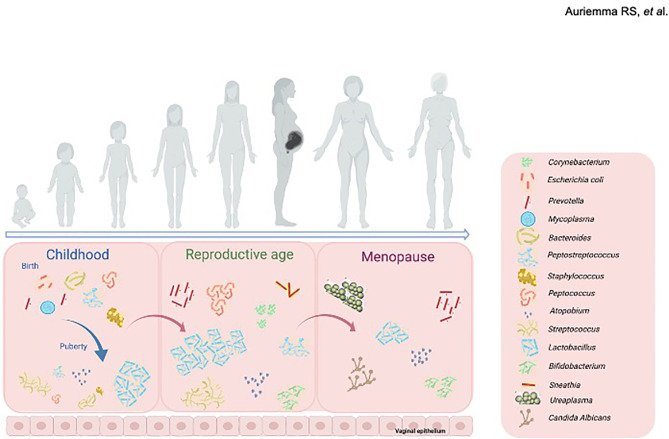
Figure 1
Figure 1
Changes in the composition of vaginal microbiome throughout women life. In childhood (left panel), Corynebacterium spp., coagulase-negative Staphylococcus spp., Escherichia coli and Mycoplasma spp., form the vaginal microbiome. At puberty, upon estrogen/progestin exposure the vaginal microbial niche shifts towards other predominant colonies, mainly including Lactobacillus spp., Atopobium, and Streptococcus spp. During reproductive age (middle panel), vaginal microbiome houses a range of bacterial communities, mainly including lactobacilli (L. crispatus, L. gasseri, L. jensenii and L. iners) along with anaerobic bacteria. Menopause (right panel) induces further changes in the composition of vaginal microbiome, mainly composed by Gardnerella vaginalis, Ureaplasma urealyticum, Candida albicans and Prevotella spp., together with a progressive decrease in species of Lactobacillus. Created with BioRender.com.

References

    1. Aagaard K., Ma J., Antony K. M., Ganu R., Petrosino J., Versalovic J. (2014). The Placenta Harbors a Unique Microbiome. Sci. Transl. Med. 6 (237), 237ra65. 10.1126/scitranslmed.3008599 - DOI - PMC - PubMed
    1. Amabebe E., Anumba D. O. C. (2018). The Vaginal Microenvironment: The Physiologic Role of Lactobacilli. Front. Med. (Lausanne) 13 (5), 181. 10.3389/fmed.2018.00181 - DOI - PMC - PubMed
    1. Amsel R., Totten P. A., Spiegel C. A., Chen K. C., Eschenbach D., Holmes K. K. (1983). Nonspecific Vaginitis. Diagnostic Criteria and Microbial and Epidemiologic Associations. Am. J. Med. 74 (1), 14–22. 10.1016/0002-9343(83)91112-9 - DOI - PubMed
    1. Bakken L. R. (1985). Separation and Purification of Bacteria From Soil. Appl. Environ. Microbiol. 49 (6), 1482–1487. 10.1128/aem.49.6.1482-1487.1985 - DOI - PMC - PubMed
    1. Blaser M. J., Devkota S., McCoy K. D., Relman D. A., Yassour M., Young V. B. (2021). Lessons Learned From the Prenatal Microbiome Controversy. Microbiome 9 (1), 8. 10.1186/s40168-020-00946-2 - DOI - PMC - PubMed

LinkOut - more resources
