Review
. 2021 Jul 6:11:704099.
doi: 10.3389/fcimb.2021.704099. eCollection 2021.

Playing With Fire: Proinflammatory Virulence Mechanisms of Group A Streptococcus

Affiliations
Review

Playing With Fire: Proinflammatory Virulence Mechanisms of Group A Streptococcus

Shyra Wilde et al. Front Cell Infect Microbiol. .

Abstract

Group A Streptococcus is an obligate human pathogen that is a major cause of infectious morbidity and mortality. It has a natural tropism for the oropharynx and skin, where it causes infections with excessive inflammation due to its expression of proinflammatory toxins and other virulence factors. Inflammation directly contributes to the severity of invasive infections, toxic shock syndrome, and the induction of severe post-infection autoimmune disease caused by autoreactive antibodies. This review discusses what is known about how the virulence factors of Group A Streptococcus induce inflammation and how this inflammation can promote disease. Understanding of streptococcal pathogenesis and the role of hyper-immune activation during infection may provide new therapeutic targets to treat the often-fatal outcome of severe disease.

Keywords: Group A Streptococcus; Streptococcus pyogenes; inflammation; pathogenesis; toxins; virulence factors.


Conflict of interest statement

The authors declare that the research was conducted in the absence of any commercial or financial relationships that could be construed as a potential conflict of interest.

Figures
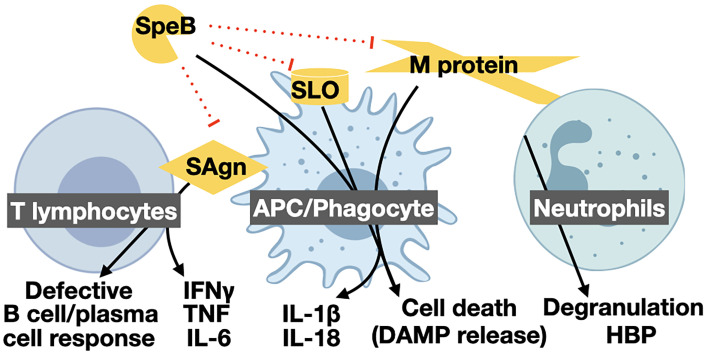
Figure 1
Figure 1
Proinflammatory virulence mechanisms of GAS and their targets. The GAS protease SpeB is directly proinflammatory by activating pro-IL-1β, other host substrates, and inactivating anti-inflammatory GAS effectors. SpeB cleavage of other proinflammatory cytokines, and proinflammatory virulence factors such as superantigens (SAgn), streptolysin O (SLO), and M protein can lead to their inactivation and have anti-inflammatory contributions. Superantigens forcibly bind T lymphocytes and APCs, leading to excessive T cell activation. Activated T cells kill other immune cells and release a “cytokine storm” of IFN-γ, TNF, and IL-6, hallmark of STSS. The pore-forming toxins SLO and streptolysin S (SLS) form large pores in host cells that can lead to the passive release DAMPs, and other cytosolic or organelle-associated proinflammatory compounds, or be detected by the inflammasome to further activate inflammatory cell death by pyroptosis. Proinflammatory effects of SLO can include aiding translocation of the virulence factors Nga. M protein proteolytically released from the GAS surface can similarly form complexes that induce pyroptosis in macrophages or hyper-degranulation by neutrophils. Like other microbes, GAS has numerous TLR agonists that activate proinflammatory regulatory programs [reviewed in (LaRock and Nizet, 2015)]. Created with BioRender.com.

References

    1. Anderson E. L., Cole J. N., Olson J., Ryba B., Ghosh P., Nizet V., et al. (2014). The Fibrinogen-Binding M1 Protein Reduces Pharyngeal Cell Adherence and Colonization Phenotypes of M1T1 Group A Streptococcus. J. Biol. Chem. 289, 3539–3546. 10.1074/jbc.M113.529537 - DOI - PMC - PubMed
    1. Andreoni F., Zürcher C., Tarnutzer A., Schilcher K., Neff A., Keller N., et al. (2017). Clindamycin Affects Group A Streptococcus Virulence Factors and Improves Clinical Outcome. J. Infect. Dis. 215, 269–277. 10.1093/infdis/jiw229 - DOI - PubMed
    1. Arpaia N., Godec J., Lau L., Sivick K. E., McLaughlin L. M., Jones M. B., et al. (2011). TLR Signaling Is Required for Salmonella Typhimurium Virulence. Cell 144, 675–688. 10.1016/j.cell.2011.01.031 - DOI - PMC - PubMed
    1. Ashbaugh C. D., Warren H. B., Carey V. J., Wessels M. R. (1998). Molecular Analysis of the Role of the Group A Streptococcal Cysteine Protease, Hyaluronic Acid Capsule, and M Protein in a Murine Model of Human Invasive Soft-Tissue Infection. J. Clin. Invest. 2 (4), 283–292. 10.1172/JCI3065 - DOI - PMC - PubMed
    1. Aziz R. K., Pabst M. J., Jeng A., Kansal R., Low D. E., Nizet V., et al. (2004). Invasive M1T1 Group A Streptococcus Undergoes a Phase-Shift In Vivo to Prevent Proteolytic Degradation of Multiple Virulence Factors by SpeB. Mol. Microbiol. 51, 123–134. 10.1046/j.1365-2958.2003.03797.x - DOI - PubMed

Publication types

Substances
