. 2017;4(12):263-271.
doi: 10.20517/2347-8659.2017.50. Epub 2017 Dec 8.

Altered filamin A enables amyloid beta-induced tau hyperphosphorylation and neuroinflammation in Alzheimer's disease

Affiliations

Altered filamin A enables amyloid beta-induced tau hyperphosphorylation and neuroinflammation in Alzheimer's disease

Lindsay H Burns et al. Neuroimmunol Neuroinflamm. 2017.

Abstract

Alzheimer's disease (AD) is a neurodegenerative disease with proteopathy characterized by abnormalities in amyloid beta (Aβ) and tau proteins. Defective amyloid and tau propagate and aggregate, leading to eventual amyloid plaques and neurofibrillary tangles. New data show that a third proteopathy, an altered conformation of the scaffolding protein filamin A (FLNA), is critically linked to the amyloid and tau pathologies in AD. Altered FLNA is pervasive in AD brain and without apparent aggregation. In a striking interdependence, altered FLNA is both induced by Aβ and required for two prominent pathogenic signaling pathways of Aβ. Aβ monomers or small oligomers signal via the α7 nicotinic acetylcholine receptor (α7nAChR) to activate kinases that hyperphosphorylate tau to cause neurofibrillary lesions and formation of neurofibrillary tangles. Altered FLNA also enables a persistent activation of toll-like-receptor 4 (TLR4) by Aβ, leading to excessive inflammatory cytokine release and neuroinflammation. The novel AD therapeutic candidate PTI-125 binds and reverses the altered FLNA conformation to prevent Aβ's signaling via α7nAChR and aberrant activation of TLR4, thus reducing multiple AD-related neuropathologies. As a regulator of Aβ's signaling via α7nAChR and TLR4, altered FLNA represents a novel AD therapeutic target.

Keywords: PTI-125; Proteopathy; hyperphosphorylation; neuroinflammation; toll-like receptor 4; α7 nicotinic acetylcholine receptor.


Conflict of interest statement

Conflicts of interest LHB is an employee of and HYW is a consultant to Pain Therapeutics Inc., who owns all rights to PTI-125 and related technology.

Figures
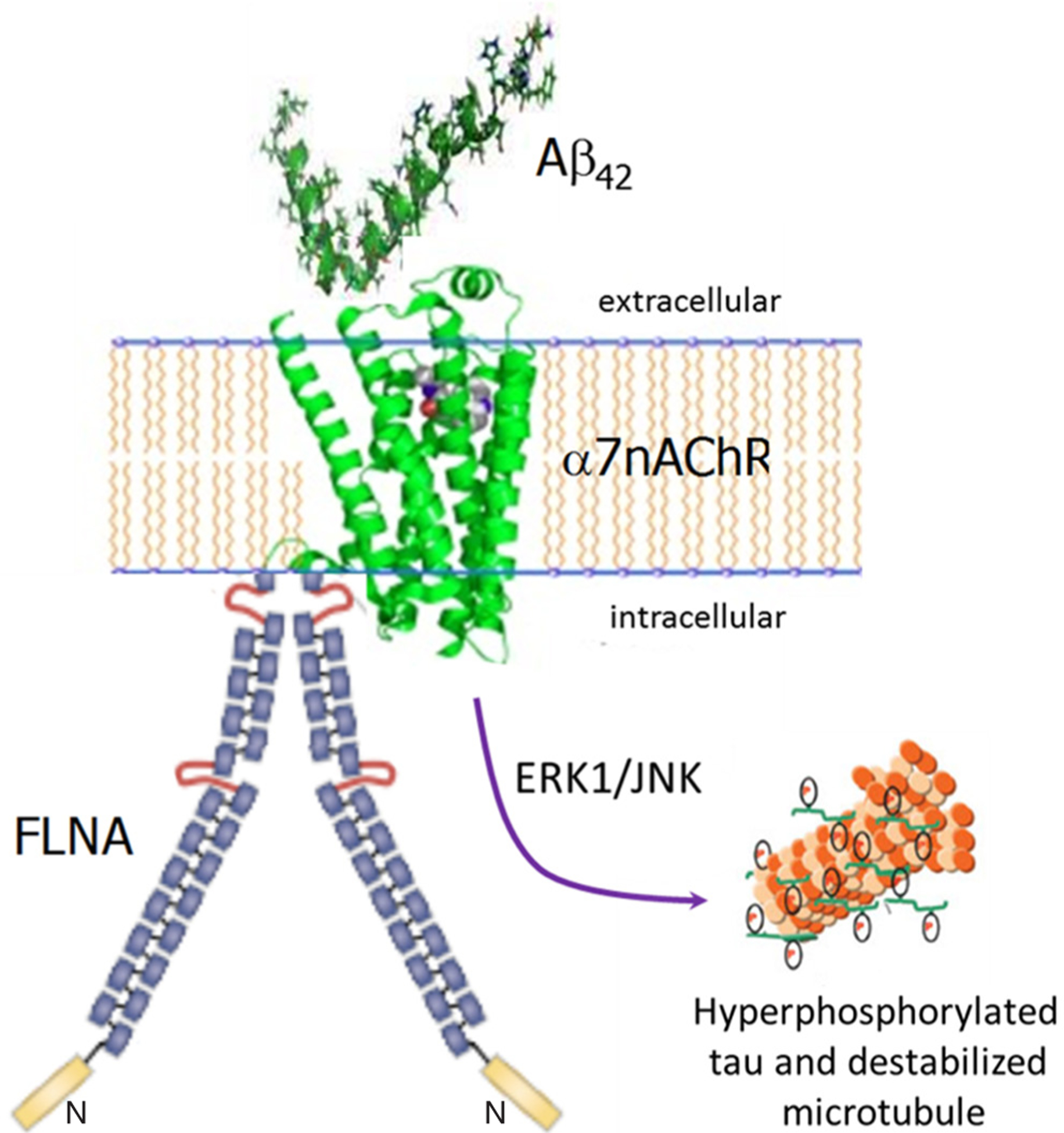
Figure 1:
Figure 1:
Altered FLNA linkage to α7nAChR enables Aβ42’s toxic signaling via α7nAChR to hyperphosphorylate tau. Monomers or small oligomers of Aβ42 bind α7nAChR, which recruits FLNA to link to α7nAChR. This recruitment likely alters FLNA’s conformation, which in turn increases the affinity of the Aβ42-α7nAChR interaction to a femtomolar affinity and enables the signaling. ERK1 and JNK kinases are activated to hyperphosphorylate tau. Hyperphosphorylated tau loses its function of stabilizing microtubules and dissociates from them, eventually creating PHFs and neurofibrillary tangles. FLNA: filamin A; Aβ: amyloid beta; α7nAChR: α7 nicotinic acetylcholine receptor; PHF: paired helical filament
Figure 2:
Figure 2:
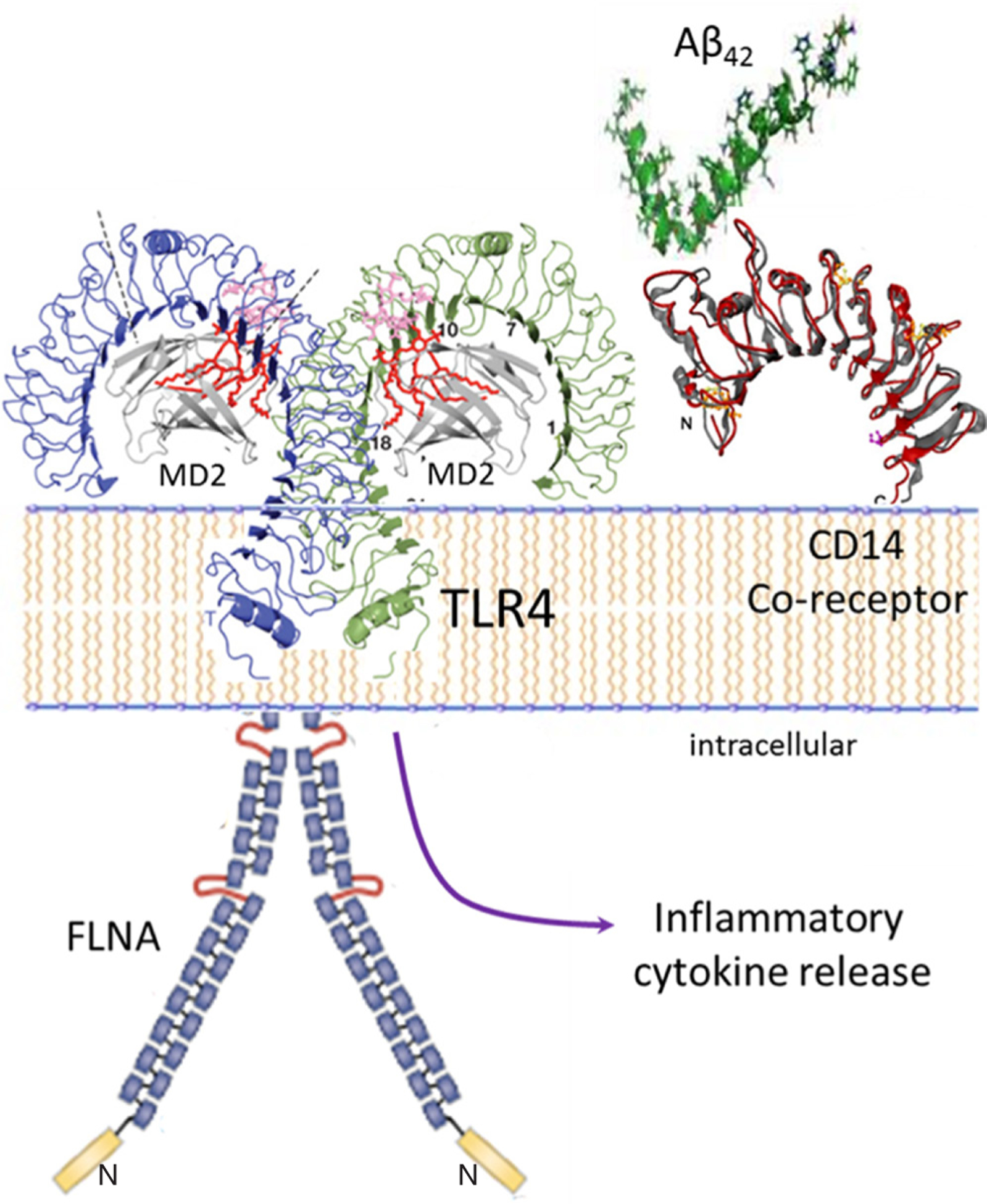
Altered FLNA linkage to TLR4 enables persistent Aβ42-induced TLR4 activation and neuroinflammation. Aβ42 binds the CD14 co-receptor to induce FLNA recruitment to TLR4. As with α7nAChR, the FLNA linkage likely alters the FLNA conformation. With Aβ42 binding CD14, altered FLNA linkage to TLR4 enables a sustained TLR4 activation, leading to substantial inflammatory cytokine release and the neuroinflammation characteristic of AD. FLNA: filamin A; Aβ: amyloid beta; α7nAChR: α7 nicotinic acetylcholine receptor; TLR4: toll-like-receptor 4
Figure 3:
Figure 3:
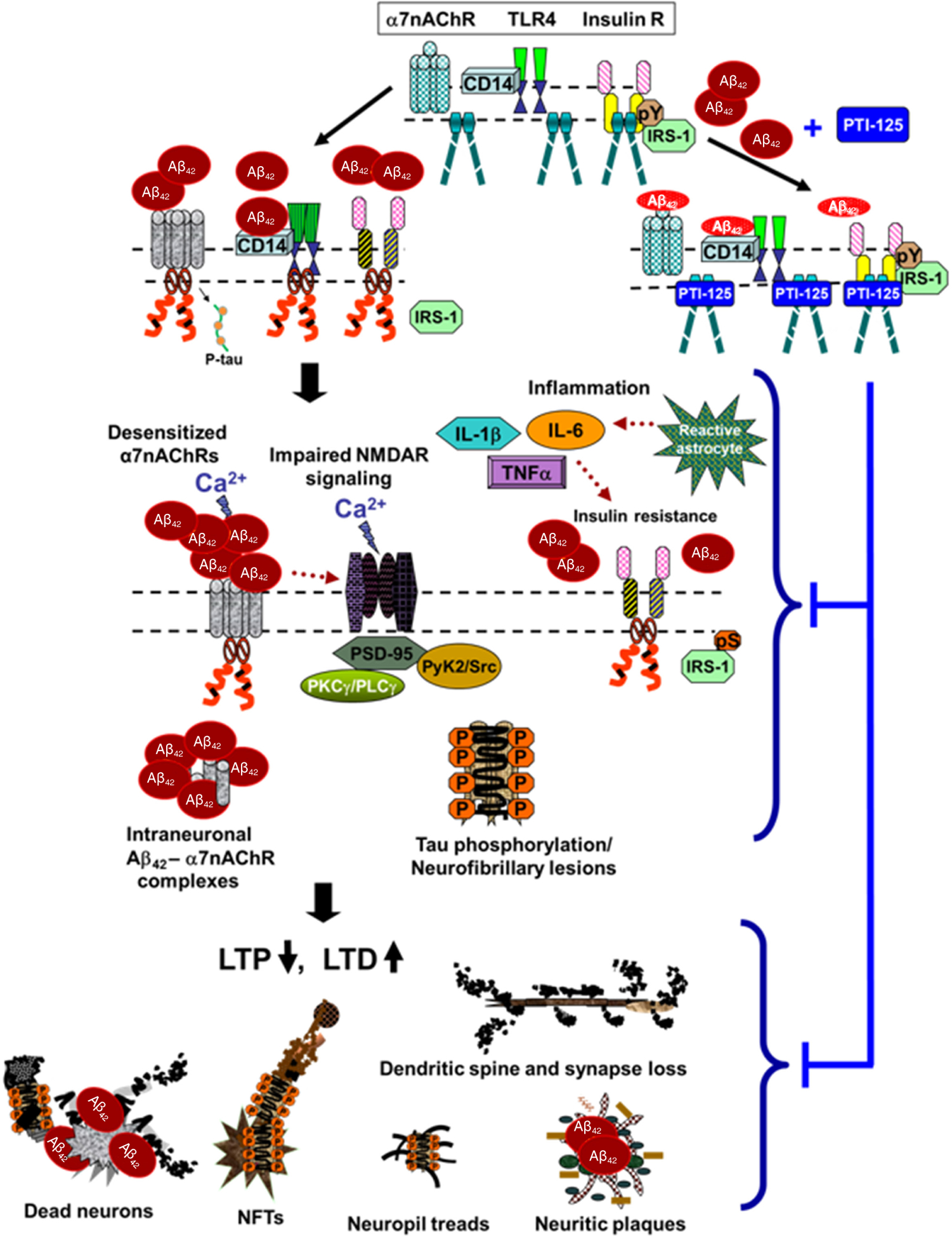
Proposed model of pathological consequences of altered FLNA-enabled Aβ42 signaling via α7nAChR and TLR4. Soluble Aβ42 monomers or small oligomers bind α7nAChR or CD14, complexed with TLR4, inducing recruitment of FLNA to these receptors. Dimers of native FLNA, coupled to insulin receptors but not to α7nAChR or TLR4, are depicted as straight rods; red curly FLNA depicts the altered form, which is recruited to α7nAChR and TLR4 (and possibly also insulin receptors). Enabled by altered FLNA’s new linkages, Aβ42 activates α7nAChR to hyperphosphorylate tau and persistently activates TLR4 to induce inflammatory cytokine release (TNFα, IL-1β and IL-6) by reactive astrocytes. This neuroinflammation likely contributes to insulin receptor desensitization[57]. Although the insulin receptor is constitutively associated with native FLNA, it is possible that altered FLNA also contributes to the insulin receptor dysfunction in AD. Aβ42’s aberrant signaling through α7nAChR impairs function of α7nAChR and of NMDARs, restricting calcium influx through both receptors. Increasing Aβ42 piling onto α7nAChR leads to intraneuronal Aβ42-α7nAChR complexes. The hyperphosphorylated tau dissociates from microtubules, disrupting microtubule stability, axonal transport and neuronal function. Along with dysfunctional tau, impaired NMDARs reduce LTP and heighten LTD. Dendritic spines and synapses are lost. Neuritic plaques, neuropil treads and neurofibrillary tangles are formed, and neurons degenerate. FLNA: filamin A; Aβ: amyloid beta; α7nAChR: α7 nicotinic acetylcholine receptor; TLR4: toll-like-receptor 4; TNFα: tumor necrosis factor-α; IL: interleukin; AD: Alzheimer’s disease; NMDAR: N-methyl-D-aspartate receptor; LTP: long-term potentiation; LTD: long-term depression

References

    1. Frost B, Diamond M. Prion-like mechanisms in neurodegenerative diseases. Nat Rev Neurosci 2010;11:155–9. - PMC - PubMed
    1. Sengupta U, Nilson A, Kayed R. The role of amyloid-β oligomers in toxicity, propagation, and immunotherapy. EBioMedicine 2016;6:42–9. - PMC - PubMed
    1. Yin R, Tan L, Jiang T, Yu J. Prion-like mechanisms in Alzheimer’s disease. Curr Alzheimer Res 2014;11:755–64. - PubMed
    1. Eisenberg D, Jucker M. The amyloid state of proteins in human diseases. Cell 2012;148:1188–203. - PMC - PubMed
    1. Rasmussen J, Jucker M, Walkerd L. Aβ seeds and prions: how close the fit? Prion 2017;11:215–25. - PMC - PubMed

LinkOut - more resources