Review
. 2021 Jul 15;22(14):7582.
doi: 10.3390/ijms22147582.

Problems of Pathogenesis and Pathogenetic Therapy of COVID-19 from the Perspective of the General Theory of Pathological Systems (General Pathological Processes)

Affiliations
Review

Problems of Pathogenesis and Pathogenetic Therapy of COVID-19 from the Perspective of the General Theory of Pathological Systems (General Pathological Processes)

Evgenii Gusev et al. Int J Mol Sci. .

Abstract

The COVID-19 pandemic examines not only the state of actual health care but also the state of fundamental medicine in various countries. Pro-inflammatory processes extend far beyond the classical concepts of inflammation. They manifest themselves in a variety of ways, beginning with extreme physiology, then allostasis at low-grade inflammation, and finally the shockogenic phenomenon of "inflammatory systemic microcirculation". The pathogenetic core of critical situations, including COVID-19, is this phenomenon. Microcirculatory abnormalities, on the other hand, lie at the heart of a specific type of general pathological process known as systemic inflammation (SI). Systemic inflammatory response, cytokine release, cytokine storm, and thrombo-inflammatory syndrome are all terms that refer to different aspects of SI. As a result, the metabolic syndrome model does not adequately reflect the pathophysiology of persistent low-grade systemic inflammation (ChSLGI). Diseases associated with ChSLGI, on the other hand, are risk factors for a severe COVID-19 course. The review examines the role of hypoxia, metabolic dysfunction, scavenger receptors, and pattern-recognition receptors, as well as the processes of the hemophagocytic syndrome, in the systemic alteration and development of SI in COVID-19.

Keywords: ARDS; MODS; SARS-CoV-2; cytokine storm; general pathological process; low-grade inflammation; microcirculation; receptor scavengers; systemic inflammation.


Conflict of interest statement

The authors declare no conflict of interest. The funders had no role in the design of the study; in the collection, analyses, or interpretation of data; in the writing of the manuscript, or in the decision to publish the results.

Figures
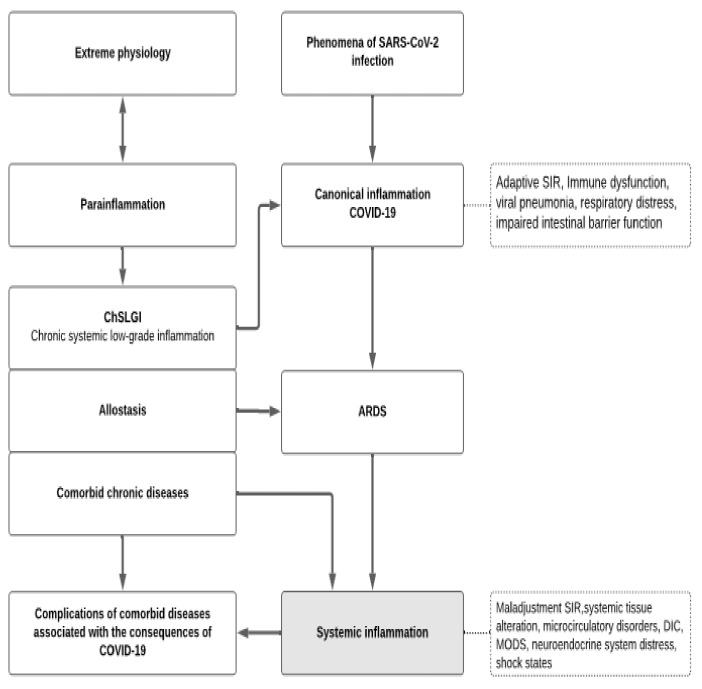
Figure 3
Figure 3
The relationship of general pathological processes in COVID-19. Two interrelated processes are depicted in the heuristic diagram of COVID-19 pathogenesis. In the left part of the scheme, the development of comorbid chronic pathologies, risk factors for SARS-CoV-2 infection, and chronic systemic low-grade inflammation (ChSLGI), which is a common, typical pathogenetic basis of chronic pathologies (in the form of allostasis), as well as comorbid chronic diseases are depicted. ChSLGI is linked to pro-inflammatory tissue stress, a subthreshold for the formation of focus of classical inflammation processes, and life-threatening “systemic inflammatory microcirculation”. In the center, the transformation of canonical pneumonia into Acute Respiratory Distress Syndrome (ARDS), which is already a sign of systemic inflammation (SI), is described. The source for ChSLGI development and stabilization (in the form of allostasis) are the extreme physiological processes in which tissue stress has limitations in its severity, time, and prevalence in the body.
Figure 1
Figure 1
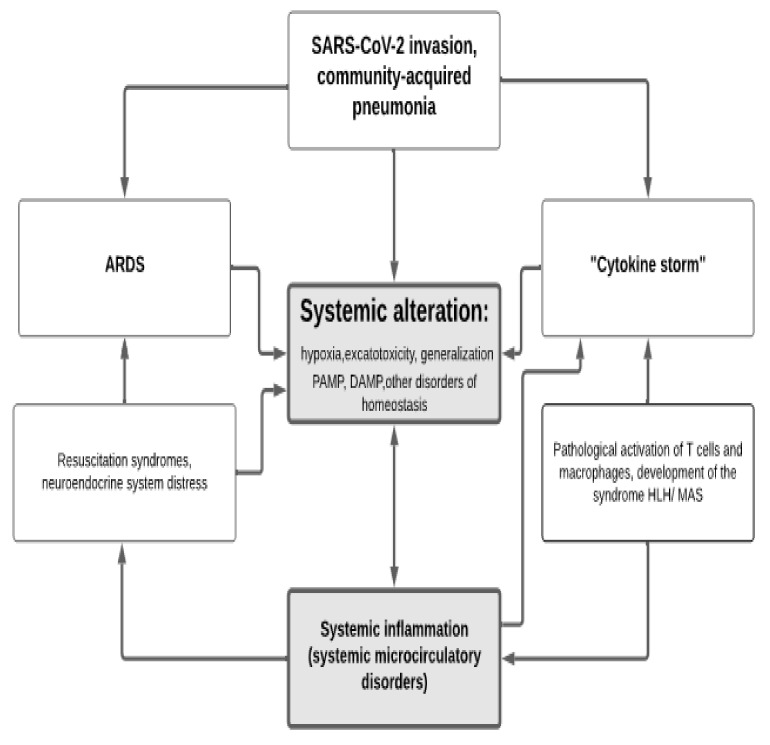
Transformation of classic inflammation in COVID-19 into systemic inflammation with the formation of a vicious pathogenetic circle. Three key mechanisms may be distinguished in the formation of a vicious pathogenetic circle and the development of a critical state in COVID-19: (1) the severity of ARDS (Acute Respiratory Distress Syndrome), which is linked to acute lung damage and systemic microcirculatory abnormalities, regardless of the primary focus of damage. Additionally, with the development of other resuscitation syndromes such as DIC and MODS, the phenomenon of systemic change promotes the onset of organ dysfunctions and coagulopathy. (2) During the development of microcirculatory diseases, DAMPs (damage-associated molecular pattern) and TF (Tissue Factor) and other hazardous products of tissue degradation are widespread. (3) The emergence of the “cytokine storm” phenomenon, which is linked to hemophagocytic lymphohistiocytosis (macrophage activation syndrome, MAS) and overproduction of cytokines in the focus of COVID-19 canonical inflammation, sharply increases with the generalization of pro-inflammatory tissue stress linked to SI.
Figure 2
Figure 2
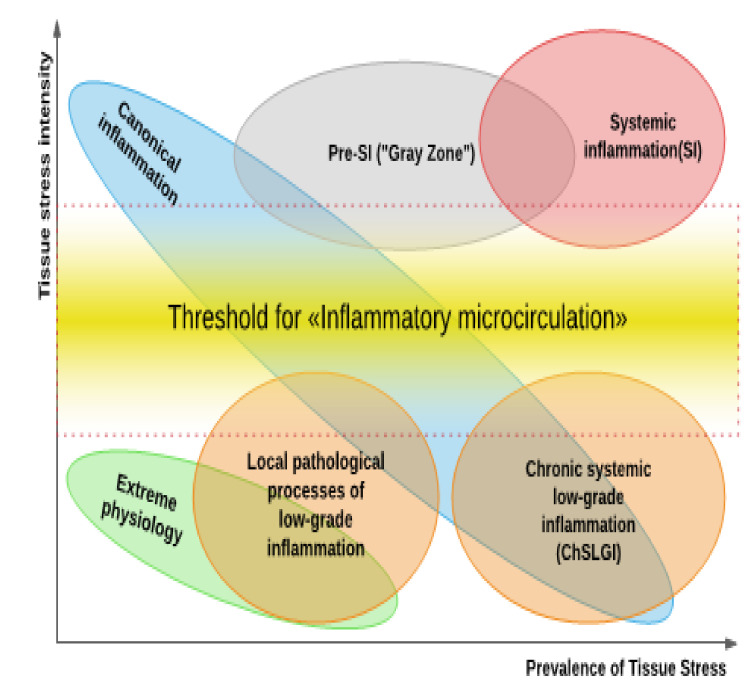
Tissue stress and general pathological processes. Three “large” general pathological processes can be distinguished based on the ratio of intensity (the ordinate in the Figure) to prevalence (the abscissa) of damaging factors initiating a “response” in the form of tissue pro-inflammatory stress—a common pathogenetic basis of all pathological processes (classical inflammation, SI, and ChSLGI). The “inflammatory microcirculation”—a reaction of microvessels that causes a clinically significant exudative reaction and enormous migration of leukocytes into a damaged area with the establishment of the inflammation focus—is the key differentiating phenomenon for their separation. (1) The existence of an inflammation focus (upper-left corner in Figure 2), as well as, in some cases, the systemic manifestations of tissue stress at a subthreshold level for “inflammatory microcirculation”, characterizes classic inflammation. In most cases, these systemic reactions are protective and targeted at providing resource support for the inflammation’s focal point (immune response, the acute-phase response of the liver, forced leuko-cytopoiesis, neuroendocrine stress, and mobilization of metabolic reserves). (2) Systemic inflammation (SI) is characterized by shockogenic systemic “inflammatory microcirculation” and the presence of a transitional “gray” zone, in which it is impossible to prove or refute the presence of SI in situations of the “pushing” variant development (upper-right corner of the Figure). (3) Parainflammation (low-intensity inflammation): can be local (see the figure in the lower-left corner of Figure 1) or can spread throughout the body (see ChSLGI) (lower-right corner of Figure 1). The signs of endotheliosis and, in certain circumstances, latent microcirculatory disorders can be disclosed within these types of tissue pro-inflammatory stress.

References

    1. Malik Y.S., Sircar S., Bhat S., Sharun K., Dhama K., Dadar M., Tiwari R., Chaicumpa W. Emerging Novel Coronavirus (2019-NCoV)-Current Scenario, Evolutionary Perspective Based on Genome Analysis and Recent Developments. Vet. Q. 2020;40:68–76. doi: 10.1080/01652176.2020.1727993. - DOI - PMC - PubMed
    1. Bellocchio L., Bordea I.R., Ballini A., Lorusso F., Hazballa D., Isacco C.G., Malcangi G., Inchingolo A.D., Dipalma G., Inchingolo F., et al. Environmental Issues and Neurological Manifestations Associated with COVID-19 Pandemic: New Aspects of the Disease? Int. J. Environ. Res. Public Health. 2020;17:8049. doi: 10.3390/ijerph17218049. - DOI - PMC - PubMed
    1. Dhama K., Khan S., Tiwari R., Sircar S., Bhat S., Malik Y.S., Singh K.P., Chaicumpa W., Bonilla-Aldana D.K., Rodriguez-Morales A.J. Coronavirus Disease 2019-COVID-19. Clin. Microbiol Rev. 2020;33:e00028. doi: 10.1128/CMR.00028-20. - DOI - PMC - PubMed
    1. Zotova N.V., Chereshnev V.A., Gusev E.Y. Systemic Inflammation: Methodological Approaches to Identification of the Common Pathological Process. PLoS ONE. 2016;11:e0155138. doi: 10.1371/journal.pone.0155138. - DOI - PMC - PubMed
    1. Gusev E.Y., Zotova N.V. Cellular Stress and General Pathological Processes. Curr. Pharm. Des. 2019;25:251–297. doi: 10.2174/1381612825666190319114641. - DOI - PubMed

MeSH terms