Review
. 2021 Jul 16;22(14):7644.
doi: 10.3390/ijms22147644.

Diabetes Mellitus and Its Metabolic Complications: The Role of Adipose Tissues

Affiliations
Review

Diabetes Mellitus and Its Metabolic Complications: The Role of Adipose Tissues

Lowell Dilworth et al. Int J Mol Sci. .

Abstract

Many approaches have been used in the effective management of type 2 diabetes mellitus. A recent paradigm shift has focused on the role of adipose tissues in the development and treatment of the disease. Brown adipose tissues (BAT) and white adipose tissues (WAT) are the two main types of adipose tissues with beige subsets more recently identified. They play key roles in communication and insulin sensitivity. However, WAT has been shown to contribute significantly to endocrine function. WAT produces hormones and cytokines, collectively called adipocytokines, such as leptin and adiponectin. These adipocytokines have been proven to vary in conditions, such as metabolic dysfunction, type 2 diabetes, or inflammation. The regulation of fat storage, energy metabolism, satiety, and insulin release are all features of adipose tissues. As such, they are indicators that may provide insights on the development of metabolic dysfunction or type 2 diabetes and can be considered routes for therapeutic considerations. The essential roles of adipocytokines vis-a-vis satiety, appetite, regulation of fat storage and energy, glucose tolerance, and insulin release, solidifies adipose tissue role in the development and pathogenesis of diabetes mellitus and the complications associated with the disease.

Keywords: adipose; diabetes mellitus; insulin resistance.


Conflict of interest statement

The authors declare no conflict of interest.

Figures
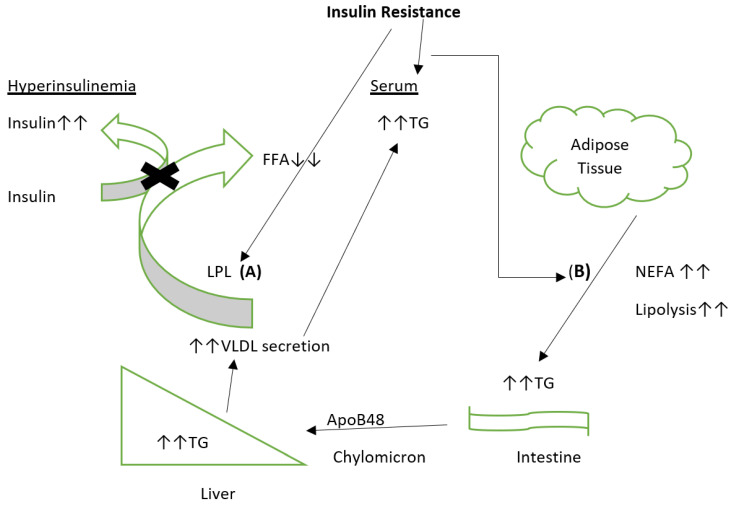
Figure 1
Figure 1
Insulin resistance leads to the diminished capacity of lipoprotein lipase (LPL) to metabolize very low-density-lipoprotein (VLDL) and other triglycerides (TG) rich particles to free fatty acids (FFA). It ultimately results in increased serum triglycerides because of blunted LPL activity (A). Chronic hyperinsulinemia facilitates VLDL production in states of insulin resistance. The suppressive effects of insulin are lost in insulin-resistant conditions, e.g., obesity or diabetes mellitus (DM). (B) Insulin resistance can lead to increased nonesterified fatty acid (NEFA) production via lipolysis, resulting in increased FFA flux to the liver, leading to increased VLDL production. Additionally, Fatty acids (FA) may increase, due to increased FA trapping by insulin-resistant adipocytes. Increased serum FA is associated with stimulation of the body to produce large amounts of reactive oxygen species.
Figure 2
Figure 2
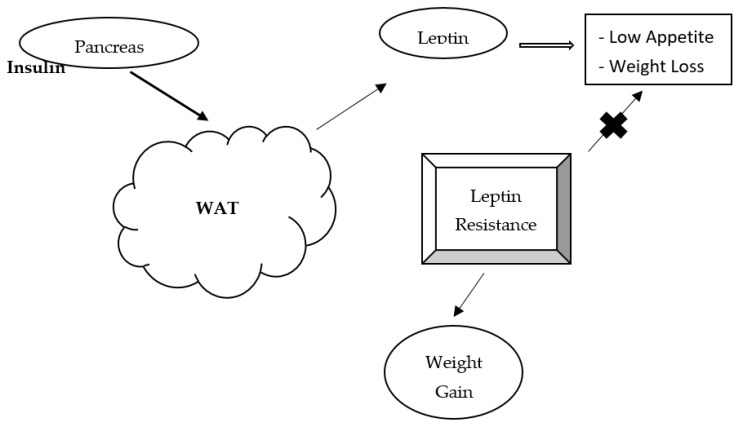
Insulin stimulates leptin synthesis and secretion from white adipose tissue. Increased serum leptin results in reduced appetite, food intake, and eventual weight loss. High serum leptin negatively impacts insulin secretion. In leptin-resistant patients, there is no suppression of appetite—eventually resulting in weight gain over time.
Figure 3
Figure 3
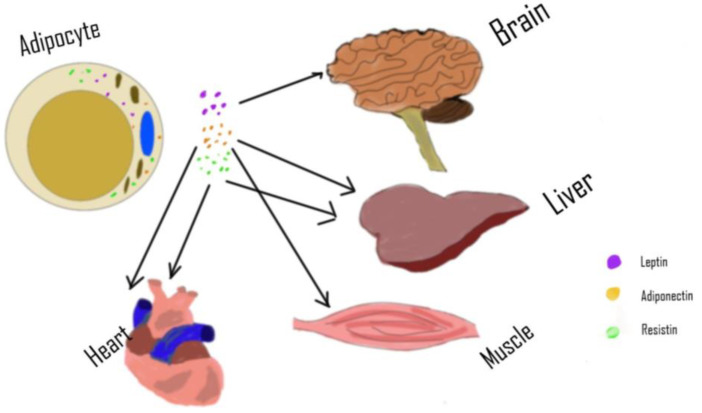
Lipid-filled adipocytes release the hormones adiponectin, leptin, and resistin, which target various tissues to affect their metabolic actions. Adiponectin targets the liver, skeletal muscles, bone, cartilage, heart, and adipose tissues. Leptin primarily targets the brain and central nervous system, while resistin targets adipose tissues, liver endothelium, and heart.

References

    1. Xu Y., He Z., King G.L. Introduction of hyperglycemia and dyslipidemia in the pathogenesis of diabetic vascular complications. Curr. Diabetes Rep. 2005;5:91–97. doi: 10.1007/s11892-005-0034-z. - DOI - PubMed
    1. Watala C., Golanski J., Boncler M.A., Pietrucha T., Gwozdzinski K. Membrane Lipid Fluidity of Blood Platelets: A Common Denominator Underlying the Opposite Actions of Various Agents Affecting Platelet Activation in Whole Blood. Platelets. 1998;9:315–327. doi: 10.1080/09537109876564. - DOI - PubMed
    1. Zheng F., Lu W., Jia C., Li H., Wang Z., Jia W. Relationships between Glucose Excursion and the Activation of Oxidative Stress in Patients with Newly Diagnosed Type 2 Diabetes or Impaired Glucose Regulation. Endocrine. 2010;37:201–208. doi: 10.1007/s12020-009-9296-6. - DOI - PubMed
    1. Augustyniak K., Zavodnik I., Palecz D., Szosland K., Bryszewska M. The Effect of Oxidizing Agent and Diabetes Mellitus on the Human Red Blood Cell Membrane Potential. Clin. Biochem. 1996;29:283–286. doi: 10.1016/0009-9120(95)02045-N. - DOI - PubMed
    1. Zavodnik I.B., Szosaland K., Bryszewska M. Human Red Blood Cell membrane potential and fluidity in glucose solutions. Scand. J. Clin. Lab. Investig. 1997;57:59–63. doi: 10.3109/00365519709057819. - DOI - PubMed