


A Systematic Review of the Effects of Temperature on Anopheles Mosquito Development and Survival: Implications for Malaria Control in a Future Warmer Climate
- PMID: 34299706
- PMCID: PMC8306597
- DOI: 10.3390/ijerph18147255
A Systematic Review of the Effects of Temperature on Anopheles Mosquito Development and Survival: Implications for Malaria Control in a Future Warmer Climate
Abstract
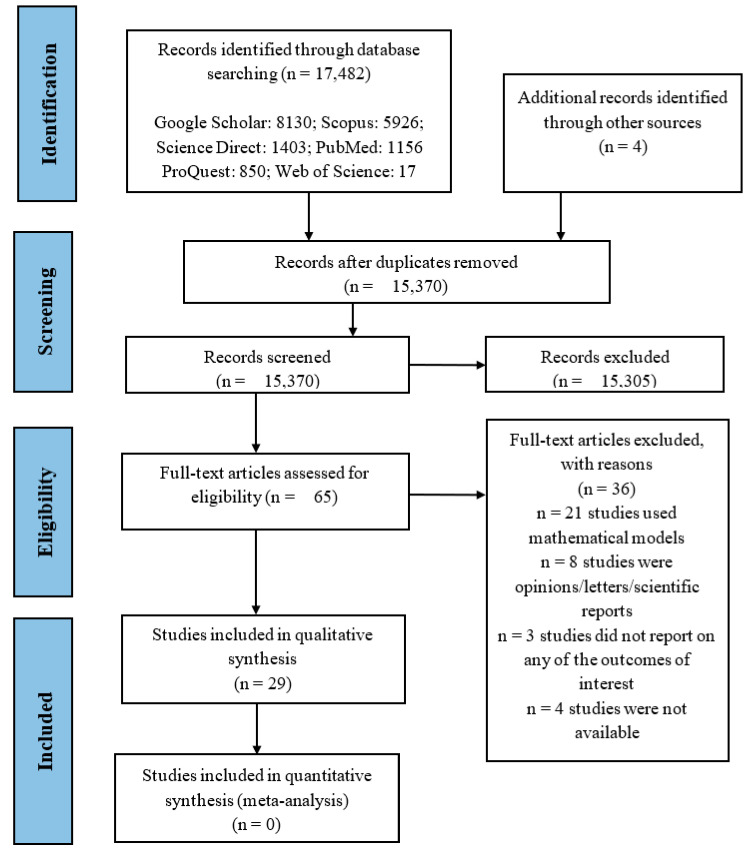
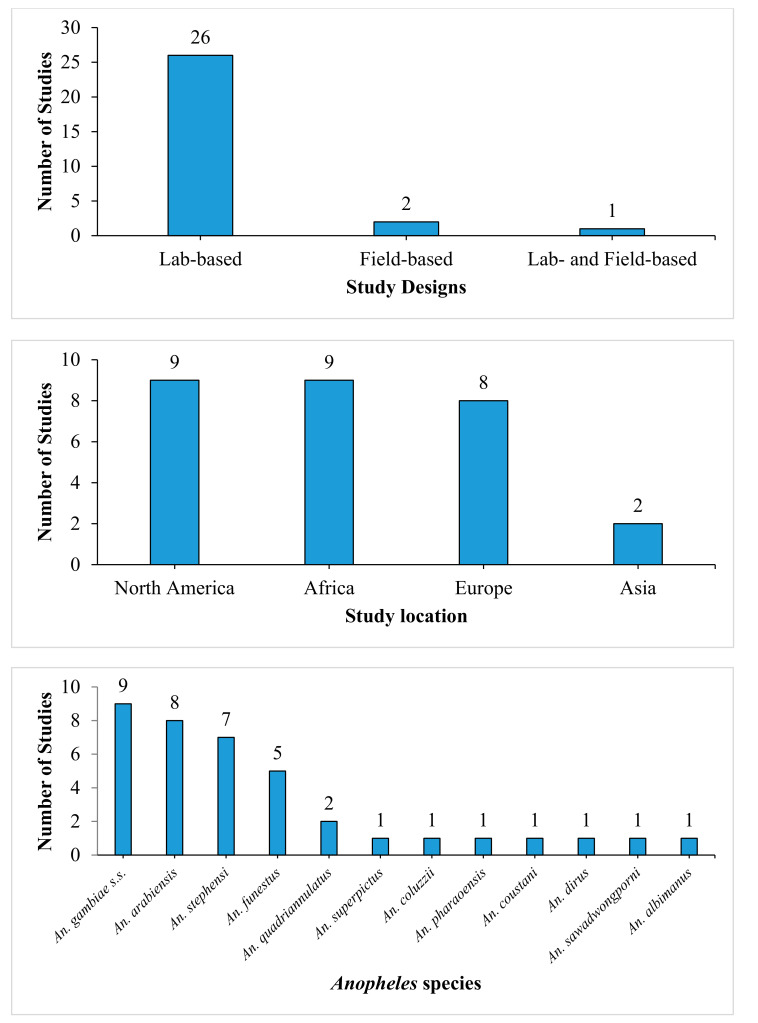
The rearing temperature of the immature stages can have a significant impact on the life-history traits and the ability of adult mosquitoes to transmit diseases. This review assessed published evidence of the effects of temperature on the immature stages, life-history traits, insecticide susceptibility, and expression of enzymes in the adult Anopheles mosquito. Original articles published through 31 March 2021 were systematically retrieved from Scopus, Google Scholar, Science Direct, PubMed, ProQuest, and Web of Science databases. After applying eligibility criteria, 29 studies were included. The review revealed that immature stages of An. arabiensis were more tolerant (in terms of survival) to a higher temperature than An. funestus and An. quadriannulatus. Higher temperatures resulted in smaller larval sizes and decreased hatching and pupation time. The development rate and survival of An. stephensi was significantly reduced at a higher temperature than a lower temperature. Increasing temperatures decreased the longevity, body size, length of the gonotrophic cycle, and fecundity of Anopheles mosquitoes. Higher rearing temperatures increased pyrethroid resistance in adults of the An. arabiensis SENN DDT strain, and increased pyrethroid tolerance in the An. arabiensis SENN strain. Increasing temperature also significantly increased Nitric Oxide Synthase (NOS) expression and decreased insecticide toxicity. Both extreme low and high temperatures affect Anopheles mosquito development and survival. Climate change could have diverse effects on Anopheles mosquitoes. The sensitivities of Anopeheles mosquitoes to temperature differ from species to species, even among the same complex. Notwithstanding, there seem to be limited studies on the effects of temperature on adult life-history traits of Anopheles mosquitoes, and more studies are needed to clarify this relationship.
Keywords: Anopheles mosquito; body size; fecundity; gonotrophic cycle; immature stage; insecticide; longevity; temperature.
Conflict of interest statement
The authors declare that they have no competing interests.
Figures
References
-
- Bulkeley H. Cities and Climate Change. Routledge; London, UK: 2013.
-
- de Lima-Camara T.N., Honorio N.A. Climate Change and Its Effect on Urban Mosquitoes in South America. Clim. Chang. Impacts Urban Pests. 2016;10:127.
-
- Smith E.K., Mayer A. A social trap for the climate? Collective action, trust and climate change risk perception in 35 countries. Glob. Environ. Chang. 2018;49:140–153. doi: 10.1016/j.gloenvcha.2018.02.014. - DOI
-
- Sánchez García J.L., Díez Sanz J.M. Climate change, ethics and sustainability: An innovative approach. J. Innov. Knowl. 2018;3:70–75. doi: 10.1016/j.jik.2017.12.002. - DOI
-
- National Research Council . Advancing the Science of Climate Change. National Academies Press; Washington, DC, USA: 2011.
Publication types
MeSH terms
Substances
LinkOut - more resources
Full Text Sources
Medical
Miscellaneous
