


The Role of Myofunctional Therapy in Treating Sleep-Disordered Breathing: A State-of-the-Art Review
- PMID: 34299742
- PMCID: PMC8306407
- DOI: 10.3390/ijerph18147291
The Role of Myofunctional Therapy in Treating Sleep-Disordered Breathing: A State-of-the-Art Review
Abstract
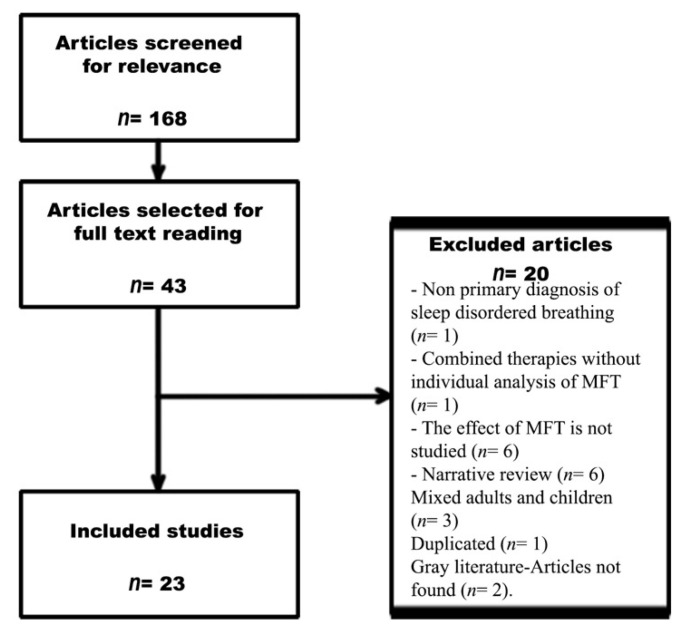
Myofunctional therapy (MFT) may have a role in improving muscle tone and alleviating upper airway collapse in sleep-disordered breathing. The purposes of this state-of-the-art review are to first review systematically the current literature on the effectiveness of MFT in treating sleep-disordered breathing and then to provide an overview of the current understanding of patient selection, side effects, type and duration of exercises, guidance of exercise performance, evaluation of results, and how best to promote adherence. PubMed (Medline), the Cochrane Library, and the EMBASE, Scopus and SciELO databases were checked for relevant studies by three authors, and a total of 23 studies were included. This review focuses only on adults with sleep-disordered breathing. The available evidence shows a positive effect of MFT in reducing sleep apnoea, as measured using polysomnography and clinical variables (including snoring). There is no evidence of the utility of MFT for treating upper airway resistance syndrome, the duration of the effects of MFT, or regarding which MFT protocol is best. Despite these knowledge gaps, the available evidence suggests that MFT is a safe treatment modality.
Keywords: myofunctional therapy; obstructive; sleep apnoea; snoring.
Conflict of interest statement
C.O.-R. developed the myofunctional app “Airway Gym”. M.C.-L. and C.C.-H. declare no conflict of interest.
References
-
- Mediano O., González Mangado N., Montserrat J.M., Alonso-Álvarez M.L., Almendros I., Alonso-Fernández A., Barbé F., Borsini E., Caballero-Eraso C., Cano-Pumarega I., et al. International Consensus Document on Obstructive Sleep Apnea. Arch. Bronconeumol. 2021 doi: 10.1016/j.arbres.2021.03.017. - DOI - PubMed
-
- O’Sullivan D., Wilk S., Michalowski W., Farion K. Using PICO to Align Medical Evidence with MDs Decision Making Models. Stud. Health Technol. Inform. 2013;192:1057. - PubMed
Publication types
MeSH terms
LinkOut - more resources
Full Text Sources
Medical
