


COVID-19 Pandemic as a Traumatic Event and Its Associations with Fear and Mental Health: A Cognitive-Activation Approach
- PMID: 34299873
- PMCID: PMC8303753
- DOI: 10.3390/ijerph18147422
COVID-19 Pandemic as a Traumatic Event and Its Associations with Fear and Mental Health: A Cognitive-Activation Approach
Abstract
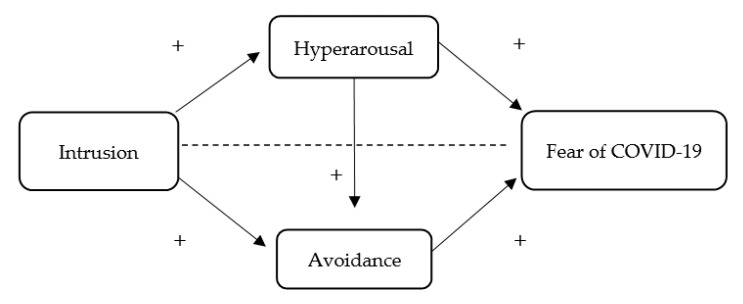
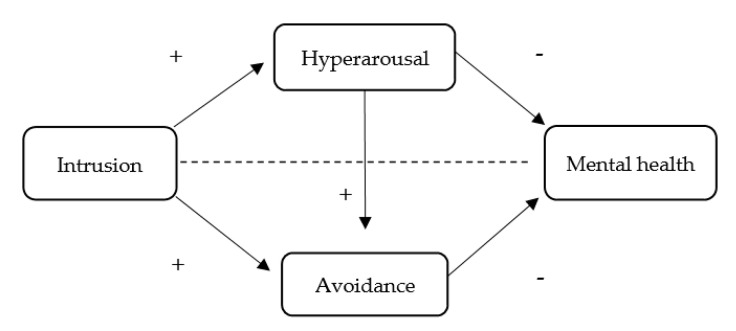
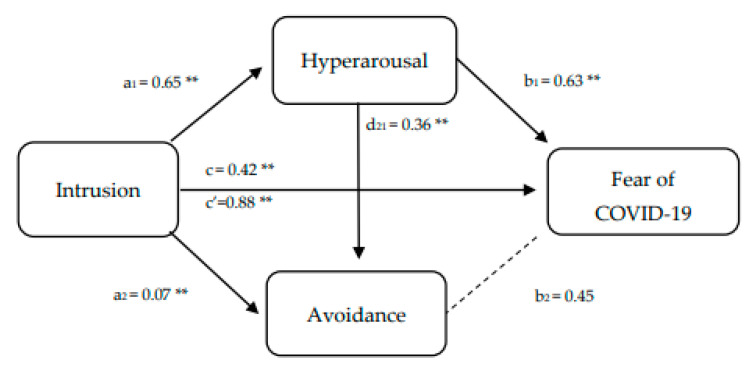
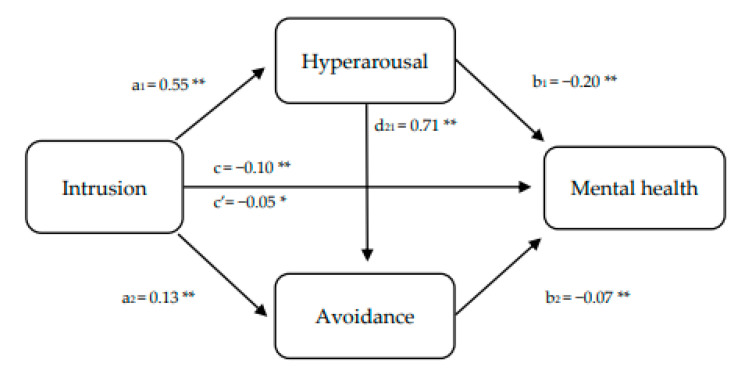
The COVID-19 global pandemic still represents a major threat with detrimental health consequences. Analyzing the psychological outcomes, COVID-19 could be interpreted as a collective traumatic event that can generate symptoms related to post-traumatic stress disorder (PTSD). Considering this, the purpose of this paper is twofold: first, to investigate the relationship between intrusive thoughts and fear related to the COVID-19 pandemic and between intrusive thoughts and mental health; second, to test the mediating role of hyperarousal and avoidance in these two relationships. In order to reach these aims, the present study investigated these relationships and tested a mediation model in two cross-sectional studies in Italy. Altogether, 627 individuals and 495 workers completed an online survey for study 1 and study 2, respectively. Mediation analyses were performed via the SPSS macro PROCESS; the significance of total, direct, and indirect effect was tested via bootstrapping. The results showed that within the PTSD framework, hyperarousal compared with avoidance mediated the relationship between intrusion and the analyzed outcomes. In conclusion, the present study provided empirical evidence for the influence of hyperarousal on individual consequences such as fear of COVID-19 and mental health. Research, as well as theoretical and practical implications, are discussed.
Keywords: COVID-19; PTSD; avoidance; hyperarousal; intrusion; mental health; pattern.
Conflict of interest statement
The authors declare no conflict of interest.
Figures
References
-
- American Psychiatric Association, editor. Diagnostic and Statistical Manual of Mental Disorders: DSM-5. 5th ed. American Psychiatric Association; Washington, DC, USA: 2013.
MeSH terms
LinkOut - more resources
Full Text Sources
Medical
