


25-Hydroxyvitamin D reference percentiles and the role of their determinants among European children and adolescents
- PMID: 34302130
- PMCID: PMC8993686
- DOI: 10.1038/s41430-021-00985-4
25-Hydroxyvitamin D reference percentiles and the role of their determinants among European children and adolescents
Abstract
Background/objectives: To provide age- and sex-specific percentile curves of serum 25-hydroxyvitamin D (25(OH)D) by determinants from 3-<15 year-old European children, and to analyse how modifiable determinants influence 25(OH)D.
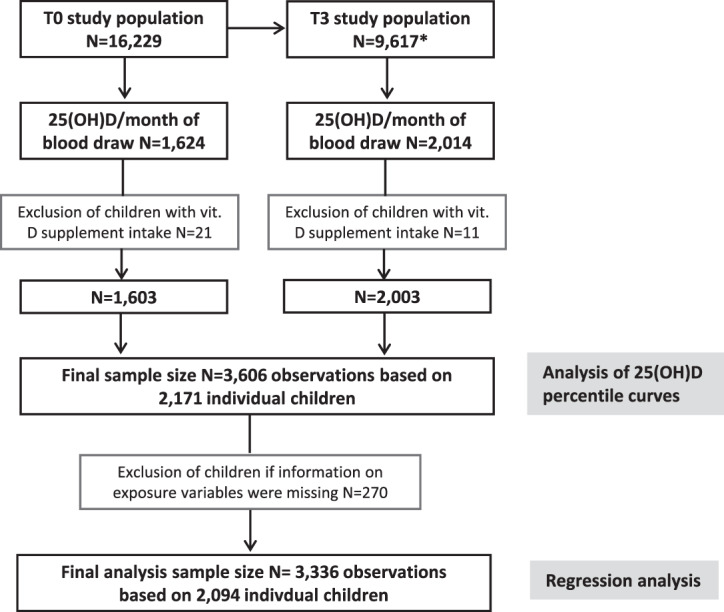
Subjects/methods: Serum samples were collected from children of eight European countries participating in the multicenter IDEFICS/I.Family cohort studies. Serum 25(OH)D concentrations were analysed in a central lab by a chemiluminescence assay and the values from 2171 children (N = 3606 measurements) were used to estimate percentile curves using the generalized additive model for location, scale and shape. The association of 25(OH)D with time spent outdoors was investigated considering sex, age, country, parental education, BMI z score, UV radiation, and dietary vitamin D in regressions models.
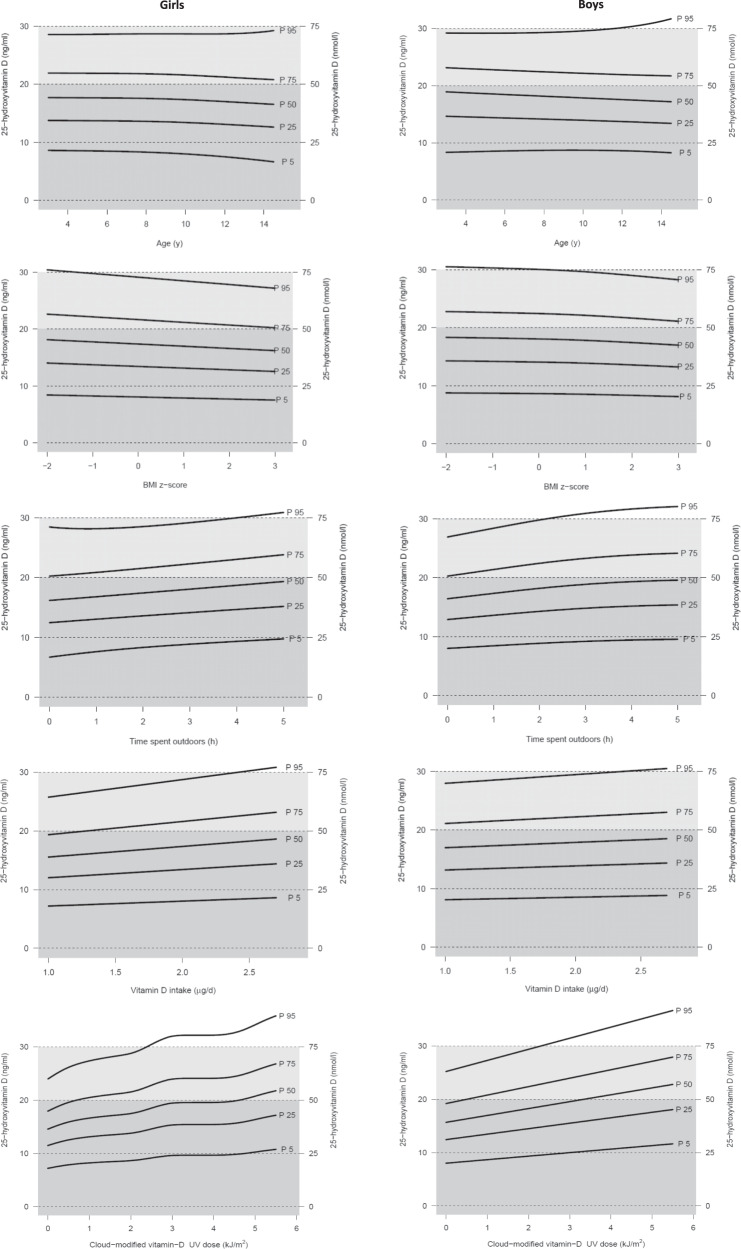
Results: The age- and sex-specific 5th and 95th percentiles of 25(OH)D ranged from 16.5 to 73.3 and 20.8 to 79.3 nmol/l in girls and boys, respectively. A total of 63% had deficient (<50 nmol/l), 33% insufficient (50-<75 nmol/l) and 3% sufficient (≥75 nmol/l) levels. 25(OH)D increased with increasing UV radiation, time spent outdoors, and vitamin D intake and slightly decreased with increasing BMI z score and age. The odds ratio (OR) for a non-deficient 25(OH)D status (reference category: deficient status) by one additional hour spent outdoors was 1.21, 95% CI [1.12-1.31], i.e., children who spent one more hour per day outdoors than other children had a 21% higher chance of a non-deficient than a deficient status.
Conclusion: A majority of children suffer from deficient 25(OH)D. UV radiation, outdoor time, and dietary vitamin D are important determinants of 25(OH)D.
© 2021. The Author(s).
Conflict of interest statement
The authors declare no competing interests.
Figures
References
Publication types
MeSH terms
Substances
LinkOut - more resources
Full Text Sources
Medical
Miscellaneous
