Review
. 2021 Jul 24;40(1):241.
doi: 10.1186/s13046-021-02041-2.

Statins: a repurposed drug to fight cancer

Affiliations
Review

Statins: a repurposed drug to fight cancer

Wen Jiang et al. J Exp Clin Cancer Res. .

Abstract

As competitive HMG-CoA reductase (HMGCR) inhibitors, statins not only reduce cholesterol and improve cardiovascular risk, but also exhibit pleiotropic effects that are independent of their lipid-lowering effects. Among them, the anti-cancer properties of statins have attracted much attention and indicated the potential of statins as repurposed drugs for the treatment of cancer. A large number of clinical and epidemiological studies have described the anticancer properties of statins, but the evidence for anticancer effectiveness of statins is inconsistent. It may be that certain molecular subtypes of cancer are more vulnerable to statin therapy than others. Whether statins have clinical anticancer effects is still an active area of research. Statins appear to enhance the efficacy and address the shortcomings associated with conventional cancer treatments, suggesting that statins should be considered in the context of combined therapies for cancer. Here, we present a comprehensive review of the potential of statins in anti-cancer treatments. We discuss the current understanding of the mechanisms underlying the anti-cancer properties of statins and their effects on different malignancies. We also provide recommendations for the design of future well-designed clinical trials of the anti-cancer efficacy of statins.

Keywords: Drug repurposing; Mevalonate pathway; Statins; Synergistic antitumor; Tumor microenvironment.


Conflict of interest statement

The authors declare that they have no competing interests.

Figures
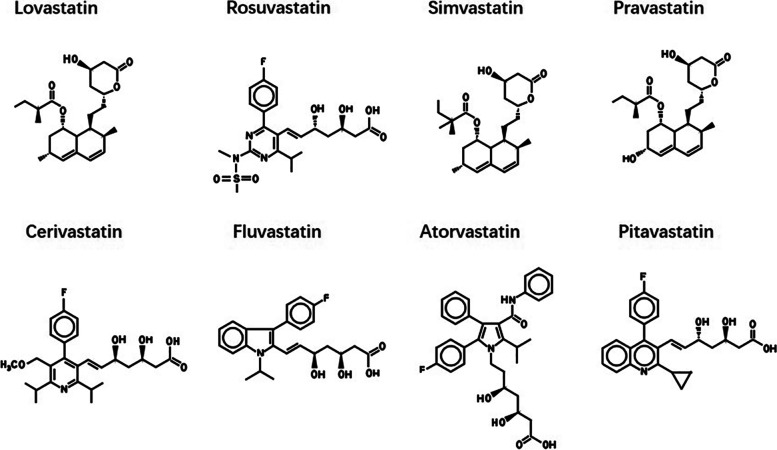
Fig. 1
Fig. 1
Chemical structures of selected statins
Fig. 2
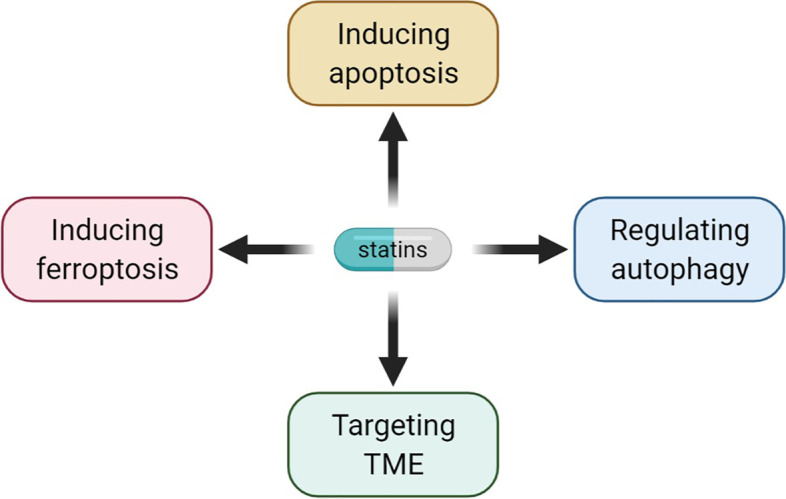
Fig. 2
Statin targets in cancer therapy
Fig. 3
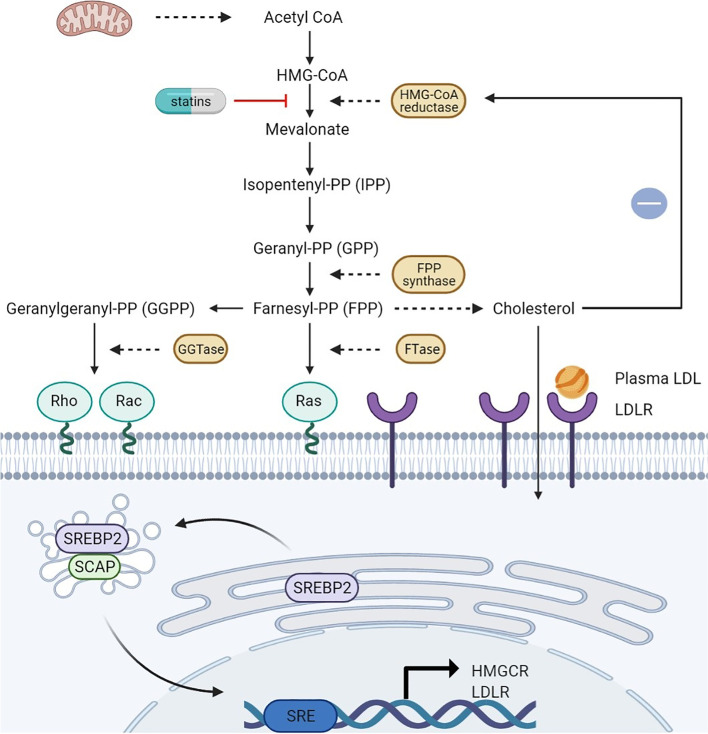
Fig. 3
The mevalonate pathway and its transcriptional regulation. The mevalonate pathway begins with the end-product of glycolysis, acetyl-CoA, which is metabolized through several enzymatic steps to mevalonate, IPP, GPP, FPP, GGPP and cholesterol. Both FPP and GGPP can be post-translationally added to proteins, especially small monomeric GTPases (such as Ras, Rho, or Rac). Cholesterol is produced by cells via the mevalonate pathway or LDLR-mediated LDL endocytosis from the serum. When intracellular cholesterol levels are low, SCAP mediates the translocation of SREBP2 to the Golgi apparatus, where it is cleaved by proteases. The active N-terminal fragment is released and translocated to the nucleus, where it binds to the SRE regions of the HMGCR and LDLR promoters to induce gene expression. The inhibitory feedback mechanism mediated by cholesterol is indicated in blue. The mevalonate pathway can be blocked by statins
Fig. 4
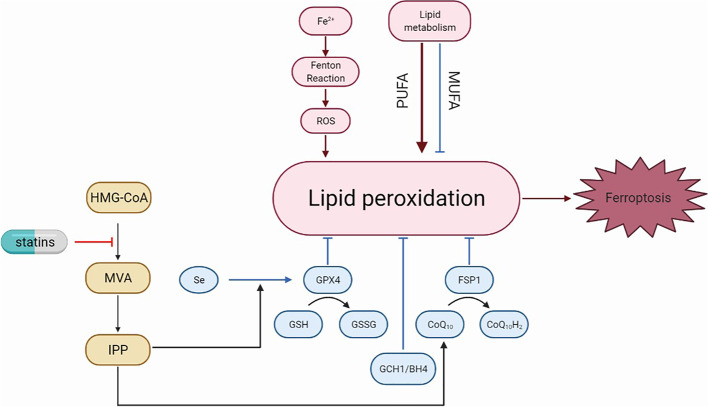
Fig. 4
The relationship between statins and ferroptosis. Iron overload, lipid reactive oxygen species (ROS) accumulation, and lipid peroxidation are prerequisites for the activation of cell death by ferroptosis. Ferroptosis is governed by three antioxidant axes, i.e., the GSH/GPX4, FSP1/CoQ10/NAD(P)H and GCH1/BH4 axes. The FSP1/CoQ10/NAD(P)H axis relies on the mevalonate pathway to generate CoQ10. IPP, the precursor of CoQ10, is also a limiting substrate for enzymatic isopentenylation of Sec-tRNA, thereby influencing the expression of GPX4. Statins regulate the GSH/GPX4 and FSP1/CoQ10/NAD(P)H axes via the mevalonate pathway, thereby inducing cell death by ferroptosis
Fig. 5
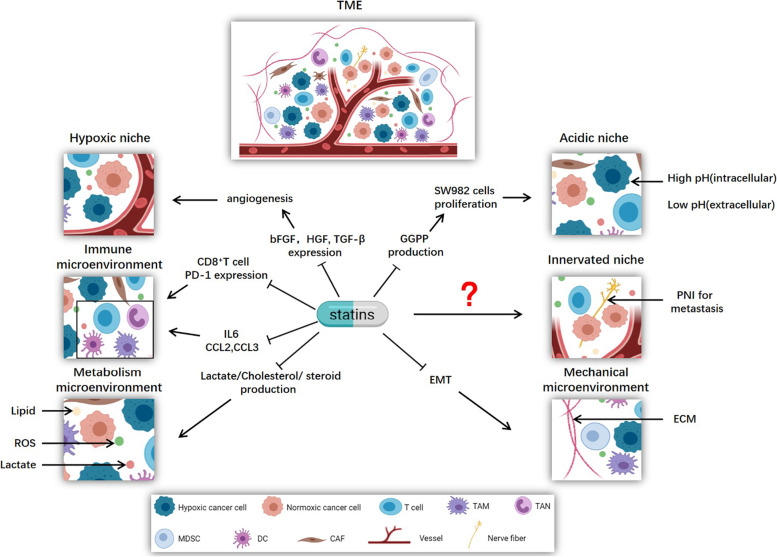
Fig. 5
Statins fight cancer by targeting TME. TME can be classified into six specialized microenvironments: hypoxic niche, immune microenvironment, metabolism microenvironment, acidic niche, innervated niche, and mechanical microenvironment. Statins exert anticancer properties by targeting these specialized microenvironments

References

    1. Sung H, Ferlay J, Siegel RL, Laversanne M, Soerjomataram I, Jemal A, Bray F. Global cancer statistics 2020: GLOBOCAN estimates of incidence and mortality worldwide for 36 cancers in 185 countries. CA Cancer J Clin. 2021;71(3):209–249. doi: 10.3322/caac.21660. - DOI - PubMed
    1. Morgan S, Grootendorst P, Lexchin J, Cunningham C, Greyson D. The cost of drug development: a systematic review. Health Policy. 2011;100(1):4–17. doi: 10.1016/j.healthpol.2010.12.002. - DOI - PubMed
    1. Gupta SC, Sung B, Prasad S, Webb LJ, Aggarwal BB. Cancer drug discovery by repurposing: teaching new tricks to old dogs. Trends Pharmacol Sci. 2013;34(9):508–517. doi: 10.1016/j.tips.2013.06.005. - DOI - PubMed
    1. Mohammadzadeh N, Montecucco F, Carbone F, Xu S, Al-Rasadi K, Sahebkar A. Statins: Epidrugs with effects on endothelial health? Eur J Clin Invest. 2020;50(12):e13388. doi: 10.1111/eci.13388. - DOI - PubMed
    1. Kodach LL, Jacobs RJ, Voorneveld PW, Wildenberg ME, Verspaget HW, van Wezel T, Morreau H, Hommes DW, Peppelenbosch MP, van den Brink GR, et al. Statins augment the chemosensitivity of colorectal cancer cells inducing epigenetic reprogramming and reducing colorectal cancer cell ‘stemness’ via the bone morphogenetic protein pathway. Gut. 2011;60(11):1544–1553. doi: 10.1136/gut.2011.237495. - DOI - PubMed

MeSH terms

Substances