. 2021 Oct;191(10):1754-1773.
doi: 10.1016/j.ajpath.2021.07.002. Epub 2021 Jul 23.

Trajectory of Growth of Severe Acute Respiratory Syndrome Coronavirus 2 (SARS-CoV-2) Variants in Houston, Texas, January through May 2021, Based on 12,476 Genome Sequences

Affiliations

Trajectory of Growth of Severe Acute Respiratory Syndrome Coronavirus 2 (SARS-CoV-2) Variants in Houston, Texas, January through May 2021, Based on 12,476 Genome Sequences

Randall J Olsen et al. Am J Pathol. 2021 Oct.

Abstract

Certain genetic variants of severe acute respiratory syndrome coronavirus 2 (SARS-CoV-2) are of substantial concern because they may be more transmissible or detrimentally alter the pandemic course and disease features in individual patients. SARS-CoV-2 genome sequences from 12,476 patients in the Houston Methodist health care system diagnosed from January 1 through May 31, 2021 are reported here. Prevalence of the B.1.1.7 (Alpha) variant increased rapidly and caused 63% to 90% of new cases in the latter half of May. Eleven B.1.1.7 genomes had an E484K replacement in spike protein, a change also identified in other SARS-CoV-2 lineages. Compared with non-B.1.1.7-infected patients, individuals with B.1.1.7 had a significantly lower cycle threshold (a proxy for higher virus load) and significantly higher hospitalization rate. Other variants [eg, B.1.429 and B.1.427 (Epsilon), P.1 (Gamma), P.2 (Zeta), and R.1] also increased rapidly, although the magnitude was less than that in B.1.1.7. Twenty-two patients infected with B.1.617.1 (Kappa) or B.1.617.2 (Delta) variants had a high rate of hospitalization. Breakthrough cases (n = 207) in fully vaccinated patients were caused by a heterogeneous array of virus genotypes, including many not currently designated variants of interest or concern. In the aggregate, this study delineates the trajectory of SARS-CoV-2 variants circulating in a major metropolitan area, documents B.1.1.7 as the major cause of new cases in Houston, TX, and heralds the arrival of B.1.617 variants in the metroplex.


Figures

Figure 1
Figure 1
Epidemiologic curve showing three waves of SARS-CoV-2 infections in Houston Methodist patients. Daily totals are shown as a +/– 3-day moving average. The figure was generated with Tableau version 2020.3.4.
Figure 2
Figure 2
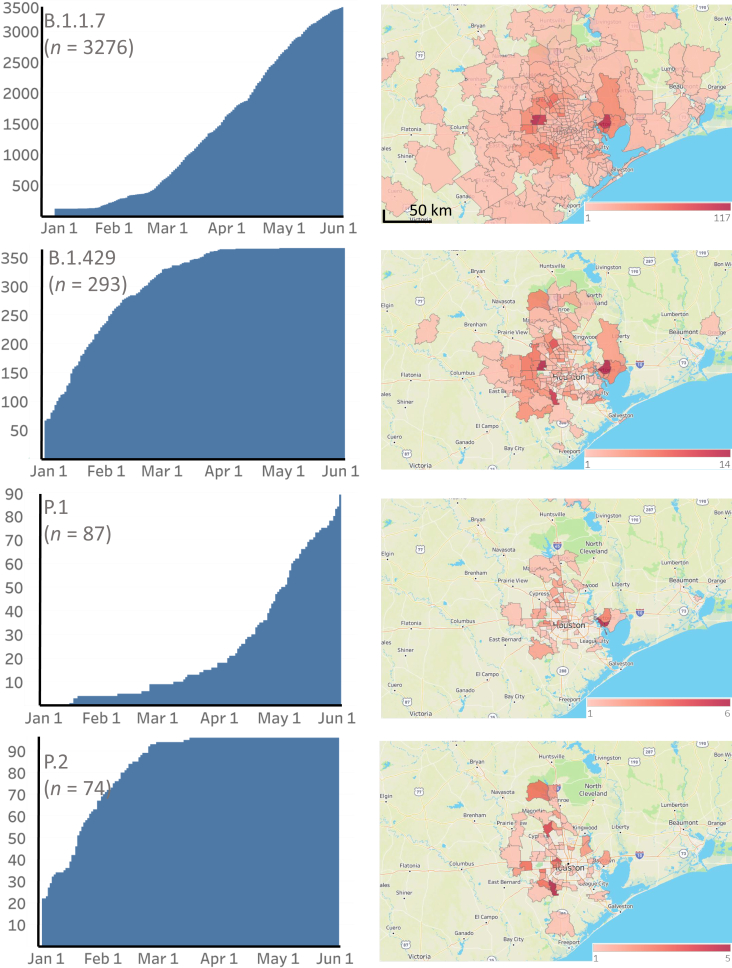
Cumulative increase in SARS-CoV-2 B.1.1.7, B.1.429, P.1, and P.2 variants and their distribution in metropolitan Houston, TX. The time frame used is January 1, 2021, through May 31, 2021. Left column: The cumulative increase in unique patients with each variant. Right column: The geospatial distribution of these variants based on the home address zip code for each patient. Figures were generated with Tableau version 2020.3.4.
Figure 3
Figure 3
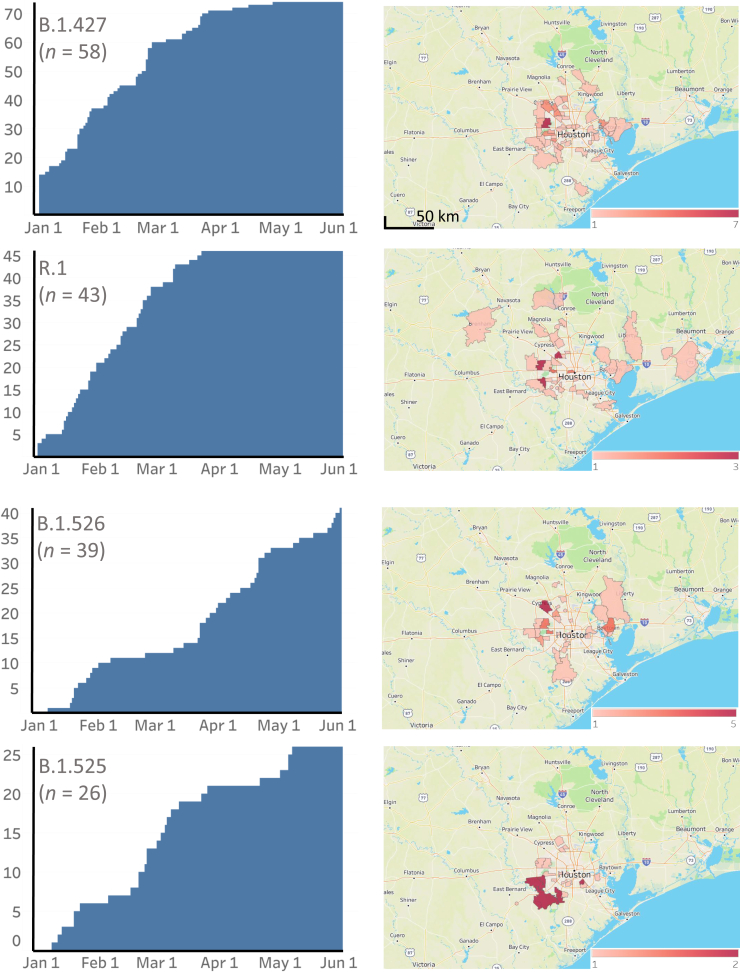
Cumulative increase in SARS-CoV-2 B.1.427, R.1, B.1.526, and B.1.525 variants and their distribution in metropolitan Houston, TX. The time frame used is January 1, 2021, through May 31, 2021. Left column: The cumulative increase in unique patients with each variant. Right column: The geospatial distribution of these variants based on the home address zip code for each patient. Figures were generated with Tableau version 2020.3.4.
Figure 4
Figure 4
Cumulative increase in SARS-CoV-2 B.1.617.2, B.1.526.1, B.1.617.1, and B.1.351 variants and their distribution in metropolitan Houston, TX. The time frame used is January 1, 2021, through May 31, 2021. Left column: The cumulative increase in unique patients with each variant. Right column: The geospatial distribution of these variants based on the home address zip code for each patient. Figures were generated with Tableau version 2020.3.4.
Figure 5
Figure 5
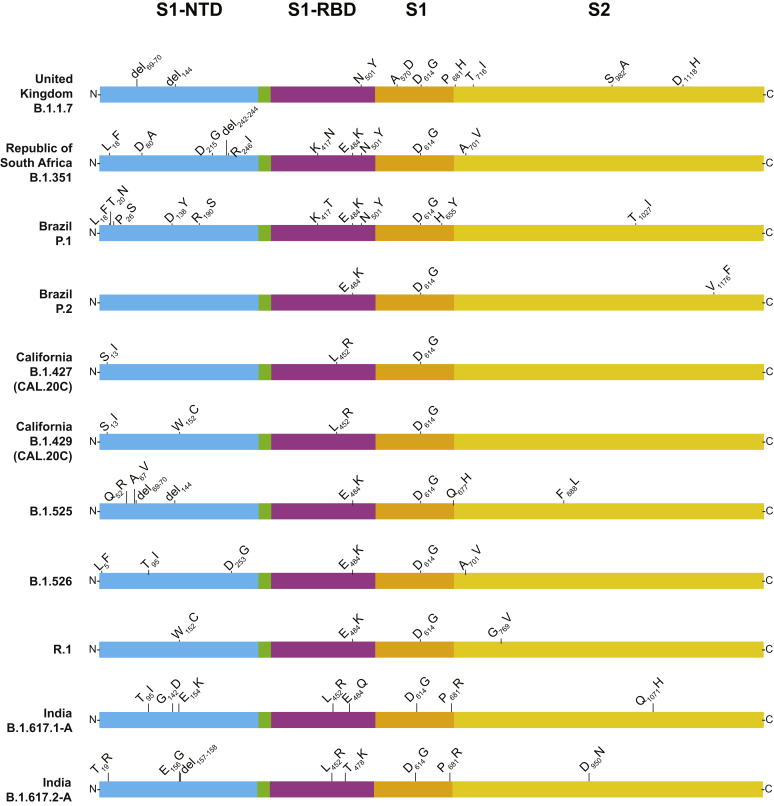
Structural changes present in spike protein of the major SARS-CoV-2 variants identified in the study, including variants of interest, variants of concern, and variant R.1. The figure is a modified version of one presented previously, with permission from Elsevier. NTD, amino-terminal domain; RBD, receptor-binding domain; S1, S1 domain; S2, S2 domain.
Figure 6
Figure 6
Structural changes present in spike protein of B.1.617-family variants. Four subvariants of B.1.617.1 and 10 subvariants of B.1.617.2 were identified. For the purpose of clarity, each subvariant was given an upper-case letter designation. The subvariants are listed (top to bottom) based on their decreasing abundance in The Global Initiative on Sharing Avian Influenza Data (GISAID) as of June 2, 2021. For example, B.1.617.1-A is the most common subvariant of B.1.617.1, and B.1.617.2-A is the most common subvariant of B.1.617.2. The number in parentheses below the subvariant designation denotes the number of patients with each subvariant identified in this study. Note that some annotation methods treat the E156G and del157-158 differently; we have used the GISAID annotation nomenclature. The figure is a modified version of one presented previously, with permission from Elsevier. NTD, amino-terminal domain; RBD, receptor-binding domain; S1, S1 domain; S2, S2 domain.
Figure 7
Figure 7
CT value for every SARS-CoV-2 patient sample tested using the Abbott Alinity m (AF) or Hologic Panther (GL) assays, as described in Materials and Methods. Data are presented as median (95% CI) (AL). ∗P < 0.05, ∗∗P < 0.01, ∗∗∗P < 0.001, and ∗∗∗∗P < 0.0001 (U-test).
Figure 8
Figure 8
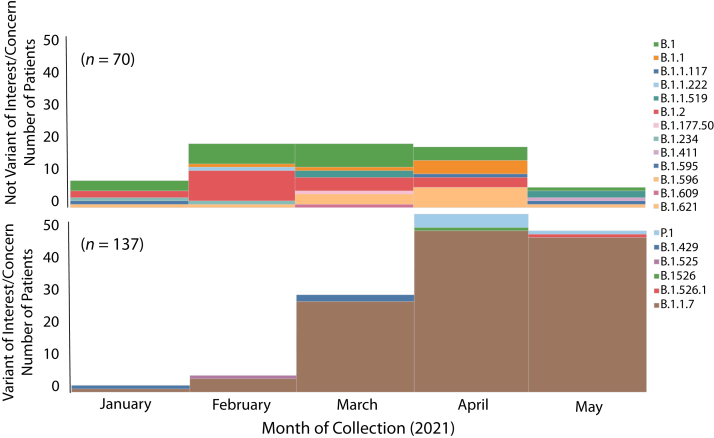
Number of COVID-19 vaccine breakthrough cases over time, by virus variant. The month of diagnosis and the infecting virus variant based on whole-genome sequencing are shown. A total of 207 vaccine breakthrough cases was identified in patients receiving either the Pfizer [n = 181 (87%)] or Moderna [n = 26 (13%)] vaccine.

References

    1. Huang C., Wang Y., Li X., Ren L., Zhao J., Hu Y., Zhang L., Fan G., Xu J., Gu X., Cheng Z., Yu T., Xia J., Wei Y., Wu W., Xie X., Yin W., Li H., Liu M., Xiao Y., Gao H., Guo L., Xie J., Wang G., Jiang R., Gao Z., Jin Q., Wang J., Cao B. Clinical features of patients infected with 2019 novel coronavirus in Wuhan, China. Lancet. 2020;395:497–506. - PMC - PubMed
    1. Zhu N., Zhang D., Wang W., Li X., Yang B., Song J., Zhao X., Huang B., Shi W., Lu R., Niu P., Zhan F., Ma X., Wang D., Xu W., Wu G., Gao G.F., Tan W., China Novel Coronavirus I., Research T. A novel coronavirus from patients with pneumonia in China, 2019. N Engl J Med. 2020;382:727–733. - PMC - PubMed
    1. Chan J.F., Yuan S., Kok K.H., To K.K., Chu H., Yang J., Xing F., Liu J., Yip C.C., Poon R.W., Tsoi H.W., Lo S.K., Chan K.H., Poon V.K., Chan W.M., Ip J.D., Cai J.P., Cheng V.C., Chen H., Hui C.K., Yuen K.Y. A familial cluster of pneumonia associated with the 2019 novel coronavirus indicating person-to-person transmission: a study of a family cluster. Lancet. 2020;395:514–523. - PMC - PubMed
    1. Wu F., Zhao S., Yu B., Chen Y.M., Wang W., Song Z.G., Hu Y., Tao Z.W., Tian J.H., Pei Y.Y., Yuan M.L., Zhang Y.L., Dai F.H., Liu Y., Wang Q.M., Zheng J.J., Xu L., Holmes E.C., Zhang Y.Z. A new coronavirus associated with human respiratory disease in China. Nature. 2020;579:265–269. - PMC - PubMed
    1. Coronaviridae Study Group of the International Committee on Taxonomy of Viruses The species severe acute respiratory syndrome-related coronavirus: classifying 2019-nCoV and naming it SARS-CoV-2. Nat Microbiol. 2020;5:536–544. - PMC - PubMed