Review
. 2021 Oct:231:108804.
doi: 10.1016/j.clim.2021.108804. Epub 2021 Jul 23.

Understanding the immunological aspects of SARS-CoV-2 causing COVID-19 pandemic: A therapeutic approach

Affiliations
Review

Understanding the immunological aspects of SARS-CoV-2 causing COVID-19 pandemic: A therapeutic approach

Ananya Das et al. Clin Immunol. 2021 Oct.

Abstract

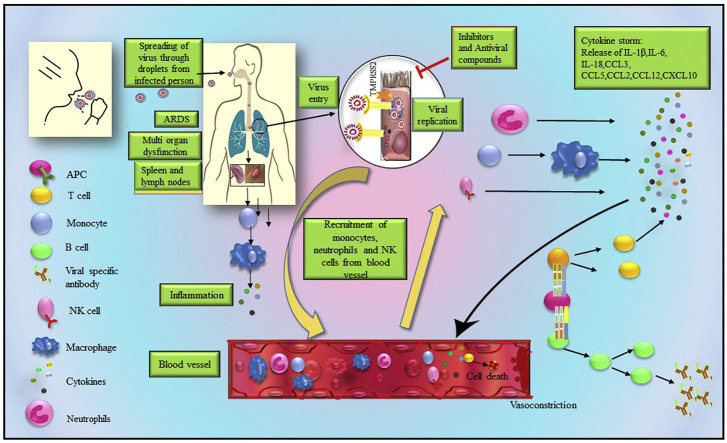
In December 2019, Severe Acute Respiratory Syndrome Coronavirus 2 (SARS-CoV-2), a novel variant of coronavirus has emerged from Wuhan in China and has created havoc impulses across the world with a larger number of fatalities. At the same time, studies are on roll to discover potent vaccine against it or repurposing of approved drugs which are widely adopted are under trial to eradicate the SARS-CoV-2 causing COVID-19 pandemic. Reports have also shown that there are asymptomatic carriers of COVID-19 disease who can transmit the disease to others too. However, the first line defense of the viral attack is body's strong and well-coordinated immune response producing excessive inflammatory innate reaction, thus impaired adaptive host immune defense which lead to death upon the malfunctioning. Considerable works are going on to establish the relation between immune parameters and viral replication that, might alter both the innate and adaptive immune system of COVID-19 patient by up riding a massive cytokines and chemokines secretion. This review mainly gives an account on how SARS-CoV-2 interacts with our immune system and how does our immune system responds to it, along with that drugs which are being used or can be used in fighting COVID-19 disease. The curative therapies as treatment for it have also been addressed in the perspective of adaptive immunity of the patients.

Keywords: COVID-19 therapy; Immune response; SARS-CoV-2.


Conflict of interest statement

Authors do not have any conflict of interest.

Figures
Unlabelled Image
Graphical abstract
Fig. 1
Fig. 1
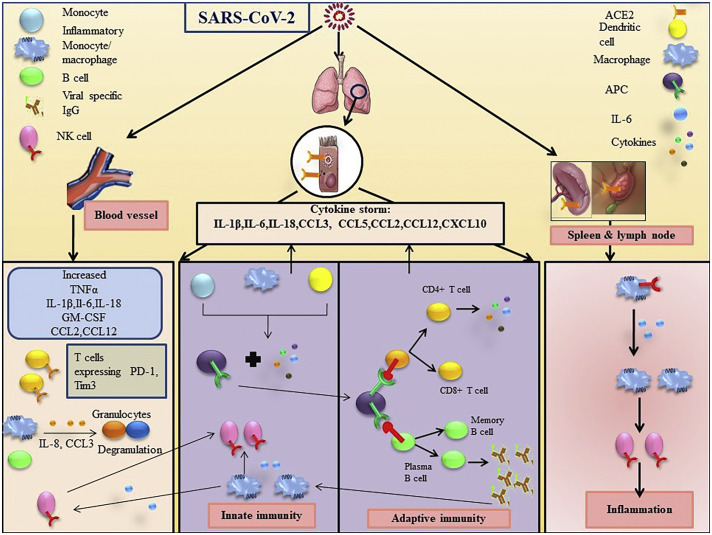
Immune response following SARS-CoV-2 infection. SARS-CoV-2 mostly affects the lungs because of higher expression of angiotensin converting enzyme 2 (ACE2) receptor. Upon binding with ACE2 receptor, SARS-CoV-2 enters into cells and elicits immune responses. Dendritic cells, monocytes, macrophages act as antigen presenting cells (APCs) that interact with CD4+ and CD8+ T cells to induce the proliferation of virus specific T cells and facilitate secretion of various cytokines in the lungs. APCs also induce the release of viral specific antibodies, which recruit natural killer (NK) cells from peripheral blood to the lungs, B cells in the lungs and ultimately results in cytokine storm by increasing the secretions of various interleukins (ILs) including IL-6, IL-6, IL-β, TNF-α, C-C motif chemokine ligand (CCL)3, CCL5, CCL2, CCL12, C-X-C motif chemokine ligand (CXCL)10, granulocyte-monocyte colony stimulating factor (GM-CSF). On the other hand, in peripheral blood, in response to virus entry in concert with the high expression of exhaustion markers such as T cell immunoglobulin and mucin domain 3 (Tim3), programmed death-1 (PD-1) in T cells, the expressions of IL-1β, IL-6, IL-18, TNF-α, GM-CSF, CCL2, CCL12 are also elevated. Inflammatory monocytes (IMs) induce the degranulation of granulocytes by secreting CCL3 and IL-8. Due to the expression of ACE2 receptor, SARS-CoV-2 affects spleen along with lymph nodes to the same extent. Virus entry also induces IMs to secret IL-6 and recruits NK cells in tissue microenvironment.
Fig. 2
Fig. 2
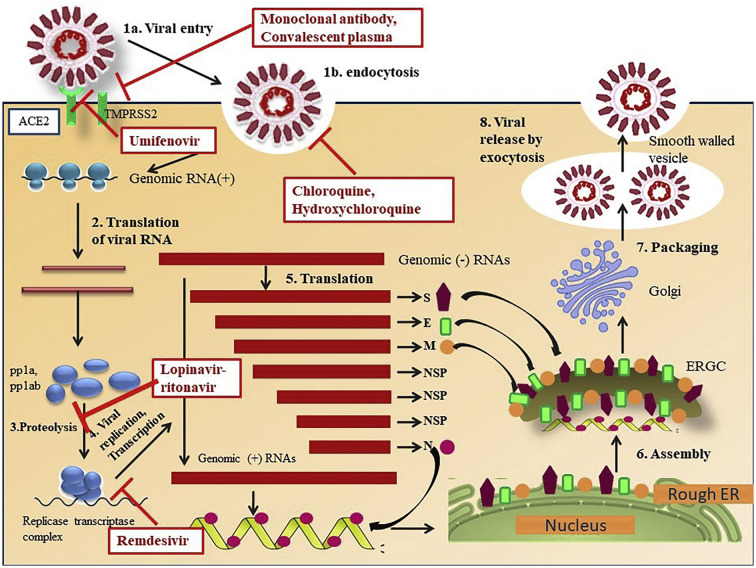
Molecular mechanism of relevant drugs and therapies for the infection of SARS-CoV-2. SARS-CoV-2 enters into the host cell via angiotensin converting enzyme 2(ACE2) receptor by endocytosis with the release of its RNA contents into the recipient cell to replicate. Monoclonal antibody or convalescent plasma therapy inhibits the ACE2 receptor or interferes with transmembrane serine protease 2 (TMPRSS2) function to affect the viral binding with the host cell. Chloroquine and hydroxychloroquine interfere with the entry of virus via endocytosis. Umifenovir targets spike (S) protein/ACE2 interaction and inhibits membrane fusion of the viral envelope. After the shedding of viral RNA, it translates into polypeptide (pp)1b, pp1ab leading to the formation of double membrane vesicles (DMVs) and establishment of the replication-transcription complex (RTC). This stage is followed by generation of intermediate negative strand RNA from which more numbers of positive strand RNA and mRNAs are generated. Lopinavir/ritonavir inhibits protease to prevent proteolysis, a mechanism that establishes RTC. Remdesivir targets the RNA dependent RNA polymerase and hamper the replication cycle of RNA viruses. Structural nucleocapsid (N) proteins are generated from the translation of nucleocapsid (N) mRNA, which in turn encapsulates the newly generated positive RNA strands. However, other structural proteins, envelope (E) proteins and membrane (M) proteins are formed via the translation in endoplasmic reticulum (ER) and gather in endoplasmic reticulum golgi intermediate complex (ERGIC) and cis-Golgi. In addition to the structural proteins some non-structural proteins (Nsps) are also generated. The assembly of the viral components begins when the accumulated proteins exit from the golgi apparatus and eventually fuse with the cell membrane, resulting in the release of new virus particles.

References

    1. Meo S.A., Alhowikan A.M., Al-Khlaiwi T., Meo I.M., Halepoto D.M., Iqbal M., Usmani A.M., Hajjar W., Ahmed N. Novel coronavirus 2019-nCoV: prevalence, biological and clinical characteristics comparison with SARS-CoV and MERS-CoV. Eur. Rev. Med. Pharmacol. Sci. 2020;24:2012–2019. doi: 10.26355/eurrev_202002_20379. - DOI - PubMed
    1. WHO Coronavirus Disease (COVID-19) Dashboard . 2021. WHO Coronavirus Disease (COVID-19) Dashboard.
    1. Gorbalenya A.E., Baker S.C., Baric R.S., de Groot R.J., Drosten C., Gulyaeva A.A., Haagmans B.L., Lauber C., Leontovich A.M., Neuman B.W., Penzar D., Perlman S., Poon L.L.M., Samborskiy D.V., Sidorov I.A., Sola I., Ziebuhr J. The species Severe acute respiratory syndrome-related coronavirus: classifying 2019-nCoV and naming it SARS-CoV-2. Nat. Microbiol. 2020;5:536–544. doi: 10.1038/s41564-020-0695-z. - DOI - PMC - PubMed
    1. Lu R., Zhao X., Li J., Niu P., Yang B., Wu H., Wang W., Song H., Huang B., Zhu N., Bi Y., Ma X., Zhan F., Wang L., Hu T., Zhou H., Hu Z., Zhou W., Zhao L., Chen J., Meng Y., Wang J., Lin Y., Yuan J., Xie Z., Ma J., Liu W.J., Wang D., Xu W., Holmes E.C., Gao G.F., Wu G., Chen W., Shi W., Tan W. Genomic characterisation and epidemiology of 2019 novel coronavirus: implications for virus origins and receptor binding. Lancet. 2020;395:565–574. doi: 10.1016/S0140-6736(20)30251-8. - DOI - PMC - PubMed
    1. Pillaiyar T., Meenakshisundaram S., Manickam M. Recent discovery and development of inhibitors targeting coronaviruses. Drug Discov. Today. 2020;25:668–688. doi: 10.1016/j.drudis.2020.01.015. - DOI - PMC - PubMed

Substances