


Fronto-parietal network function during cued visual search in the first-episode schizophrenia spectrum
- PMID: 34304038
- PMCID: PMC8364882
- DOI: 10.1016/j.jpsychires.2021.07.014
Fronto-parietal network function during cued visual search in the first-episode schizophrenia spectrum
Abstract
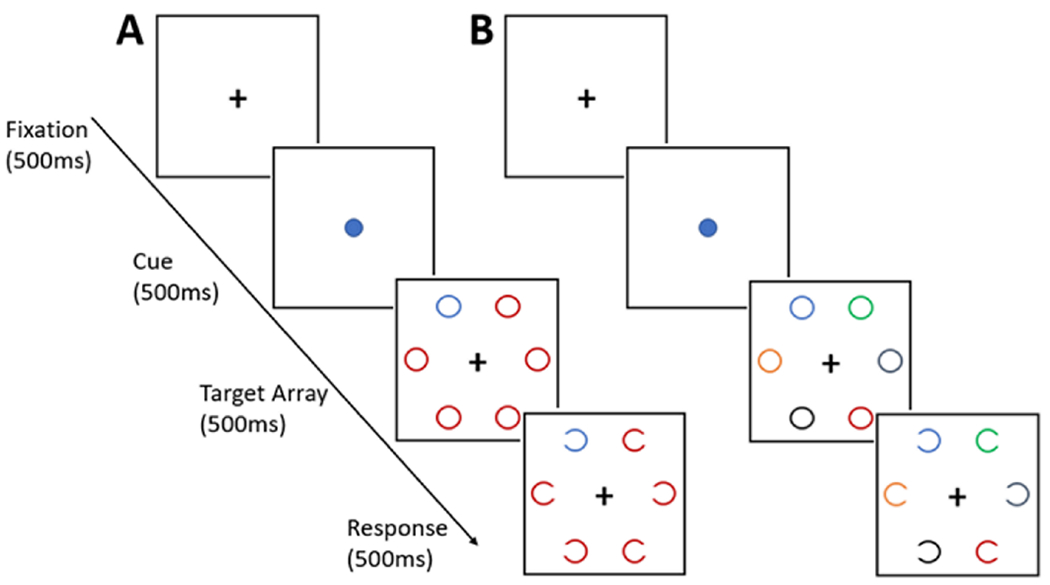
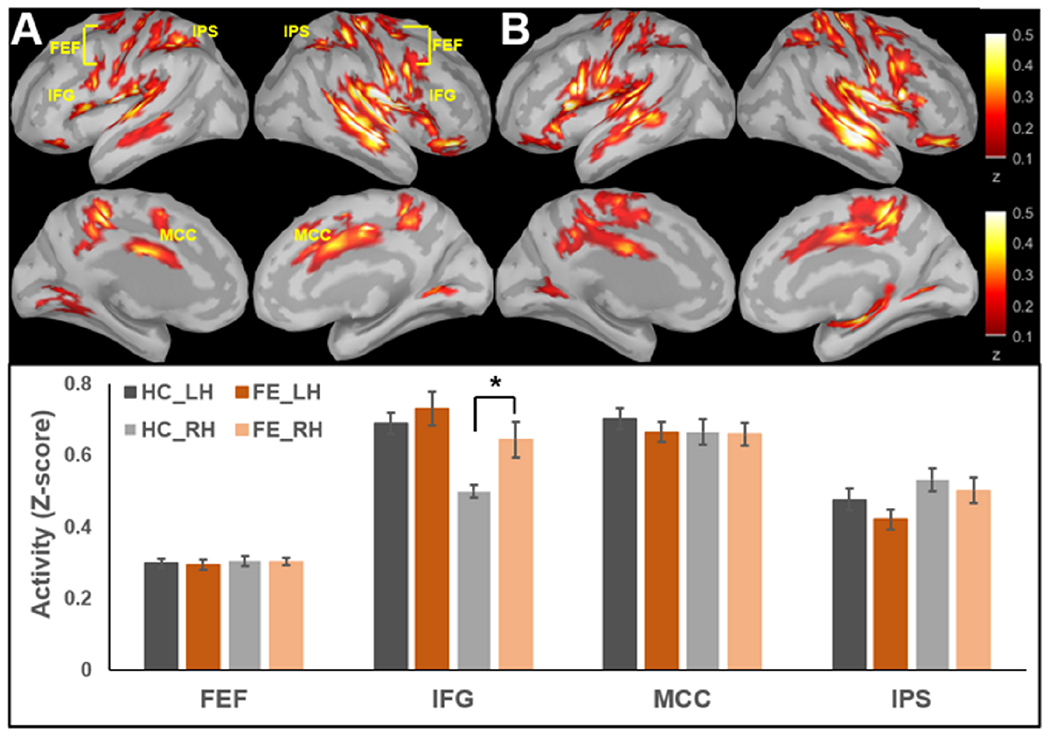
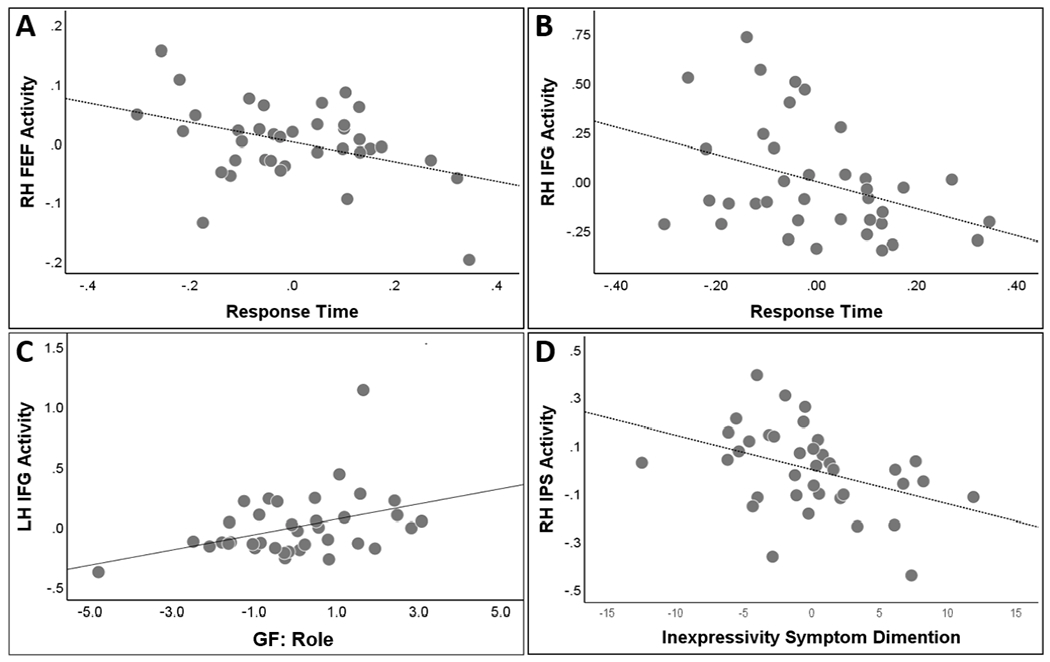
Cognitive impairments account for significant morbidity in schizophrenia and are present at disease onset. Controlled processes are particularly susceptible and may contribute to pervasive selective attention deficits. The present study assessed fronto-parietal attention network (FPAN) functioning during cue presentation on a visual search task in first-episode schizophrenia spectrum patients (FE) and its relation to symptom burden and community functioning. Brain activity was recorded with magnetoencephalography from 38 FE and 38 healthy controls (HC) during blocks of pop-out and serial search target detection. Activity during cue presentation was compared between groups across bilateral FPAN regions (frontal eye fields (FEF), inferior frontal gyrus (IFG), midcingulate cortex (MCC), and intraparietal sulcus (IPS)). FE exhibited greater right hemisphere IFG activity despite worse performance relative to HC. Performance and FPAN activity were not correlated in HC. Among FE, however, stronger activity within right hemisphere FEF and IFG was associated with faster responses. Stronger right IPS and left IFG activity in patients was also associated with reduced negative symptoms and improved community functioning, respectively. Increased reliance on the FPAN for task completion suggests an inefficient cognitive control network and might reflect a compensation for impaired attentional deployment during target detection, a strategy employed by those with less severe illness. These findings represent a critical step towards identifying the neural substrates of negative symptoms and impaired neurocognition at disease onset.
Keywords: Attention; First-episode; Fronto-parietal attention network; Magnetoencephalography; Schizophrenia.
Copyright © 2021. Published by Elsevier Ltd.
Conflict of interest statement
Disclosures
None of the authors reported any potential conflicts of interest to disclose.
Figures
Similar articles
-
Attentional control during the transient updating of cue information.Brain Res. 2009 Jan 9;1247:149-58. doi: 10.1016/j.brainres.2008.10.010. Epub 2008 Oct 22. Brain Res. 2009. PMID: 18992228 Free PMC article.
-
Inefficient visual search strategies in the first-episode schizophrenia spectrum.Schizophr Res. 2020 Oct;224:126-132. doi: 10.1016/j.schres.2020.09.015. Epub 2020 Oct 21. Schizophr Res. 2020. PMID: 33097368 Free PMC article.
-
Exogenous vs. endogenous attention: Shifting the balance of fronto-parietal activity.Neuropsychologia. 2018 Mar;111:307-316. doi: 10.1016/j.neuropsychologia.2018.02.006. Epub 2018 Feb 7. Neuropsychologia. 2018. PMID: 29425803
-
Directed Flow of Beta Band Communication During Reorienting of Attention Within the Dorsal Attention Network.Brain Connect. 2021 Nov;11(9):717-724. doi: 10.1089/brain.2020.0885. Epub 2021 Jun 1. Brain Connect. 2021. PMID: 33926233
-
A systematic review and meta-analysis of memory-guided attention: Frontal and parietal activation suggests involvement of fronto-parietal networks.Wiley Interdiscip Rev Cogn Sci. 2021 Jan;12(1):e1546. doi: 10.1002/wcs.1546. Epub 2020 Oct 25. Wiley Interdiscip Rev Cogn Sci. 2021. PMID: 33099860
Cited by
-
Early visual processing and adaptation as markers of disease, not vulnerability: EEG evidence from 22q11.2 deletion syndrome, a population at high risk for schizophrenia.Schizophrenia (Heidelb). 2022 Mar 21;8(1):28. doi: 10.1038/s41537-022-00240-0. Schizophrenia (Heidelb). 2022. PMID: 35314711 Free PMC article.
-
EEG Network Analysis of Depressive Emotion Interference Spatial Cognition Based on a Simulated Robotic Arm Docking Task.Brain Sci. 2023 Dec 31;14(1):44. doi: 10.3390/brainsci14010044. Brain Sci. 2023. PMID: 38248259 Free PMC article.
-
Decreased resting-state neural signal in the left angular gyrus as a potential neuroimaging biomarker of schizophrenia: An amplitude of low-frequency fluctuation and support vector machine analysis.Front Psychiatry. 2022 Aug 25;13:949512. doi: 10.3389/fpsyt.2022.949512. eCollection 2022. Front Psychiatry. 2022. PMID: 36090354 Free PMC article.
-
Neuroimaging features of cognitive impairments in schizophrenia and major depressive disorder.Ther Adv Psychopharmacol. 2024 May 4;14:20451253241243290. doi: 10.1177/20451253241243290. eCollection 2024. Ther Adv Psychopharmacol. 2024. PMID: 38708374 Free PMC article. Review.
-
Evidence of Neurovascular Water Exchange and Endothelial Vascular Dysfunction in Schizophrenia: An Exploratory Study.Schizophr Bull. 2023 Sep 7;49(5):1325-1335. doi: 10.1093/schbul/sbad057. Schizophr Bull. 2023. PMID: 37078962 Free PMC article.
References
-
- Arce E, Leland DS, Miller DA, Simmons AN, Winternheimer KC, & Paulus MP (2006). Individuals with schizophrenia present hypo-and hyperactivation during implicit cueing in an inhibitory task. Neuroimage, 32(2), 704–713. - PubMed
-
- Aron AR, Robbins TW, & Poldrack RA (2014). Inhibition and the right inferior frontal cortex: one decade on. Trends in cognitive sciences, 18(4), 177–185. - PubMed
-
- Chen WJ, & Faraone SV (2000). Sustained attention deficits as markers of genetic susceptibility to schizophrenia. American journal of medical genetics, 97(1), 52–57. - PubMed
-
- Coffman BA, Murphy TK, Haas G, Olson C, Cho R, Ghuman AS, & Salisbury DF (2020). Lateralized evoked responses in parietal cortex demonstrate visual short-term memory deficits in first-episode schizophrenia. Journal of Psychiatric Research, 130, 292–299. - PMC - PubMed
- Cornblatt BA, Lenzenweger MF, Dworkin RH, & Erlenmeyer-Kimling L (1985). Positive and negative schizophrenic symptoms, attention, and information processing. Schizophrenia Bulletin, 11(3), 397–408. - PubMed
Publication types
MeSH terms
Grants and funding
LinkOut - more resources
Full Text Sources
Medical
