


Robotic Pharmacy Implementation and Outcomes in Saudi Arabia: A 21-Month Usability Study
- PMID: 34304149
- PMCID: PMC8444036
- DOI: 10.2196/28381
Robotic Pharmacy Implementation and Outcomes in Saudi Arabia: A 21-Month Usability Study
Abstract
Background: We describe the introduction, use, and evaluation of an automation and integration pharmacy development program in a private facility in Saudi Arabia. The project was specifically undertaken to increase throughput, reduce medication dispensing error rates, improve patient satisfaction, and free up pharmacists' time to allow for increased face-to-face consultations with patients.
Objective: We forecasted growth of our outpatient service at 25% per annum over 5- and 10-year horizons and set out to prepare our outpatient pharmacy service to meet this demand. Initial project goals were set as a 50% reduction in the average patient wait time, a 15% increase in patient satisfaction regarding pharmacy wait time and pharmacy services, a 25% increase in pharmacist productivity, and zero dispensing errors. This was expected to be achieved within 10 months of go-live. Realignment of pharmacist activity toward counseling and medication review with patients was a secondary goal, along with the rapid development of a reputation in the served community for patient-centered care.
Methods: Preimplementation data for patient wait time for dispensing of prescribed medications as a specific measure of patient satisfaction was gathered as part of wider ongoing data collection in this field. Pharmacist activity and productivity in terms of patient interaction time were gathered. Reported and discovered dispensing errors per 1000 prescriptions were also aggregated. All preimplementation data was gathered over an 11-month period.
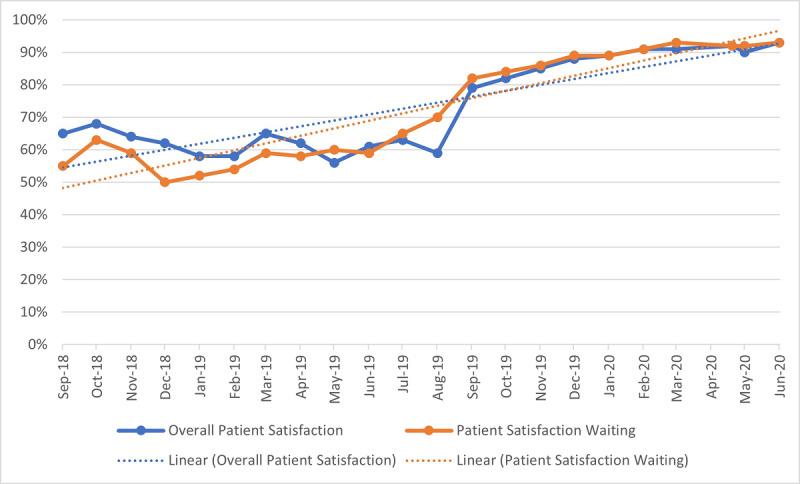
Results: From go-live, data were gathered on the above metrics in 1-month increments. At the 10-month point, there had been a 53% reduction in the average wait time, a 20% increase in patient satisfaction regarding pharmacy wait time, with a 22% increase in overall patient satisfaction regarding pharmacy services, and a 33% increase in pharmacist productivity. A zero dispensing error rate was reported.
Conclusions: The robotic pharmacy solution studied was highly effective, but a robust upstream supply chain is vital to ensure stock levels, particularly when automated filling is planned. The automation solution must also be seamlessly and completely integrated into the facility's software systems for appointments, medication records, and prescription generation in order to garner its full benefits. Overall patient satisfaction with pharmacy services is strongly influenced by wait time and follow-up studies are required to identify how to use this positive effect and make optimal use of freed-up pharmacist time. The extra time spent by pharmacists with patients and the opportunity for complete overview of the patient's medication history, which full integration provides, may allow us to address challenging issues such as medication nonadherence. Reduced wait times may also allow for smaller prescription fill volumes, and more frequent outpatient department visits, allowing patients to have increased contact time with pharmacists.
Keywords: automation; error; implementation; integration; medication dispensing; medication error; medication management; medication records; outcome; outpatient; patient satisfaction; pharmacy; record; robotics; usability.
©Hisham Momattin, Shokry Arafa, Shahad Momattin, Rayan Rahal, James Waterson. Originally published in JMIR Human Factors (https://humanfactors.jmir.org), 01.09.2021.
Conflict of interest statement
Conflicts of Interest: RR (Medication Management Solutions) and JW (Medical Affairs Department) are employed at Becton, Dickinson and Company (BD). HM, SA, and SM have no conflicts of interest to declare.
Figures
References
-
- Busquets FB, Celma MS, Escoda AC, Suárez JA, Comas AM, Moreno MC, Cayuela MR, Foguet JC, Riba RF. DD-025 Automatic storage system: Impact in reducing medication errors in a paediatric hospital. Eur J Hosp Pharm. 2016 Feb 14;23(Suppl 1):A115.2–A115. doi: 10.1136/ejhpharm-2016-000875.260. https://www.eahp.eu/sites/default/files/abstractbook2016.pdf - DOI
-
- Tam V, Lim M. Patients' Perceptions and Expectations of Outpatient Pharmacy Services in a Teaching Hospital. Int J Pharm Prac. 1997;5:128–32. doi: 10.1111/j.2042-7174.1997.tb00897.x. - DOI
LinkOut - more resources
Full Text Sources
