


Machine learning-based heart disease prediction system for Indian population: An exploratory study done in South India
- PMID: 34305284
- PMCID: PMC8282535
- DOI: 10.1016/j.mjafi.2020.10.013
Machine learning-based heart disease prediction system for Indian population: An exploratory study done in South India
Abstract
Background: In India, huge mortality occurs due to cardiovascular diseases (CVDs) as these diseases are not diagnosed in early stages. Machine learning (ML) algorithms can be used to build efficient and economical prediction system for early diagnosis of CVDs in India.
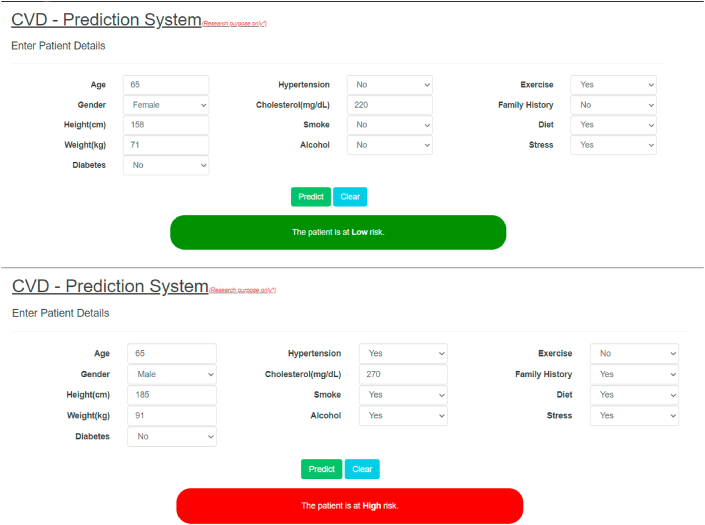
Methods: A total of 1670 anonymized medical records were collected from a tertiary hospital in South India. Seventy percent of the collected data were used to train the prediction system. Five state-of-the-art ML algorithms (k-Nearest Neighbours, Naïve Bayes, Logistic Regression, AdaBoost and Random Forest [RF]) were applied using Python programming language to develop the prediction system. The performance was evaluated over remaining 30% of data. The prediction system was later deployed in the cloud for easy accessibility via Internet.
Results: ML effectively predicted the risk of heart disease. The best performing (RF) prediction system correctly classified 470 out of 501 medical records thus attaining a diagnostic accuracy of 93.8%. Sensitivity and specificity were observed to be 92.8% and 94.6%, respectively. The prediction system attained positive predictive value of 94% and negative predictive value of 93.6%. The prediction model developed in this study can be accessed at http://das.southeastasia.cloudapp.azure.com/predict/.
Conclusions: ML-based prediction system developed in this study performs well in early diagnosis of CVDs and can be accessed via Internet. This study offers promising results suggesting potential use of ML-based heart disease prediction system as a screening tool to diagnose heart diseases in primary healthcare centres in India, which would otherwise get undetected.
Keywords: Affordable healthcare; Cardiovascular diseases; Early diagnosis; Machine learning.
© 2020 Director General, Armed Forces Medical Services. Published by Elsevier, a division of RELX India Pvt. Ltd.
Conflict of interest statement
The authors have none to declare.
Figures


References
-
- Noncommunicable Diseases Country Profiles. World Health Organization; 2018. https://www.who.int/nmh/publications/ncd-profiles-2018/en/ [Internet] 2019 [cited 17 December 2019]. Available from:
-
- Institute for Health Metrics and Evaluation (IHME). Findings from the Global Burden of Disease Study 2017. IHME; Seattle, WA: 2018. http://www.healthdata.org/sites/default/files/files/policy_report/2019/G... [Internet]. Healthdata.org [cited 17 December 2019] Available from:
-
- George A., Badagabettu S., Berra K., George L.S., Kamath V., Thimmappa L. Prevention of cardiovascular disease in India: barriers and opportunities for nursing. J Clin Prev Cardiol. 2018;7:72–77.
LinkOut - more resources
Full Text Sources
