Review
. 2021 Jul;34(4):219-226.
doi: 10.1055/s-0041-1725204. Epub 2021 Jul 20.

Small Bowel Obstruction

Affiliations
Review

Small Bowel Obstruction

Allison A Aka et al. Clin Colon Rectal Surg. 2021 Jul.

Abstract

Small bowel obstruction (SBO) remains a common problem for surgeons and nonsurgeons alike. Management of SBO has shifted from primarily being surgical to a nonoperative approach, which can be attributed to a multitude of reasons, including better understanding of the pathophysiology of SBO, the advent of laparoscopy, and improvement in diagnostic imaging. But given the nature of SBO, the need for surgical consultation continues to remain a necessity. This article will review the etiology, diagnosis, and management of SBO.

Keywords: adhesive disease; nasogastric tube; small bowel obstruction.


Conflict of interest statement

Conflict of Interest The authors have no conflict of interest to declare.

Figures

Fig. 1
Fig. 1
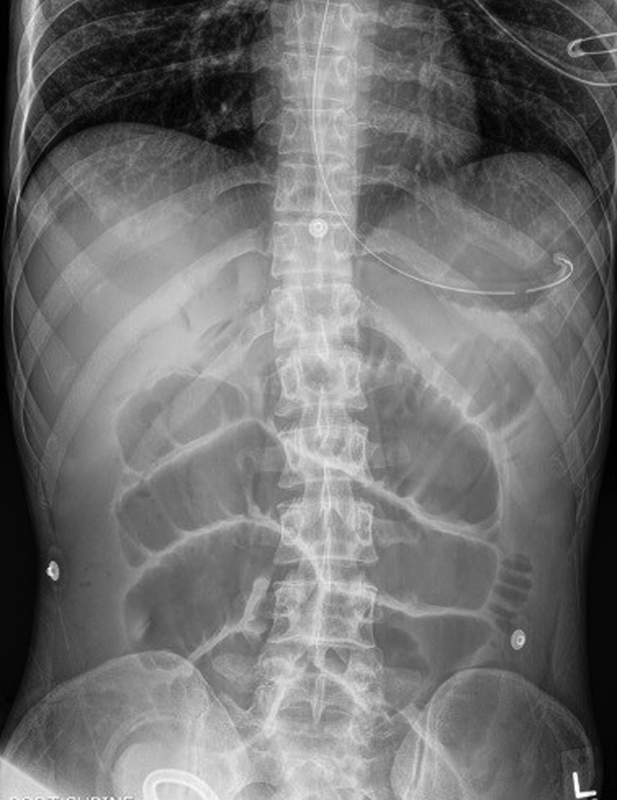
Upright plain abdominal radiograph demonstrating air-fluid levels in the stomach and intestines ( arrows ) and dilated loops of small bowel.
Fig. 2
Fig. 2
Axial image of a CT abdomen, with proximally dilated bowel ( circled ) and distally collapsed bowel ( arrow ).
Fig. 3
Fig. 3
Coronal image of a CT abdomen, with a distended stomach ( star ) proximally dilated bowel ( circled ) and distally collapsed bowel ( arrow ).
Fig. 4
Fig. 4
CT abdomen/pelvis with oral contrast that abruptly stops, with proximal bowel dilation and gastric distenstion, demonstrating a high-grade obstruction in the left upper quadrant in the proximal jejunum ( arrow ).
Fig. 5
Fig. 5
Plain abdominal radiograph demonstrating gastric decompression via NGT and dilated loops of small bowel from a partial bowel obstruction at the site of a loop ileostomy. NGT, nasogastric tube.
Fig. 6
Fig. 6
Plain abdominal radiograph demonstrating an NGT that is correctly positioned in the stomach but not functioning properly, resulting in gastric distension. NGT, nasogastric tube.
Fig. 7
Fig. 7
Gastrografin small bowel follow through demonstrating dilated loops of small bowel ( arrow ) and delayed transit to the colon, consistent with a partial bowel obstruction originating in the right lower quadrant.
Fig. 8
Fig. 8
CT abdomen/pelvis with a stricture secondary to Crohn's disease.
Fig. 9
Fig. 9
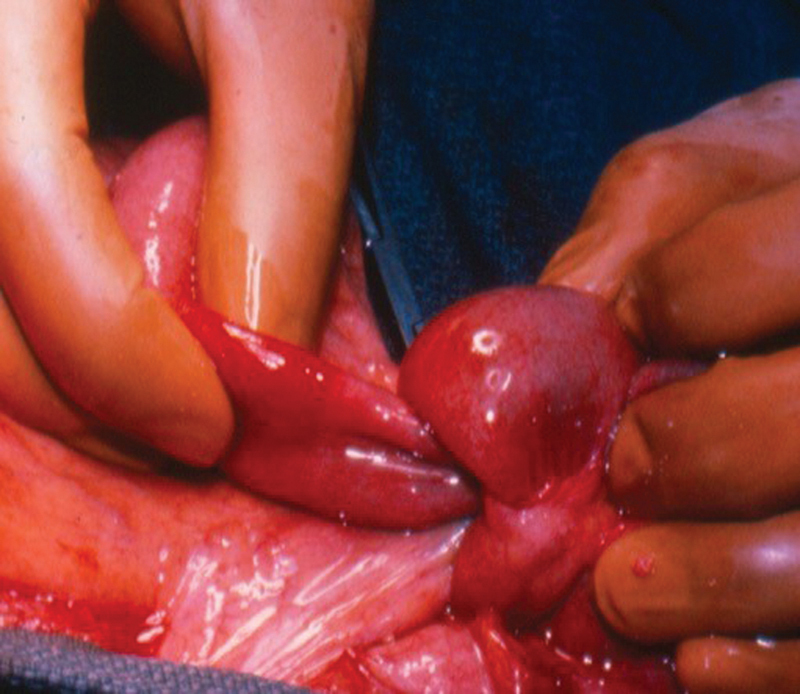
Intussusception secondary to a tumor.

References

    1. Ouaïssi M, Gaujoux S, Veyrie N. Post-operative adhesions after digestive surgery: their incidence and prevention: review of the literature. J Visc Surg. 2012;149(02):e104–e114. - PubMed
    1. Rami Reddy S R, Cappell M S. A systematic review of the clinical presentation, diagnosis, and treatment of small bowel obstruction. Curr Gastroenterol Rep. 2017;19(06):28. - PubMed
    1. Ten Broek R PG, Krielen P, Di Saverio S. Bologna guidelines for diagnosis and management of adhesive small bowel obstruction (ASBO): 2017 update of the evidence-based guidelines from the world society of emergency surgery ASBO working group. World J Emerg Surg. 2018;13:24. - PMC - PubMed
    1. Weibel M A, Majno G. Peritoneal adhesions and their relation to abdominal surgery. A postmortem study. Am J Surg. 1973;126(03):345–353. - PubMed
    1. Parker M C, Ellis H, Moran B J.Postoperative adhesions: ten-year follow-up of 12,584 patients undergoing lower abdominal surgery Dis Colon Rectum 20014406822–829., discussion 829–830 - PubMed