. 2021 Jul;82(Suppl 3):e131-e137.
doi: 10.1055/s-0039-3402026. Epub 2020 Jan 14.

Induction Therapy Prior to Surgical Resection for Patients Presenting with Locally Advanced Esthesioneuroblastoma

Affiliations

Induction Therapy Prior to Surgical Resection for Patients Presenting with Locally Advanced Esthesioneuroblastoma

Kevin C Miller et al. J Neurol Surg B Skull Base. 2021 Jul.

Abstract

Esthesioneuroblastoma (ENB) is a rare olfactory malignancy that can present with locally advanced disease. At our institution, patients with ENB in whom the treating surgeon believes that a margin-negative resection is initially not achievable are selected to undergo induction with chemotherapy with or without radiotherapy prior to surgery. In a retrospective review of 61 patient records, we identified six patients (10%) treated with this approach. Five of six patients (83%) went on to definitive surgery. Prior to surgery, three of five patients (60%) had a partial response after induction therapy, whereas two of five (40%) had stable disease. Microscopically margin-negative resection was achieved in four of five (80%) of the patients who went on to surgery, while one patient had negative margins on frozen section but microscopically positive margins on permanent section. Three of five patients (60%) recurred after surgery; two of these patients died with recurrent/metastatic ENB. In summary, induction therapy may facilitate margin-negative resection in locally advanced ENB. Given the apparent sensitivity of ENB to chemotherapy and radiotherapy, future prospective studies should investigate the optimal multidisciplinary approach to improve long-term survival in this rare disease.

Keywords: esthesioneuroblastoma; induction; neoadjuvant; outcomes; therapy.


Conflict of interest statement

Conflict of Interest A.V.C. reports funding for clinical trials from Merck, AstraZeneca/MedImmune, Kura Oncology, Inovio, Eisai (all institutional). The other authors report no relevant conflict of interest in submitting this article for publication.

Figures
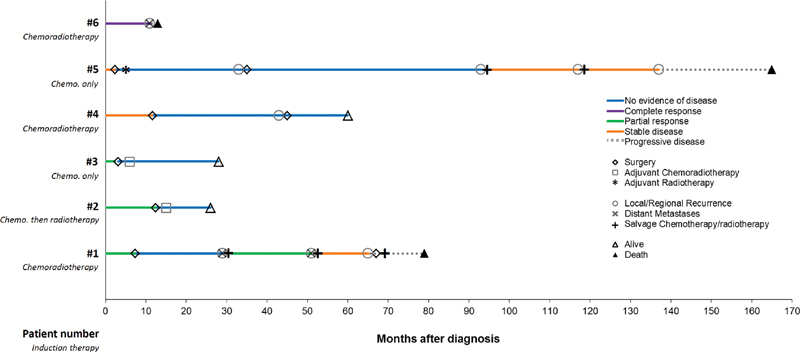
Fig. 1
Fig. 1
Swimmer plot demonstrating the clinical course of the six patients in our cohort from the time of diagnosis. Patient number and IT are denoted in the y-axis. Best response to IT before surgery is denoted with the color of the line (i.e., stable disease, partial response, or complete response). Time of surgery is denoted for both primary and salvage surgery. Postsurgery adjuvant chemotherapy and/or radiotherapy are indicated. Salvage chemotherapy/radiotherapy is indicated, with best responses shown. Time of local/regional recurrence is indicated with circles; time of distant metastases is indicated with Xs. Patients alive at the time of last follow-up are indicated with an open triangle; filled triangles denote the time of death. IT, induction therapy.
Fig. 2
Fig. 2
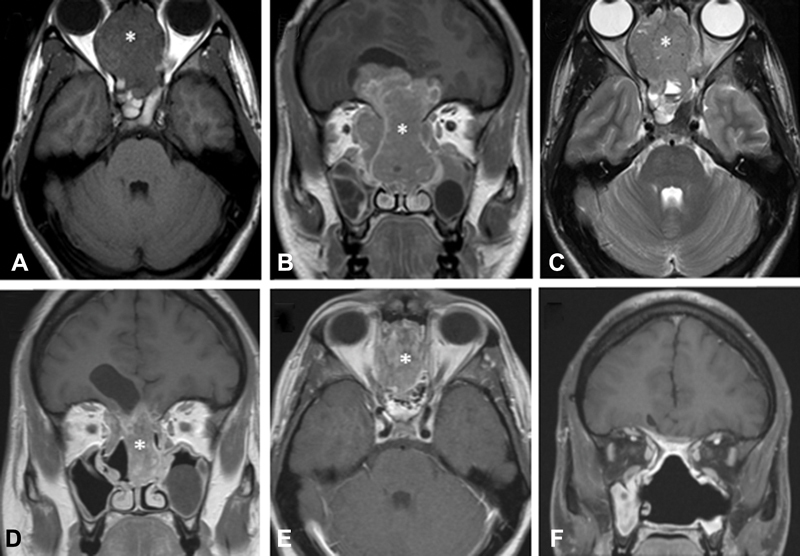
Magnetic resonance imaging of a 25-year-old male with esthesioneuroblastoma initially deemed unresectable prior to induction therapy (patient 3). ( A ) Axial T1-weighted pregadolinium image demonstrating a large locally destructive sinonasal mass (*). ( B ) Corresponding coronal T1-weighted gadolinium-enhanced image. ( C ) Corresponding axial T2-weighted image. ( D ) Coronal T1-weighted postgadolinium image status postinduction chemotherapy with three cycles of etoposide and cisplatin, demonstrating a partial response to induction chemotherapy (without radiotherapy). He was subsequently taken to surgery, which achieved a gross total resection with negative microscopic margins. ( E ) Corresponding axial T1-weighted gadolinium-enhanced image. ( F ) 2-year postoperative coronal T1-weighted gadolinium enhanced imaging demonstrating no evidence for residual or recurrent disease after postsurgery chemoradiotherapy.
Fig. 3
Fig. 3
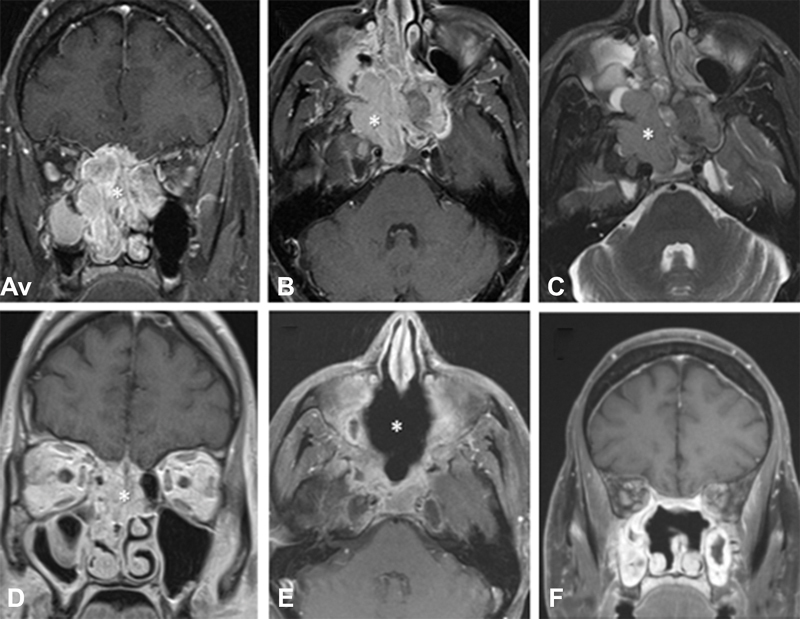
Magnetic resonance imaging of a 44-year-old male presenting with esthesioneuroblastoma initially deemed unresectable prior to induction therapy (patient 1). ( A ) Coronal T1-weighted postgadolinium image demonstrating a large sinonasal mass (*). ( B ) Corresponding axial T1-weighted gadolinium-enhanced image. ( C ) Corresponding axial T2-weighted image. ( D ) Coronal T1-weighted postgadolinium image status postinduction chemotherapy with two cycles of cisplatin, doxorubicin, and vincristine, followed by two cycles of etoposide and cisplatin and then two cycles of etoposide and cisplatin with concurrent 6,480 cGy of external beam radiotherapy in 36 fractions. This image was taken immediately prior to surgery, which was achieved in a gross total fashion with negative microscopic margins. ( E ) 4-month postoperative axial T1-weighted gadolinium enhanced imaging demonstrated no evidence for residual or recurrent disease. ( F ) Corresponding coronal T1-weighted gadolinium-enhanced image.

References

    1. Dulguerov P, Allal A S, Calcaterra T C. Esthesioneuroblastoma: a meta-analysis and review. Lancet Oncol. 2001;2(11):683–690. - PubMed
    1. Broich G, Pagliari A, Ottaviani F.Esthesioneuroblastoma: a general review of the cases published since the discovery of the tumour in 1924 Anticancer Res 199717(4A):2683–2706. - PubMed
    1. Theilgaard S A, Buchwald C, Ingeholm P, Kornum Larsen S, Eriksen J G, Sand Hansen H. Esthesioneuroblastoma: a Danish demographic study of 40 patients registered between 1978 and 2000. Acta Otolaryngol. 2003;123(03):433–439. - PubMed
    1. Diaz E M, Jr, Johnigan R H, III, Pero C. Olfactory neuroblastoma: the 22-year experience at one comprehensive cancer center. Head Neck. 2005;27(02):138–149. - PubMed
    1. Tajudeen B A, Arshi A, Suh J D. Esthesioneuroblastoma: an update on the UCLA experience, 2002-2013. J Neurol Surg B Skull Base. 2015;76(01):43–49. - PMC - PubMed