


Oriented Growth of In-Oxo Chain Based Metal-Porphyrin Framework Thin Film for High-Sensitive Photodetector
- PMID: 34306983
- PMCID: PMC8292912
- DOI: 10.1002/advs.202100548
Oriented Growth of In-Oxo Chain Based Metal-Porphyrin Framework Thin Film for High-Sensitive Photodetector
Abstract
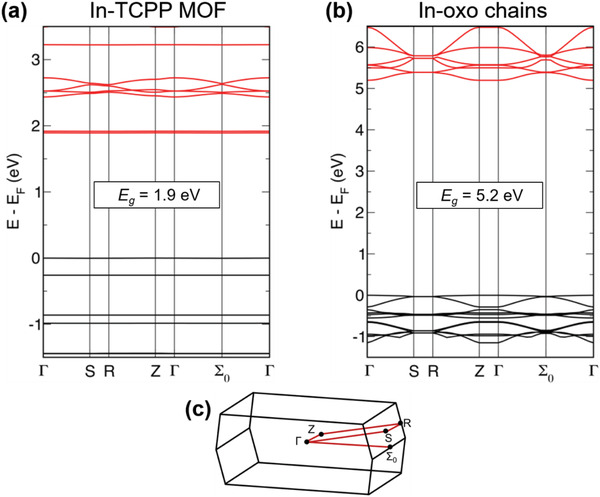
The potential of metal-organic frameworks (MOFs) for applications in optoelectronics results from a unique combination of interesting photophysical properties and straightforward tunability of organic and inorganic units. Here, it is demonstrated that using MOF approach chromophores can be assembled into well-ordered 1D arrays using metal-oxo strands as lead structure, and the resulting porphyrinic rows exhibit unique photophysical properties and allow the realization of highly sensitive photodetectors. A porphyrinic MOF thin film, In-TCPP surface-coordinated MOF thin films with [021] orientation is fabricated using a layer-by-layer method, from In(NO3)3 and TCPP (5,10,15,20-(4-carboxyphenyl)porphyrin). Detailed experimental and theoretical analysis reveals that the assembly yields a structure where In-oxo strands running parallel to the substrate fix the chromophoric linkers to yield 1D arrays of porphyrins. The frontier orbitals of this highly anisotropic arrangement are localized in these columnar arrangements of porphyrins and result in high photoactivity, which is exploited to fabricate a photodetector with record (as compared to other organic materials) responsivity in visible regime of 7.28 × 10¹⁴ Jones and short rise/fall times (0.07/0.04 s). This oriented MOF thin film-based high-sensitive photodetector provides a new avenue to use inorganic, stable lead structures to assemble organic semiconductors into regular arrays, thus creating a huge potential for the fabrication of optoelectronic devices.
Keywords: In‐oxo chains; metal‐porphyrin; metal–organic frameworks; oriented growth; photodetectors.
© 2021 The Authors. Advanced Science published by Wiley‐VCH GmbH.
Conflict of interest statement
The authors declare no conflict of interest.
Figures


References
-
- Mueller T., Xia F., Avouris P., Nat. Photonics 2010, 4, 297.
-
- Pi L. J., Li L., Liu K. L., Zhang Q. F., Li H. Q., Zhai T. Y., Adv. Funct. Mater. 2019, 29, 1904932.
-
- Yang Q., Liu Y., Li Z. T., Yang Z. Y., Wang X., Wang Z. L., Angew. Chem., Int. Ed. 2012, 124, 6549.
-
- Lü Y. Y., Zhan W. W., He Y., Wang Y. T., Kong X. J., Kuang Q., Xie Z. X., Zheng L. S., ACS Appl. Mater. Interfaces 2014, 6, 4186. - PubMed
LinkOut - more resources
Full Text Sources