


Prevalence of SARS-CoV-2 in Household Members and Other Close Contacts of COVID-19 Cases: A Serologic Study in Canton of Vaud, Switzerland
- PMID: 34307723
- PMCID: PMC8083624
- DOI: 10.1093/ofid/ofab149
Prevalence of SARS-CoV-2 in Household Members and Other Close Contacts of COVID-19 Cases: A Serologic Study in Canton of Vaud, Switzerland
Abstract
Background: Research on severe acute respiratory syndrome coronavirus 2 (SARS-CoV-2) transmission within households and other close settings using serological testing is scarce.
Methods: We invited coronavirus disease 2019 (COVID-19) cases diagnosed between February 27 and April 1, 2020, in Canton of Vaud, Switzerland, to participate, along with household members and other close contacts. Anti-SARS-CoV-2 immunoglobulin G antibodies were measured using a Luminex immunoassay. We estimated factors associated with serological status using generalized estimating equations.
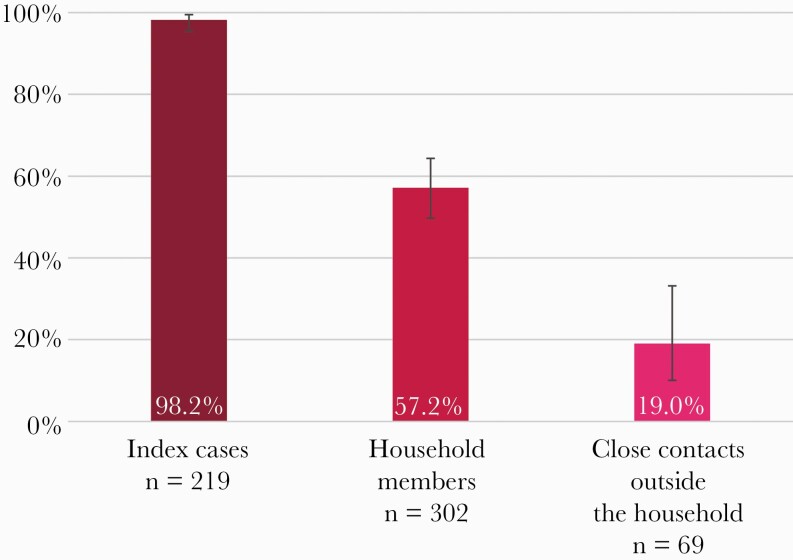
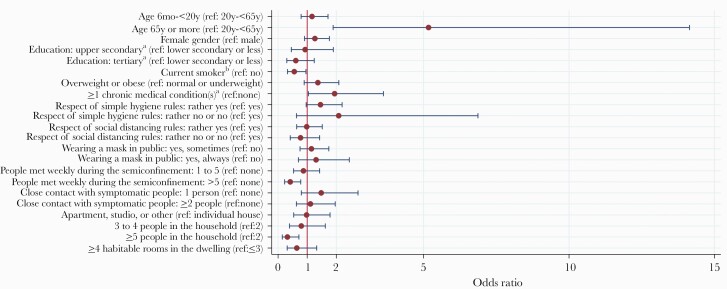
Results: Overall, 219 cases, 302 household members, and 69 other close contacts participated between May 4 and June 27, 2020. More than half of household members (57.2%; 95% CI, 49.7%-64.3%) had developed a serologic response to SARS-CoV-2, while 19.0% (95% CI, 10.0%-33.2%) of other close contacts were seropositive. After adjusting for individual and household characteristics, infection risk was higher in household members aged ≥65 years than in younger adults (adjusted odds ratio [aOR], 3.63; 95% CI, 1.05-12.60) and in those not strictly adhering to simple hygiene rules like hand washing (aOR, 1.80; 95% CI, 1.02-3.17). The risk was lower when more than 5 people outside home were met during semiconfinement, compared with none (aOR, 0.35; 95% CI, 0.16-0.74). Individual risk of household members to be seropositive was lower in large households (22% less per each additional person).
Conclusions: During semiconfinement, household members of a COVID-19 case were at very high risk of getting infected, 3 times more than close contacts outside home. This highlights the need to provide clear messages on protective measures applicable at home. For elderly couples, who were especially at risk, providing external support for daily basic activities is essential.
Keywords: COVID-19; SARS-CoV-2; household; serology; transmission.
© The Author(s) 2021. Published by Oxford University Press on behalf of Infectious Diseases Society of America.
Figures
References
-
- World Health Organization. Unity studies: early investigation protocols. Available at: https://www.who.int/emergencies/diseases/novel-coronavirus-2019/technica.... Accessed 30 June 2020.
LinkOut - more resources
Full Text Sources
Miscellaneous
