


Lunate bone loss associated with Chlamydia pneumoniae infection
- PMID: 34307820
- PMCID: PMC8283024
- DOI: 10.1016/j.tcr.2021.100431
Lunate bone loss associated with Chlamydia pneumoniae infection
Erratum in
-
Erratum regarding missing Declaration of Competing Interest statements in previously published articles.Trauma Case Rep. 2023 Feb 17;45:100799. doi: 10.1016/j.tcr.2023.100799. eCollection 2023 Jun. Trauma Case Rep. 2023. PMID: 37234581 Free PMC article.
-
Erratum regarding missing Patient Consent statement in previously published articles.Trauma Case Rep. 2023 Mar 1;45:100819. doi: 10.1016/j.tcr.2023.100819. eCollection 2023 Jun. Trauma Case Rep. 2023. PMID: 37234586 Free PMC article.
Abstract
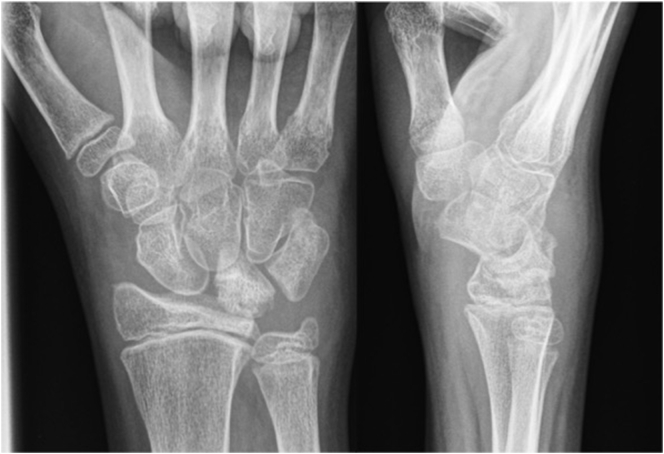
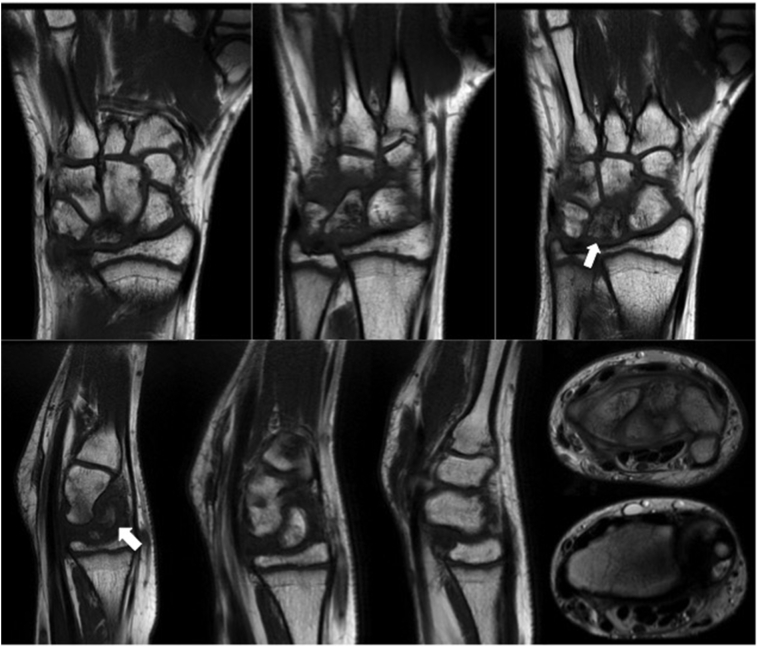
Respiratory pathogens such as Chlamydia pneumoniae may activate osteoclast cells, thereby inducing bone resorption and joint inflammation. Herein is a case report of a young man with misdiagnosed persistent wrist pain without any major trauma. Investigation of the patient's medical history confirmed a recent systemic C. pneumoniae infection. Preoperative X-ray and magnetic resonance imaging (MRI) showed a substantial decrease in cancellous lunate bone compactness. A stepwise approach was undertaken considering the rapid onset of bone devascularisation and the clinical presentation. Wrist arthroscopy confirmed extensive joint inflammation associated with decreased osteochondral lunate solidity. Microbiological examination excluded joint infection. Histological analysis showed a diffuse inflammatory infiltration. Temporary mediocarpal K-wire stabilization and synovectomy were performed. Postoperative MRI confirmed lunate bone revascularization. At 6 and 12 months' follow-up the young man was pain-free and had good recovery of range of motion. In vitro and in vivo studies demonstrate that inflammatory conditions may promote osteoclast cell activity and induce bone resorption. Moreover, infection with C. pneumoniae could activate specific "osteoporotic" bone pathways. To the authors' knowledge, this is the first published case report of specific lunate bone loss induced by systemic C. pneumoniae infection. The authors proposed an etiologic explanation, and a stepwise approach was associated with good outcome.
Keywords: Bone loss infection; Chlamydia pneumonia; Lunate bone loss.
© 2021 Published by Elsevier Ltd.
Figures




References
-
- Marriott I. Osteoblast responses to bacterial pathogens: a previously unappreciated role for bone-forming cells in host defense and disease progression. Immunol. Res. 2004;30:291–308. - PubMed
-
- Henderson B., Nair S.P., Ward J.M., Wilson M. Molecular pathogenicity of the oral opportunistic pathogen Actinobacillus actinomycetemcomitans. Annu. Rev. Microbiol. 2003;57:29–55. - PubMed
-
- Gracey E., Inman R.D. Chlamydia-induced ReA: immune imbalances and persistent pathogens. Nat. Rev. Rheumatol. 2011;8:55–59. - PubMed
Publication types
LinkOut - more resources
Full Text Sources
