


Situation assessment and natural dynamics of COVID-19 pandemic in Nigeria, 31 May 2020
- PMID: 34308003
- PMCID: PMC8274274
- DOI: 10.1016/j.sciaf.2021.e00844
Situation assessment and natural dynamics of COVID-19 pandemic in Nigeria, 31 May 2020
Abstract
Background: The coronavirus disease (COVID-19) remains a global public health issue due to its high transmission and case fatality rate. There is apprehension on how to curb the spread and mitigate the socio-economic impacts of the pandemic, but timely and reliable daily confirmed cases' estimates are pertinent to the pandemic's containment. This study therefore conducted a situation assessment and applied simple predictive models to explore COVID-19 progression in Nigeria as at 31 May 2020.
Methods: Data used for this study were extracted from the websites of the European Centre for Disease Control (World Bank data) and Nigeria Centre for Disease Control. Besides descriptive statistics, four predictive models were fitted to investigate the pandemic natural dynamics.
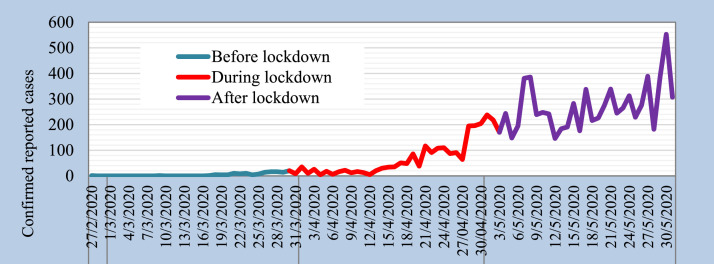
Results: The case fatality rate of COVID-19 was 2.8%. A higher number of confirmed cases of COVID-19 was reported daily after the relaxation of lockdown than before and during lockdown. Of the 36 states in Nigeria, including the Federal Capital Territory, 35 have been affected with COVID-19. Most active cases were in Lagos (n = 4064; 59.2%), followed by Kano (n = 669; 9.2%). The percentage of COVID-19 recovery in Nigeria (29.5%) was lower compared to South Africa (50.3%), but higher compared to Kenya (24.1%). The cubic polynomial model had the best fit. The projected value for COVID-19 cumulative cases for 30 June 2020 in Nigeria was 27,993 (95% C.I: 27,001-28,986).
Conclusion: The daily confirmed cases of COVID-19 are increasing in Nigeria. Increasing testing capacity for the disease may further reveal more confirmed cases. As observed in this study, the cubic polynomial model currently offers a better prediction of the future COVID-19 cases in Nigeria.
Keywords: COVID-19; Growth curve, polynomial model; Nigeria; Simple mathematical model.
© 2021 The Author(s). Published by Elsevier B.V. on behalf of African Institute of Mathematical Sciences / Next Einstein Initiative.
Conflict of interest statement
The authors declare no competing interest.
Figures


References
-
- Nigeria Centre for Disease Control. 2020. https://ncdc.gov.ng/diseases/sitreps/?cat=14&name=An update of COVID-19 outbreak in Nigeria. Accessed April 2020.
-
- WHO. Coronavirus disease 2019 (COVID-19) situation reports. 2020.
-
- Hallett TB, Gregson S, Mugurungi O, Gonese E, Garnett GP. Assessing evidence for behaviour change affecting the course of HIV epidemics: a new mathematical modelling approach and application to data from Zimbabwe. Epidemics. 2009;1(2):108–117. - PubMed
LinkOut - more resources
Full Text Sources
Research Materials