Plant-based diets, pescatarian diets and COVID-19 severity: a population-based case-control study in six countries
- PMID: 34308134
- PMCID: PMC8219480
- DOI: 10.1136/bmjnph-2021-000272
Plant-based diets, pescatarian diets and COVID-19 severity: a population-based case-control study in six countries
Abstract
Background: Several studies have hypothesised that dietary habits may play an important role in COVID-19 infection, severity of symptoms, and duration of illness. However, no previous studies have investigated the association between dietary patterns and COVID-19.
Methods: Healthcare workers (HCWs) from six countries (France, Germany, Italy, Spain, UK, USA) with substantial exposure to COVID-19 patients completed a web-based survey from 17 July to 25 September 2020. Participants provided information on demographic characteristics, dietary information, and COVID-19 outcomes. We used multivariable logistic regression models to evaluate the association between self-reported diets and COVID-19 infection, severity, and duration.
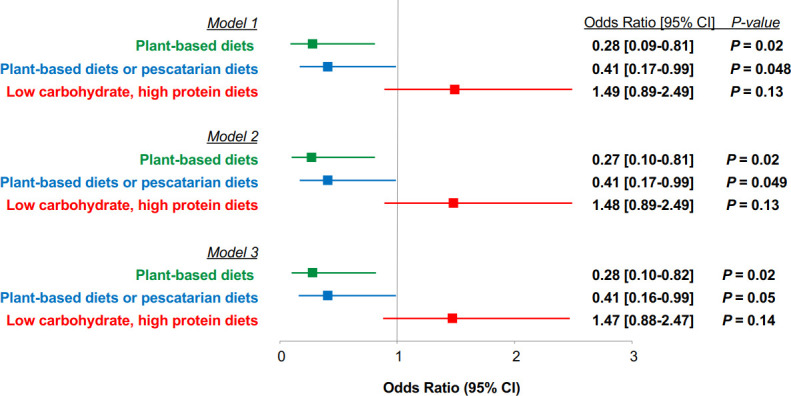
Results: There were 568 COVID-19 cases and 2316 controls. Among the 568 cases, 138 individuals had moderate-to-severe COVID-19 severity whereas 430 individuals had very mild to mild COVID-19 severity. After adjusting for important confounders, participants who reported following 'plant-based diets' and 'plant-based diets or pescatarian diets' had 73% (OR 0.27, 95% CI 0.10 to 0.81) and 59% (OR 0.41, 95% CI 0.17 to 0.99) lower odds of moderate-to-severe COVID-19 severity, respectively, compared with participants who did not follow these diets. Compared with participants who reported following 'plant-based diets', those who reported following 'low carbohydrate, high protein diets' had greater odds of moderate-to-severe COVID-19 (OR 3.86, 95% CI 1.13 to 13.24). No association was observed between self-reported diets and COVID-19 infection or duration.
Conclusion: In six countries, plant-based diets or pescatarian diets were associated with lower odds of moderate-to-severe COVID-19. These dietary patterns may be considered for protection against severe COVID-19.
Keywords: COVID-19; dietary patterns.
© Author(s) (or their employer(s)) 2021. Re-use permitted under CC BY. Published by BMJ.
Conflict of interest statement
Competing interests: None declared.
Figures
References
-
- Troeger C, Blacker B, Khalil IA, et al. . Estimates of the global, regional, and national morbidity, mortality, and aetiologies of lower respiratory infections in 195 countries, 1990-2016: a systematic analysis for the Global Burden of Disease study 2016. Lancet Infect Dis 2018;18:1191–210. 10.1016/S1473-3099(18)30310-4 - DOI - PMC - PubMed
Grants and funding
LinkOut - more resources
Full Text Sources
Other Literature Sources
Medical