. 2021 May 17:36:100885.
doi: 10.1016/j.eclinm.2021.100885. eCollection 2021 Jun.

MRI combined with early clinical variables are excellent outcome predictors for newborn infants undergoing therapeutic hypothermia after perinatal asphyxia

Affiliations

MRI combined with early clinical variables are excellent outcome predictors for newborn infants undergoing therapeutic hypothermia after perinatal asphyxia

Marianne Thoresen et al. EClinicalMedicine. .

Abstract

Background: Binary prediction-models for outcome [death, cognition, presence and severity of cerebral palsy (CP)], using MRI and early clinical data applicable for individual outcome prediction have not been developed.

Methods: From Dec 1st 2006 until Dec 31st 2013, we recruited 178 infants into a population-based cohort with moderate or severe hypoxic-ischaemic encephalopathy (HIE) including postnatal collapse (PNC, n = 12) and additional diagnoses (n = 12) using CoolCap/TOBY-trial entry-criteria including depressed amplitude-integrated EEG (aEEG). Early clinical/biochemical variables and MRI scans (median day 8) were obtained in 168 infants. Injury severity was scored for cortex, basal ganglia/thalami (BGT), white matter (WM) and posterior limb of the internal capsule, summating to a total injury score (TIS, range 0-11). Outcome was categorized as adverse or favourable at 18-24 months from Bayley-III domains (cut-off 85) and neurological examination including CP classification.

Findings: HIE and entry-aEEG severity were stable throughout the study. Outcome was favourable in 133/178 infants and adverse in 45/178: 17 died, 28 had low Cognition/Language scores, (including 9 with severe CP and 6 mild); seven had mild CP with favourable cognitive outcome. WMxBGT product scores and TIS were strong outcome predictors, and prediction improved when clinical/biochemical variables were added in binary logistic regression. The Positive Predictive Value for adverse outcome was 88%, increasing to 95% after excluding infants with PNC and additional diagnoses. Using WMxBGT in the regression predicted 8 of the 9 children with severe CP.

Interpretation: Binary logistic regression with WMxBGT or TIS and clinical variables gave excellent outcome prediction being 12% better than single variable cross-tabulation. Our MRI scoring and regression models are readily accessible and deserve investigation in other cohorts for group and individual prediction.

Funding: We thank the National Health Service (NHS) and our Universities and funders in UK and Norway: SPARKS, The Moulton Foundation, The Norwegian Research Council, The Lærdal Foundation for Acute Medicine and charitable donations for their support for cooling therapy.

Keywords: BGT, Basal ganglia/thalami; BIC, Bayesian information criterion; Basal ganglia and thalamus; Bayley-III; Bayley-III, Bayley Scales of Infant & Toddler Development 3rd edition; CLC, Cognitive and Language Composite from the Bayley-III scales; CP, Cerebral palsy; CX, Cortex; Cerebral palsy; Cortex; DWI, Diffusion-weighted imaging; GA, Gestational age; GMFCS, Gross Motor Function Classification System; HIE, Hypoxic-ischaemic encephalopathy; Hypoxic-ischaemic encephalopathy; ILEA, International League Against Epilepsy; IQR, Interquartile range; LDH72h, Lactate dehydrogenase close to 72h post-asphyxial event; LDHpeak, Highest LDH in the first 3 days; Logistic regression; MRI; MRI, Magnetic Resonance Imaging; Moderate or severe perinatal asphyxia; NPV, Negative Predictive Value; Neonatal seizures; Neurodevelopmental outcome; Outcome prediction; PA, Predictive Accuracy; PLIC, Posterior limb of the internal capsule; PNC, Postnatal collapse; PPV, Positive Predictive Value; Posterior limb of the internal capsule; RCT, Randomised controlled trial; Se, Sensitivity; Sp, Specificity; T1 and T2; TH, Therapeutic hypothermia; TIS, Total injury score; Therapeutic hypothermia; WMxBGT, Product of white matter and basal ganglia/thalami scores; White matter; aEEG, amplitude integrated electroencephalography; h, hours; lactatehrs<5mmol, plasma lactate recovery time; m, months.


Conflict of interest statement

M Karlsson declares patents Method of Determining Hypoxia and Testing System for Determining Hypoxia Induced Cellular Damage. All other authors have nothing to disclose.

Figures
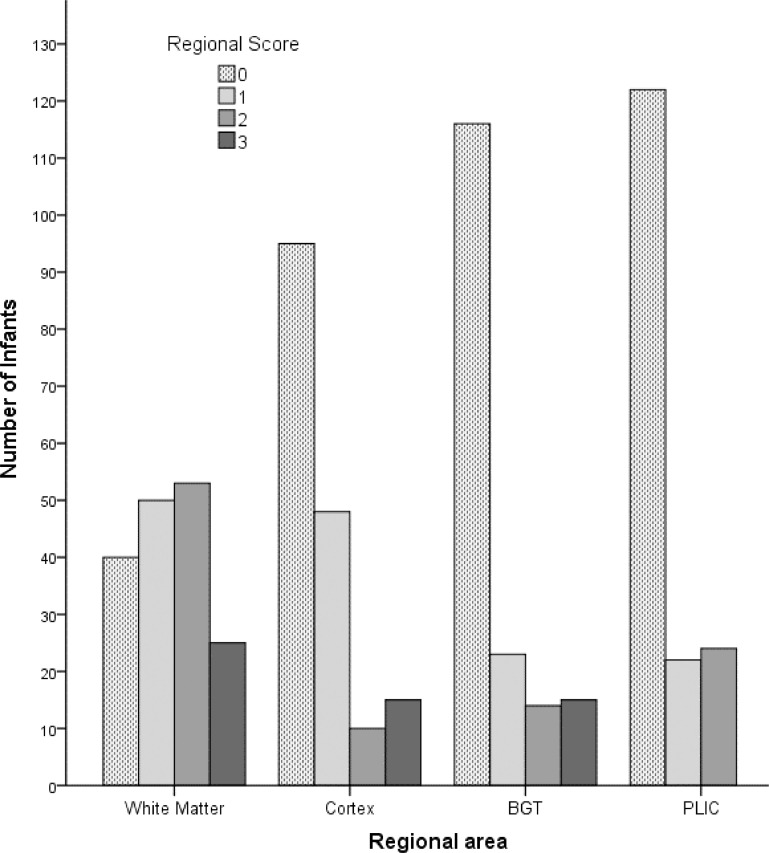
Fig. 1
Fig. 1
Regional brain MRI scores for 168 scans. (MRI scan at median 8 days after birth/asphyxial event) The images were severity scored according to Rutherford(4) for cortex (CX), white matter (WM) and basal ganglia/thalamus (BGT) (range 0–3) and posterior limb of the internal capsule (PLIC) (range 0–2).
Fig. 2
Fig. 2
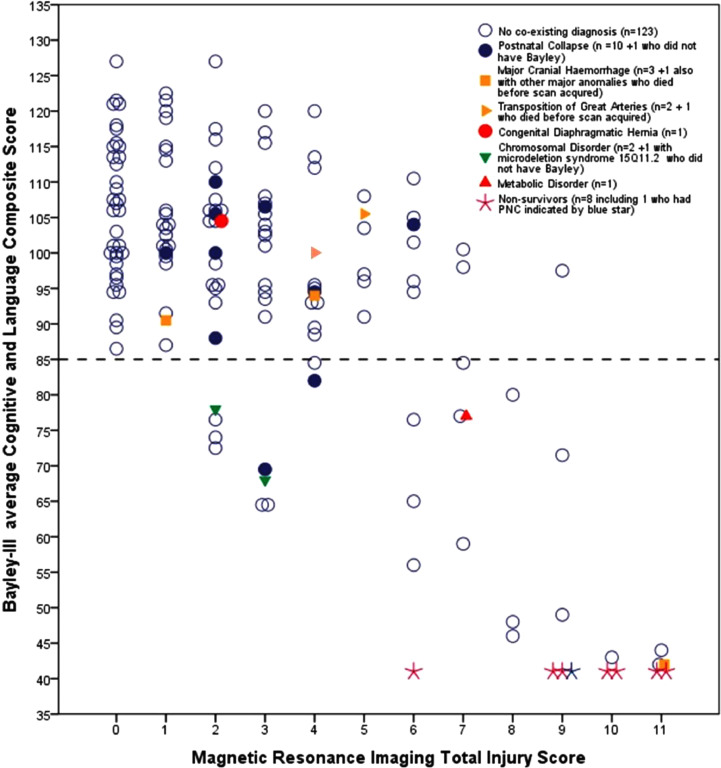
Scatter plot of Bayley-III average Cognitive/Language score (CLC) at 18m vs MRI Total Injury Score (TIS). The horizontal dotted line indicates a Bayley-III CLC score of 85, comparable to Bayley-II MDI of 70 (30) Eight scanned non-surviving infants were allocated a score of 41. Eleven of the 12 infants cooled following postnatal collapse (PNC) are indicated (10 survivors blue filled circle and 1 non-survivor blue star). The one child with PNC not shown, did not have a Bayley assessment and had TIS of 1 and a favourable outcome. One survivor, later diagnosed with a metabolic disorder, also had PNC. Nine of the 12 cooled infants who had additional diagnoses are indicated; of the 3 infants not shown, 2 died before an MRI could be acquired, 1 with major congenital anomalies and the other with transposition of the great arteries, 1 survivor with microdeletion syndrome 15q11.2 did not have a Bayley-III and had a TIS of 4 and an adverse outcome. Only five infants without PNC or other diagnosis had low Bayley-III CLC scores <85 at 18m despite low TIS scores of 2 and 3. Two had hearing loss at 18m, which improved in one by 24m, but the other had GMFCS Level I CP and went on to require hearing aids, the third developed infantile seizures that were difficult to control, the fourth was later diagnosed with Autistic Spectrum Disorder and no explanation was found for the fifth child. All 147 infants without PNC or additional diagnoses with a TIS of 4 or 5 had a Bayley-III CLC score >85, however one was diagnosed with GMFCS Level I CP at 24m. TIS scores of 6 or 7 were found in 16 infants, of whom 7 had a adverse outcome with one death and 3 with severe hearing loss. Nine had a favourable outcome but included 4 with mild CP, GMFCS Level I. Of the 14 infants with a TIS of 8–11 there were 7 neonatal deaths, 7 with severe CP (GMFCS Level V) and poor cognition and one with GMFCS Level I, dyskinetic CP had Bayley-III CLC score >85.
Fig. 3
Fig. 3
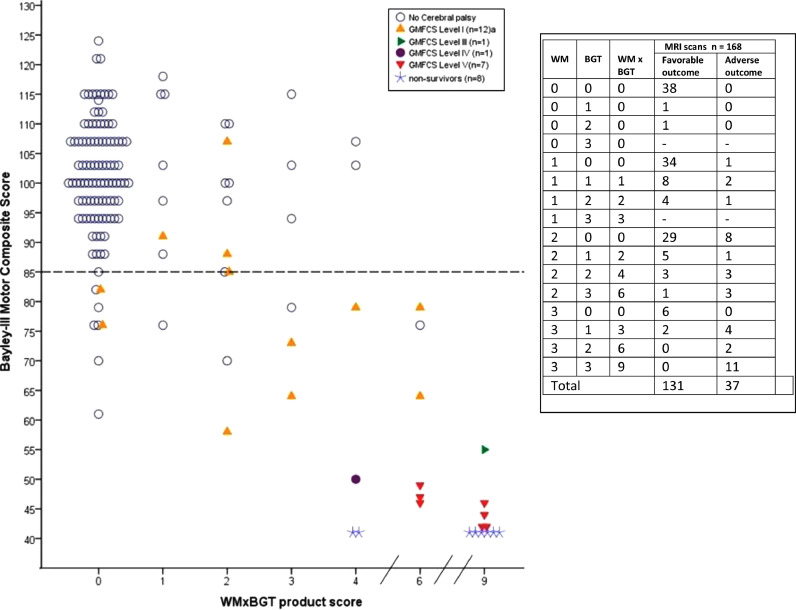
The figure shows the scatter plot of individual Bayley-III Motor Score at 18 months versus the WMxBGT product score for the 168 children. The horizontal dotted line indicated a Bayley-III score of 85. The inset lists details the WM and BGT scores, the product WMxBGT with the corresponding outcomes. Eight scanned non-survivors were allocated a Bayley-III score of 41 (star sign). 21/22 infants diagnosed with cerebral palsy (CP) are indicated according to their Gross Motor Function Classification System (GMFCS) Levels. aOne infant, GMFCS Level I CP, did not have a Bayley-III assessment. Seven of the 12 infants with CP GMFCS Level I had Bayley-III average Cognitive/Language (CLC) scores ≥85. The only child with CP GMFCS Level III had Bayley-III C CLC score of 85. The remaining 8 infants with CP GMFCS Levels IV and V had Bayley-III Cognitive/Language scores <55. Eight of nine infants with severe CP (Levels III-V) had a WMxBGT product of 6 or 9. Six of the eight children who died had a product of 9 and two had 4. All but one child with CP GMFCS Levels III-V had WMxBGT 6 or 9; the exception was an infant with WMxBGT 6, later diagnosed with complex-1 respiratory chain enzyme deficiency. When any BGT injury was present, the severity of WM injury appeared to negatively modulate outcome. Infants with WM score 3 and no BGT injury had a favourable outcome; for infants with BGT score 2 or 3, outcome worsened with increasing severity of WM injury.
Fig. 4
Fig. 4
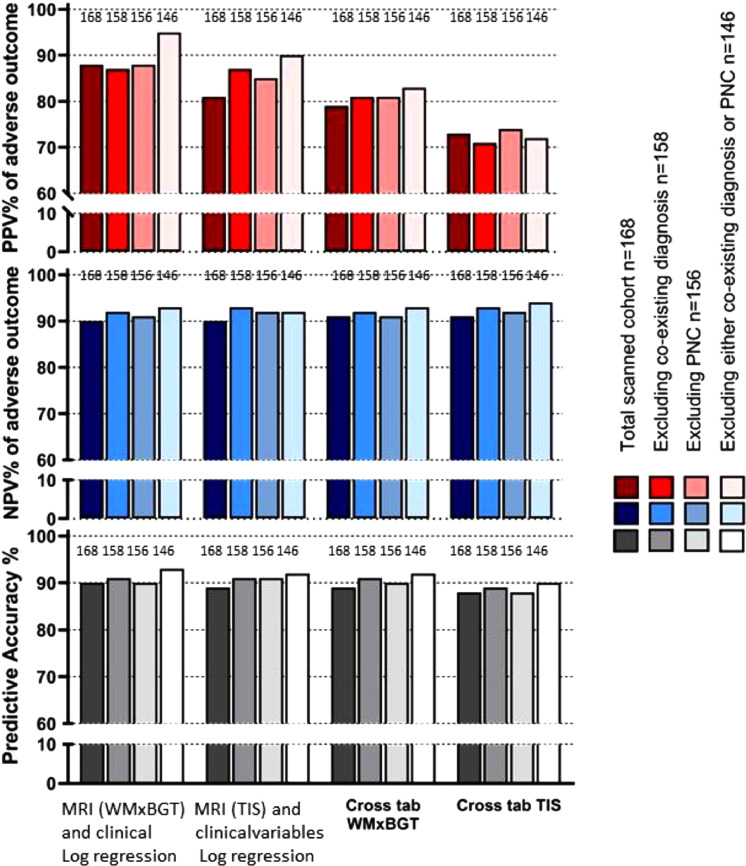
Fig 4. compares graphically three methods of outcome prediction analysis in infants having MRI scans. (data from Table 1). The whole cohort (n = 168) has the darkest colour grade fading towards the smallest cohort n = 146 where infants with postnatal collapse and/or additional diagnosis to HIE were excluded. The 146 cohort would fulfill the original cooling entry-criteria in the CoolCap and TOBY trials. The upper panel shows the positive predictive value (PPV) for adverse outcome. The first 4 shaded bars show results from binary logistic regression from the best model allowing all six MRI and all clinical and biochemical variables. WMxBGT is the strongest MRI variable. For the n = 146-group (palest colour), the best PPV from logistic regression is 95%. In the second vertical set of bars, WMxBGT is removed from the allowed variables and total injury score (TIS) is now the most significant. Again the 146 group has the best prediction, now 90%. The next two vertical sets of bars use cross-tabulation analysis with the best cut-off for a single MRI variable, either WMxBGT or TIS. The sequence of results show that logistic regression is better than cross-tabulation and that WMxBGT is better than TIS for outcome prediction. The middle horizontal panel shows that the negative predictive value (NPV) for poor outcome is good, 90–93% between all groups and methods. The lowest horizontal panel shows the predictive accuracy (PA, the sum of all correct predictions, both adverse and favourable) compared to the whole group. Again, there is little difference between methods. In a dataset with 75% favourable outcome, it is the PPV for adverse outcome that is the most important predictor.

References

    1. Gluckman P.D., Wyatt J.S., Azzopardi D., Ballard R., Edwards A.D., Ferriero D.M. Selective head cooling with mild systemic hypothermia after neonatal encephalopathy: multicentre randomised trial. Lancet. 2005;365(9460):663–670. /02/22 ed. 2005 Feb 19. - PubMed
    1. Azzopardi D.V., Strohm B., Edwards A.D., Dyet L., Halliday H.L., Juszczak E. Moderate hypothermia to treat perinatal asphyxial encephalopathy. N Engl J Med. 2009;361(14):1349–1358. /10/03 ed. 2009 Oct 1. - PubMed
    1. Shankaran S., Laptook A.R., Pappas A., McDonald S.A., Das A., Tyson J.E. Effect of depth and duration of cooling on deaths in the NICU among neonates with hypoxic ischemic encephalopathy: a randomized clinical trial. JAMA. 2014;312(24):2629–2639. /12/24 ed. 2014 Dec 24. - PMC - PubMed
    1. Rutherford M., Ramenghi L.A., Edwards A.D., Brocklehurst P., Halliday H., Levene M. Assessment of brain tissue injury after moderate hypothermia in neonates with hypoxic-ischaemic encephalopathy: a nested substudy of a randomised controlled trial. Lancet Neurol. 2009;9(1):39–45. /11/10 ed. 2010 Jan. - PMC - PubMed
    1. Azzopardi D., Strohm B., Linsell L., Hobson A., Juszczak E., Kurinczuk J.J. Implementation and conduct of therapeutic hypothermia for perinatal asphyxial encephalopathy in the UK–analysis of national data. PLoS ONE. 2012;7(6):e38504. - PMC - PubMed