


Race, ethnicity, community-level socioeconomic factors, and risk of COVID-19 in the United States and the United Kingdom
- PMID: 34308322
- PMCID: PMC8285255
- DOI: 10.1016/j.eclinm.2021.101029
Race, ethnicity, community-level socioeconomic factors, and risk of COVID-19 in the United States and the United Kingdom
Abstract
Background: There is limited prior investigation of the combined influence of personal and community-level socioeconomic factors on racial/ethnic disparities in individual risk of coronavirus disease 2019 (COVID-19).
Methods: We performed a cross-sectional analysis nested within a prospective cohort of 2,102,364 participants from March 29, 2020 in the United States (US) and March 24, 2020 in the United Kingdom (UK) through December 02, 2020 via the COVID Symptom Study smartphone application. We examined the contribution of community-level deprivation using the Neighborhood Deprivation Index (NDI) and the Index of Multiple Deprivation (IMD) to observe racial/ethnic disparities in COVID-19 incidence. ClinicalTrials.gov registration: NCT04331509.
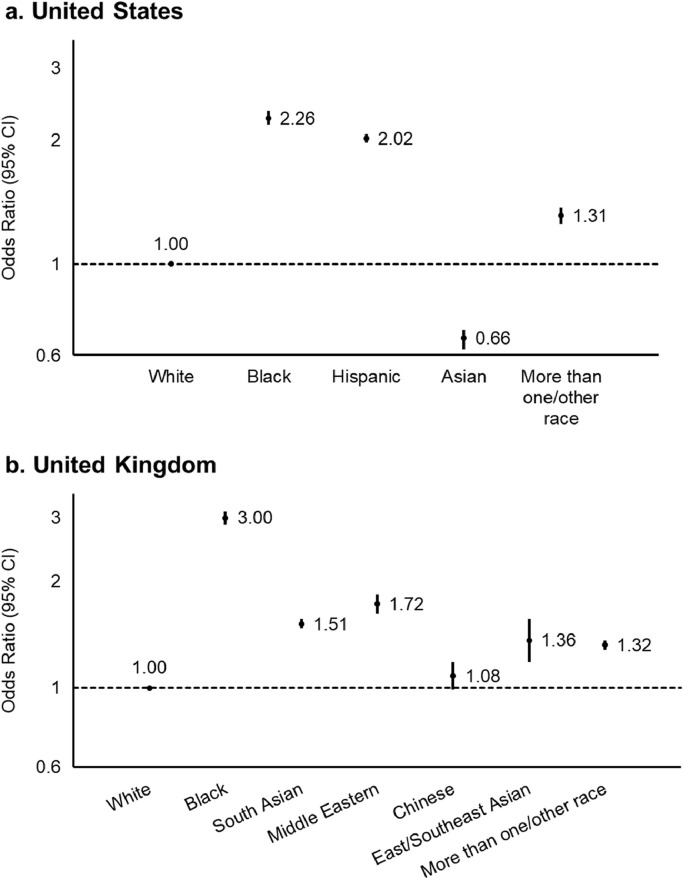
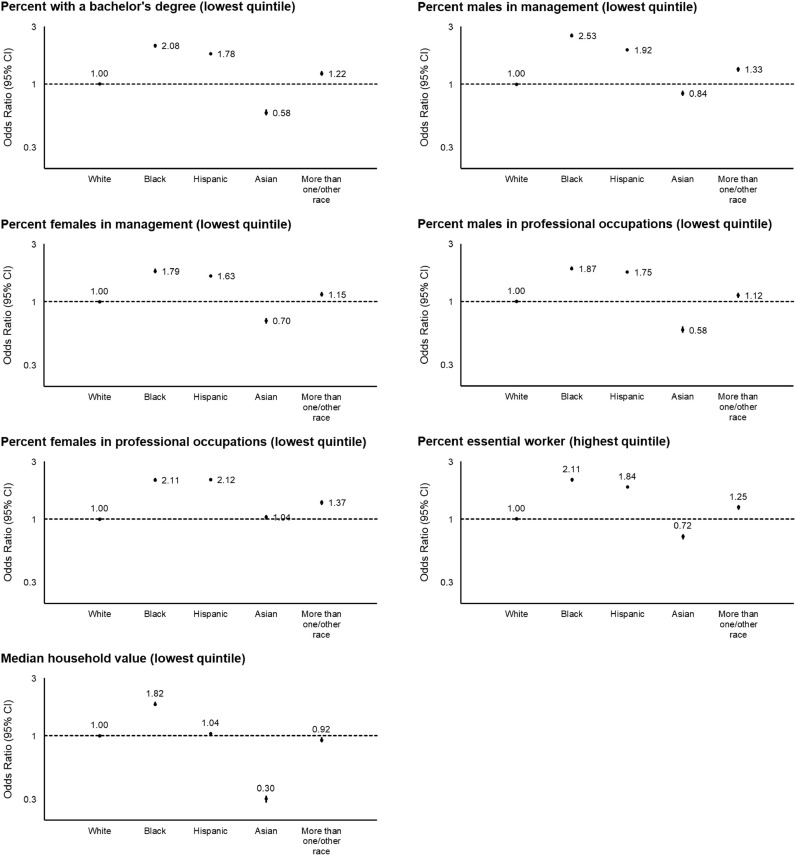
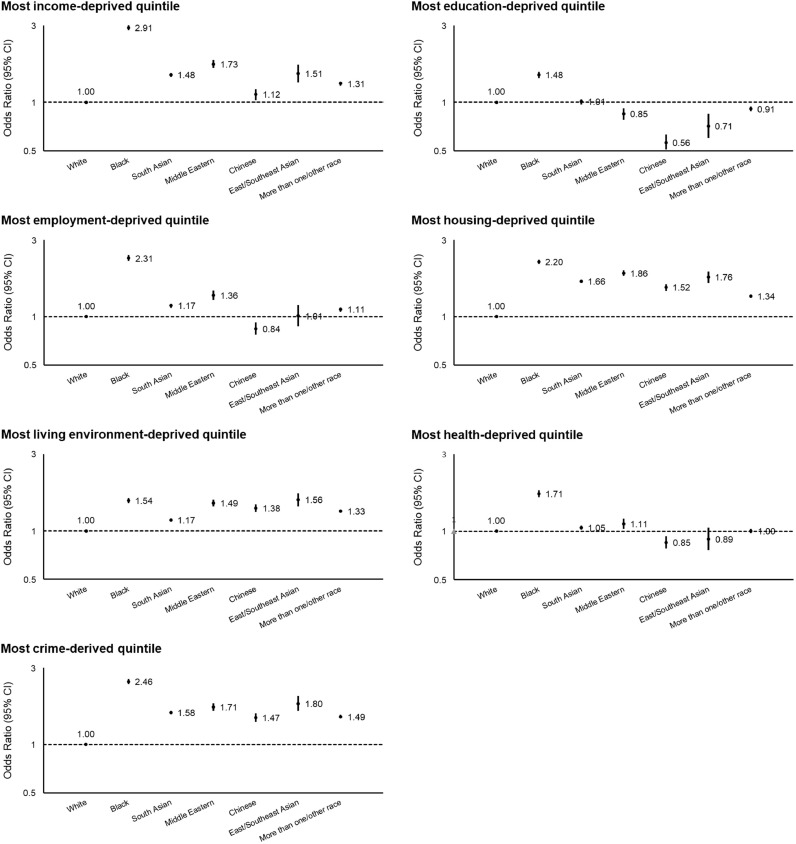
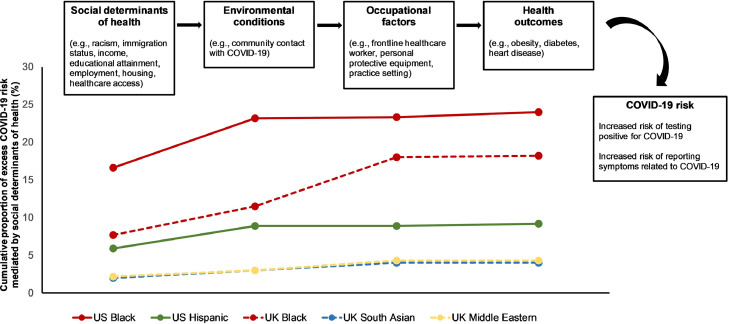
Findings: Compared with non-Hispanic White participants, the risk for a positive COVID-19 test was increased in the US for non-Hispanic Black (multivariable-adjusted odds ratio [OR], 1.32; 95% confidence interval [CI], 1.18-1.47) and Hispanic participants (OR, 1.42; 95% CI, 1.33-1.52) and in the UK for Black (OR, 1.17; 95% CI, 1.02-1.34), South Asian (OR, 1.39; 95% CI, 1.30-1.49), and Middle Eastern participants (OR, 1.38; 95% CI, 1.18-1.61). This elevated risk was associated with living in more deprived communities according to the NDI/IMD. After accounting for downstream mediators of COVID-19 risk, community-level deprivation still mediated 16.6% and 7.7% of the excess risk in Black compared to White participants in the US and the UK, respectively.
Interpretation: Our results illustrate the critical role of social determinants of health in the disproportionate COVID-19 risk experienced by racial and ethnic minorities.
Keywords: COVID-19; Epidemiology; Ethnicity; Inequity; Race; Socioeconomic factor.
© 2021 The Author(s).
Conflict of interest statement
JC reports personal fees from Zoe Ltd. during the conduct of the study and outside the submitted work and is an employee of Zoe Ltd. TDS is a consultant to Zoe Ltd. LLM reports grants from National Cancer Institute during the conduct of the study. SO reports grants from Wellcome Trust, grants from Innovate UK (UKRI), grants from Chronic Disease Research Foundation (CDRF) outside the submitted work. DAD reports grants from National Institutes of Health, grants from American Gastroenterological Association during the conduct of the study and that he previously served as an investigator for a clinical trial of diet and lifestyle using a separate mobile application that was supported by Zoe Ltd. RD reports grants from Department of Health and Social Care (UK), personal fees from Zoe Ltd. during the conduct of the study and outside the submitted work and is an employee of Zoe Ltd. CJS reports grants from Chronic Disease Research Foundation during the conduct of the study. CHS reports grants from Alzheimer's Society during the conduct of the study. CMA reports grants from National Institutes of Health K23 DK120899 and Boston Children's Hospital Office of Faculty Development Career Development Award during the conduct of the study. ATC reports personal fees from Bayer Pharma AG, Pfizer Inc., Boehringer Ingelheim, and grants from Zoe Ltd. outside the submitted work and that he previously served as an investigator for a clinical trial of diet and lifestyle using a separate mobile application that was supported by Zoe Ltd. JW is the CEO of Zoe Ltd. Other authors have no conflict of interest to declare.
Figures
References
-
- U.S. Census Bureau. Multigenerational households: 2009-2011 Internet. 2012 Oct 1. Available from: https://www.census.gov/library/publications/2012/acs/acsbr11-03.html
-
- U.S. Bureau of Labor Statistics. Workers who could work at home, did work at home, and were paid for work at home, by selected characteristics, averages for the period 2017-2018 Internet. 2019 Sep 24. Available from: https://www.bls.gov/news.release/flex2.t01.htm
Associated data
Grants and funding
LinkOut - more resources
Full Text Sources
Medical
