Review
. 2021 Sep;12(9):2267-2288.
doi: 10.1007/s13300-021-01116-9. Epub 2021 Jul 26.

Glucagon-Like Peptide 1 Receptor Agonist Usage in Type 2 Diabetes in Primary Care for the UK and Beyond: A Narrative Review

Affiliations
Review

Glucagon-Like Peptide 1 Receptor Agonist Usage in Type 2 Diabetes in Primary Care for the UK and Beyond: A Narrative Review

Kevin Fernando et al. Diabetes Ther. 2021 Sep.

Abstract

The scientific landscape of treatments for type 2 diabetes (T2D) has changed rapidly in the last decade with newer treatments becoming available. However, a large proportion of people with T2D are not able to achieve glycaemic goals because of clinical inertia. The majority of T2D management is in primary care, where clinicians (medical, nursing and pharmacist staff) play an important role in addressing patient needs and achieving treatment goals. However, management of T2D is challenging because of the heterogeneity of T2D and complexity of comorbidity, time constraints, guidance overload and the evolving treatments. Additionally, the current coronavirus disease pandemic poses additional challenges to the management of chronic diseases such as T2D, including routine access to patients for monitoring and communication. Glucagon-like peptide 1 receptor agonists (GLP-1 RAs) are a class of agents that have evolved rapidly in recent years. These agents act in a glucose-dependent manner to promote insulin secretion and inhibit glucagon secretion, as well as enhancing satiety and reducing hunger. As a result, they are effective treatment options for people with T2D, achieving glycated haemoglobin reductions, weight loss and potential cardiovascular benefit, as monotherapy or as add-on to other glucose-lowering therapies. However, given the complexity of managing T2D, it is important to equip primary care clinicians with clear information regarding efficacy, safety and appropriate positioning of GLP-1 RA therapies in clinical practice. This review provides a summary of clinical and real-world evidence along with practical guidance, with the aim of aiding primary care clinicians in the initiation and monitoring of GLP-1 RAs to help ensure that desired outcomes are realised. Furthermore, a benefit/risk tool has been developed on the basis of current available evidence and guidelines to support primary care clinicians in selecting individuals who are most likely to benefit from GLP-1 RA therapies, in addition to indicating clinical situations where caution is needed.

Keywords: Clinical guidance; Glucagon-like peptide 1 receptor agonist; Glucose-lowering medicines; Prescribing tools; Primary care; Risk/benefit; Therapy choice; Type 2 diabetes.


Figures

Fig. 1
Fig. 1
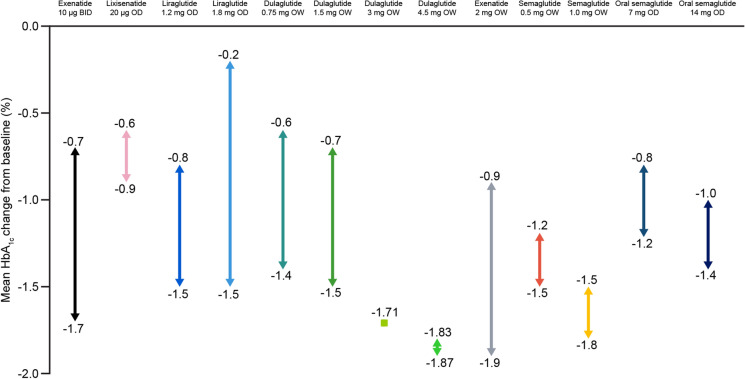
Range of mean changes from baseline in HbA1c in clinical studies reported in the summary of product characteristics for GLP-1 RAs [15, 17, 19, 21, 23, 25, 27, 52]. BID twice daily, GLP-1 RA glucagon-like peptide 1 receptor agonist, HbA1c glycated haemoglobin, OD once daily, OW once weekly
Fig. 2
Fig. 2
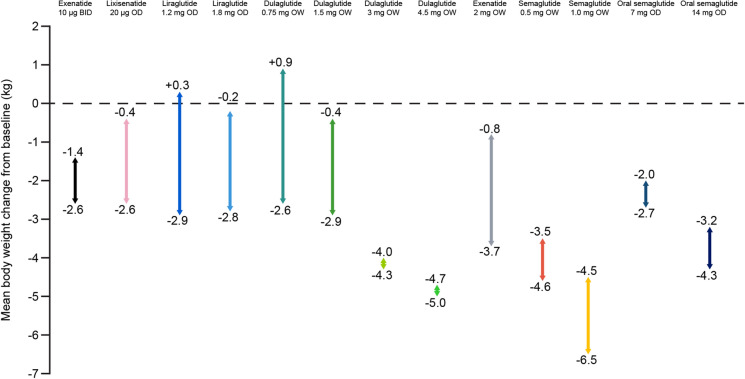
Range of mean changes from baseline in body weight in clinical studies reported in the summary of product characteristics for GLP-1 RAs [15, 17, 19, 21, 23, 25, 27, 52]. BID twice daily, GLP-1 RA glucagon-like peptide 1 receptor agonist, OD once daily, OW once weekly
Fig. 3
Fig. 3
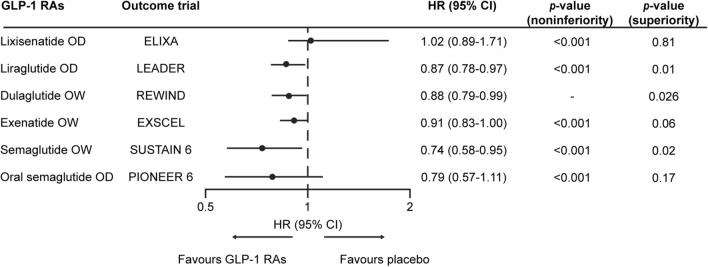
CV outcomes of GLP-1 RAs versus other glucose-lowering agents based on key CV outcome trials [–38, 56]. The non-inferiority and superiority of semaglutide OW compared with placebo were demonstrated in SUSTAIN 6 and pre-specified sensitivity analyses, respectively [37]. CI confidence interval, CV cardiovascular, GLP-1 RA glucagon-like peptide 1 receptor agonist, HR hazard ratio, OD once daily, OW once weekly
Fig. 4
Fig. 4
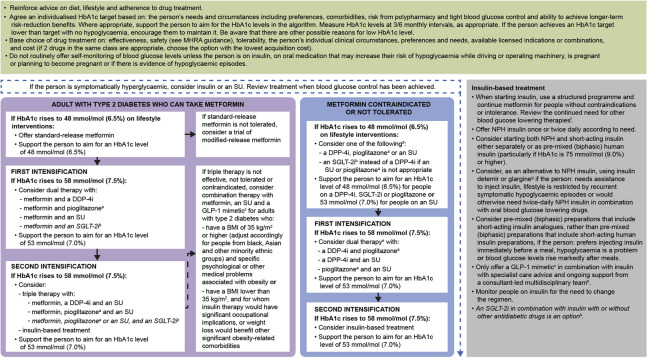
NICE treatment algorithm for blood glucose-lowering therapy in adults with T2D. ©NICE [2015] Type 2 diabetes in adults: management NICE guideline [NG28]. [41]. Available from www.nice.org.uk/guidance/ng28. All rights reserved. Subject to Notice of rights (https://www.nice.org.uk/terms-and-conditions#notice-ofrights) NICE guidance is prepared for the National Health Service in England. All NICE guidance is subject to regular review and may be updated or withdrawn. NICE accepts no responsibility for the use of its content in this product/publication. Recommendations that cover DPP4is, GLP-1 mimetics and SUs refer to these groups of drugs at a class level. aWhen prescribing pioglitazone, exercise particular caution if the person is at high risk of the AEs of the drug. Pioglitazone is associated with increased risk of heart failure, bladder cancer and bone fracture. Known risk factors for these conditions, including increased age, should be carefully evaluated before treatment: see the manufacturers’ summaries of product characteristics for details. MHRA guidance (2011) advises that ‘prescribers should review the safety and efficacy of pioglitazone in individuals after 3–6 months of treatment to ensure that only those deriving benefit continue to be treated’. bSee NICE Technology Appraisal Guidance 288 and 418, 315 and 336 on dapagliflozin, canagliflozin and empagliflozin, respectively. All these SGLT2is are recommended as options in dual therapy regimens with metformin under certain conditions, as options in triple therapy regimens and in combination with insulin. All three are also options as monotherapies in adults in whom metformin is contradicted or not tolerated. Serious and life-threatening cases of DKA have been reported in people taking SGLT2is (canagliflozin, dapagliflozin or empagliflozin) or shortly after stopping the SGLT2i. MHRA guidance (2015) advises testing for raised ketones in people with DKA symptoms, even if plasma glucose levels are near normal. cOnly continue GLP-1 mimetic therapy if the person has a beneficial metabolic response (reduction of HbA1c by at least 1.0% [11 mmol/mol] and weight loss of at least 3% of initial body weight in 6 months). dIf metformin is contradicted or not tolerated, repaglinide is both clinically effective and cost effective in adults with T2D. However, discuss with any person for whom repaglinide is being considered that there is no licensed non-metformin-based combination containing repaglinide that can be offered at first intensification. eDrugs in dual therapy should be introduced in a stepwise manner, checking tolerability and effectiveness of each drug. fMHRA guidance (2011) notes that cases of cardiac failure have been reported when pioglitazone was used in combination with insulin, especially in individuals with risk factors for development of cardiac failure. Patients should be observed for signs and symptoms of heart failure, weight gain and oedema. Pioglitazone should be discontinued if any deterioration in cardiac status occurs. gThe recommendations in this guideline also apply to any current and future biosimilar product(s) of insulin glargine that have an appropriate marketing authorisation that allows use of the biosimilar(s) in the same indication. AE adverse event, BMI body mass index, DKA diabetic ketoacidosis, DPP4i dipeptidyl peptidase 4 inhibitor, GLP-1 glucagon-like peptide 1, HbA1c glycated haemoglobin, MHRA Medicines and Healthcare Products Regulatory Agency, NICE National Institute for Health and Care Excellence, NPH Neutral Protamine Hagedorn, SGLT2i sodium-glucose cotransporter 2 inhibitor, SU sulfonylurea, T2D type 2 diabetes
Fig. 5
Fig. 5
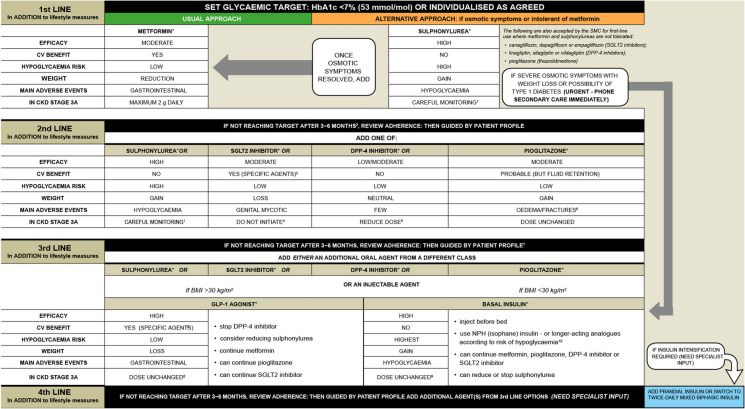
SIGN treatment algorithm for T2D management. ©Scottish Intercollegiate Guidelines Network (SIGN). Pharmacological management of glycaemic control in people with type 2 diabetes. Edinburgh: SIGN; 2017. (SIGN publication no. 154). [Accessed 19 Jan 2021]. Available from http://www.sign.ac.uk [63]. Algorithm summarises evidence from the guideline in the context of the clinical experience of the Guideline Development Group. It does not apply in severe renal or hepatic insufficient. Prescribers should refer to the BNF (www.medicinescomplete.com), Scottish Medicines Consortium (www.scottishmedicines.org.uk) and Medicines and Healthcare products Regulatory Agency warnings for updated guidance on licensed indications, full contradictions and monitoring requirements. *Continue medication at each stage if either individual target achieved or HbA1c falls more than 0.5% (5.5 mmol/mol) in 3–6 months; discontinue if evidence that it is ineffective. 1Consider dose reduction. 2Do not delay if first-line options not tolerated/inappropriate. 3See guideline pages 23 and 26–27. 4See BNF: specific agents can be continued at reduced dose. 5See BNF: no dose reduction required for linagliptin. 6Pioglitazone is contraindicated in people with (or with history of) HF or bladder cancer. 7Do not combine dapagliflozin with pioglitazone. 8Caution with exenatide when eGFR < 50 mL/min/1.73 m2. 9Adjust according to response. 10Driving, occupational hazards, risk of falls, previous history. (CKD stage 3A is defined as eGFR 45–59 mL/min/1.73 m2). BMI body mass index, BNF British National Formulary, CKD chronic kidney disease, CV cardiovascular, DPP4i dipeptidyl peptidase 4 inhibitor, eGFR estimated glomerular filtration rate, GLP-1 glucagon-like peptide 1, HbA1c glycated haemoglobin, HF heart failure, SGLT2i sodium-glucose cotransporter 2 inhibitor, SIGN Scottish Intercollegiate Guidelines Network, T2D type 2 diabetes, SU sulfonylurea
Fig. 6
Fig. 6
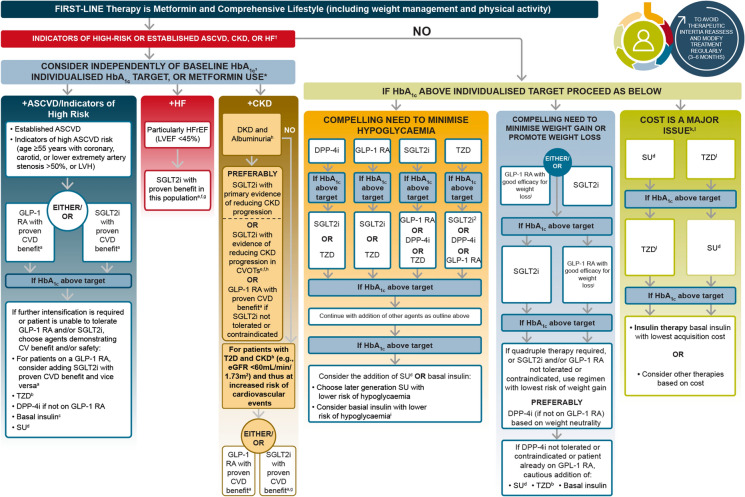
ADA treatment algorithm for T2D management: an overall approach. Adapted from ©ADA. Diabetes Care 2021;44:S111-24 [64] with permission from Springer. aProven CVD benefit means it has a label indication of reducing CVD events. bLow dose may be better tolerated, though less well studied for CVD effects. cDegludec or U100 glargine have demonstrated CVD safety. dChoose later generation SU to lower risk of hypoglycaemia. Glimepiride has shown similar CV safety to DPP4i. eBe aware that SGLT2i labelling varies by region and individual agent with regard to indicated level of eGFR for initiation and continued use. fEmpagliflozin, canagliflozin and dapagliflozin have shown HF reduction and to reduce CKD progression in CVOTs. Canagliflozin and dapagliflozin have primary renal outcome data. Dapagliflozin and empagliflozin have primary HF outcome data. gProven benefit means it has a label indication of reducing HF in this population. hRefer to Sect. 11: microvascular complications and foot care. iDegludec/glargine U300 < glargine U100/detemir < NPH insulin. jSemaglutide > liraglutide > dulaglutide > exenatide > lixisenatide. kIf no specific comorbidities (i.e. no established CVD, low risk of hypoglycaemia and low priority to avoid weight gain or no weight-related comorbidities). lConsider country-and region-specific cost of drugs. In some countries, TZDs are relatively more expensive and DPP4is relatively cheaper. Actioned whenever these become new clinical considerations regardless of background glucose-lowering medications. *Most patients enrolled in the relevant trials were on metformin at baseline as glucose-lowering therapy. ASCVD atherosclerotic cardiovascular disease, CKD chronic kidney disease, DPP4i dipeptidyl peptidase 4 inhibitor, eGFR estimated glomerular filtration rate, GLP-1 RA glucagon-like peptide 1 receptor agonist, HbA1c glycated haemoglobin, HF heart failure, HFrEF heart failure reduced ejection fraction, LVEF left ventricular ejection fraction, LVH left ventricular hypertrophy, SGLT2i sodium-glucose cotransporter 2 inhibitor, SU sulfonylurea, TZD thiazolidinedione, UACR urine albumin-to-creatinine ratio
Fig. 7
Fig. 7
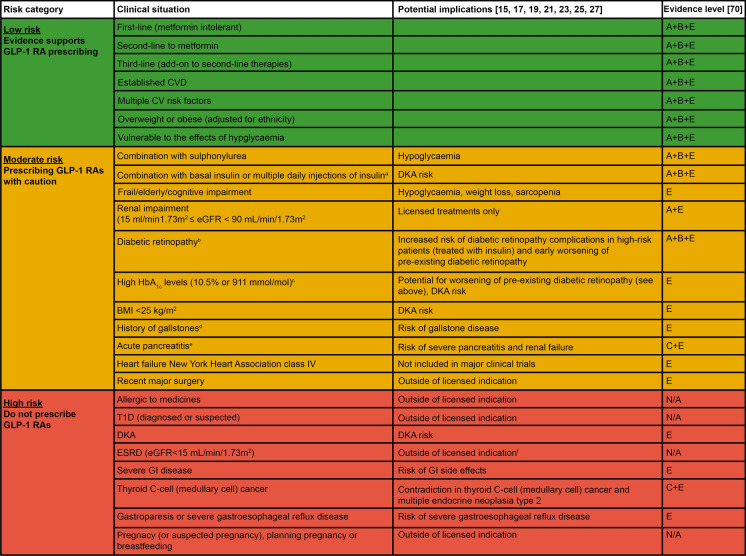
Benefit/risk tool: a reference guide regarding the use of GLP-1 RAs in patients with T2D. aGLP-1 RA therapies should be prescribed with caution in people requiring rapid reduction in insulin dose or discontinuation of insulin, because of increased risk of DKA [76]; bGLP-1 RA therapies should be prescribed with caution in people with diabetic retinopathy, because of increased risk of diabetic retinopathy complications in high-risk people (treated with insulin) and early worsening of pre-existing diabetic retinopathy, evidenced in the SUSTAIN 6 study (semaglutide OW) [37]; cHbA1c levels should be monitored regularly and stop GLP-1 RA if elevated levels continue, following treatment initiation; dGLP-1 RAs should be prescribed with caution in people with gallstones, because of increased risk of gallstone diseases, evidenced in the LEADER study (liraglutide OD) [56]; eGLP-1 RAs should be prescribed with caution in people with acute pancreatitis, because of risk of severe pancreatitis and renal failure [16, 18, 20, 22, 24, 26, 28, 77], and exenatide BID is advised to be discontinued by MHRA if pancreatitis is diagnosed [77]; fTo our knowledge, GLP-1 RAs are not recommended in patients with ESRD in European summary of product characteristics; however, there is no eGFR limitation for the use of GLP-1 RAs in some countries (e.g. for semaglutide in the USA). BID twice daily, BMI body mass index, CV cardiovascular, CVD cardiovascular disease, DKA diabetic ketoacidosis, eGFR estimated glomerular filtration rate, ESRD end-stage renal disease, GI gastrointestinal, GLP-1 RA glucagon-like peptide 1 receptor agonist, HbA1c glycated haemoglobin, MHRA Medicines and Healthcare Products Regulatory Agency, N/A not applicable, OD once daily, OW once weekly, SU sulfonylurea, T1D type 1 diabetes, T2D type 2 diabetes

References

    1. Carls GA-O, Huynh J, Tuttle E, Yee J, Edelman SV. Achievement of glycated hemoglobin goals in the US remains unchanged through 2014. Diabetes Therapy. 2017;8:863–873. doi: 10.1007/s13300-017-0280-5. - DOI - PMC - PubMed
    1. Stone MA, Charpentier G, Doggen K, Kuss O, et al. Quality of care of people with type 2 diabetes in eight European countries: findings from the Guideline Adherence to Enhance Care (GUIDANCE) study. Diabetes Care. 2013;36:2628–2638. doi: 10.2337/dc12-1759. - DOI - PMC - PubMed
    1. Okemah JA-O, Peng J, Quiñones M. Addressing clinical inertia in type 2 diabetes mellitus: a review. Adv Ther. 2018;35:1735–1745. doi: 10.1007/s12325-018-0819-5. - DOI - PMC - PubMed
    1. Rushforth B, McCrorie C, Glidewell L, Midgley E, Foy R. Barriers to effective management of type 2 diabetes in primary care: qualitative systematic review. Br J Gen Pract. 2016;66:e114. doi: 10.3399/bjgp16X683509. - DOI - PMC - PubMed
    1. Chudasama YV, Gillies CL, Zaccardi F, et al. Impact of COVID-19 on routine care for chronic diseases: a global survey of views from healthcare professionals. Diabetes Metab Syndr. 2020;14:965–967. doi: 10.1016/j.dsx.2020.06.042. - DOI - PMC - PubMed