


Assessing online gaming and pornography consumption patterns during COVID-19 isolation using an online survey: Highlighting distinct avenues of problematic internet behavior
- PMID: 34311186
- PMCID: PMC8434429
- DOI: 10.1016/j.addbeh.2021.107044
Assessing online gaming and pornography consumption patterns during COVID-19 isolation using an online survey: Highlighting distinct avenues of problematic internet behavior
Abstract
Background and aim: The Coronavirus (COVID-19) pandemic has required drastic safety precautions to contain virus spread, involving a protracted self-isolation period. Those with greater perceived or actual life stress are vulnerable to develop problematic internet behaviors. Thus, we assessed how COVID-19 social isolation affected online gaming (OG) and pornography viewing (PV) in the general population.
Methods: We developed an online cross-sectional survey, Habit Tracker (HabiT), completed by 1,344 adults (≥18 years). HabiT was released internationally with individuals from 80 countries participating; a majority residing in the United States and United Kingdom. We measured changes in OG (IGDS9-SF) and PV (CYPAT) behaviors before and during the COVID-19 quarantine period. We also assessed psychiatric factors such as anxiety, depression (HADS), and impulsivity (SUPPS-P). The primary outcome measures were change in amount of, and current OG and PV severity during quarantine. These measures were related to ten COVID-19-related stress factors.
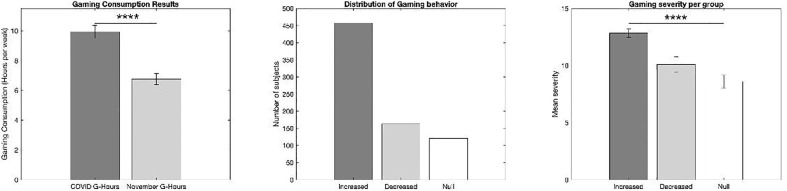
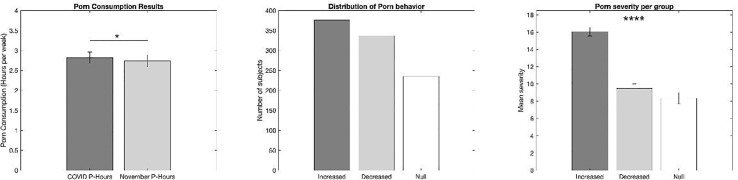
Results: Overall, we observed a large increase in OG and a minor increase in PV. Those who increased OG (63%) and PV (43%) during quarantine were younger individuals, males, those who left the quarantine household infrequently, those who reported low frequency or poor quality social interactions, and those with higher depression, anxiety, and urgency impulsivity.
Discussion: Our findings highlight similarities between forms of problematic internet behaviors driven by stress, depression, anxiety; while highlighting distinct avenues which these behaviors can manifest.
Conclusion: We emphasize the relevance of identifying those in need of emotional regulation interventions, to mitigate problematic internet behaviors in the context of COVID-19 isolation.
Keywords: COVID-19; Internet use; Online gaming; Pornography; Self-isolation; Stress.
Copyright © 2021 The Authors. Published by Elsevier Ltd.. All rights reserved.
Conflict of interest statement
The authors declare that they have no known competing financial interests or personal relationships that could have appeared to influence the work reported in this paper.
Figures
References
-
- American Psychiatric Association . 5th ed. Publisher; Washington, DC: 2013. Diagnostic and statistical manual of mental disorders.
-
- Andreassen C., Billieux J., Griffiths M., Kuss D., Demetrovics Z., Mazzoni E., Pallesen S. The relationship between addictive use of social media and video games and symptoms of psychiatric disorders: A large-scale cross-sectional study. Psychology of Addictive Behaviors. 2016;30:252–262. doi: 10.1037/adb0000160. - DOI - PubMed
-
- Billieux J., King D.L., Higuchi S., Achab S., Bowden-Jones H., Hao W., Long J., Lee H.K., Potenza M.N., Saunders J.B., Poznyak V. Functional impairment matters in the screening and diagnosis of gaming disorder. Journal of Behavioral Addictions. 2017;6(3):285–289. doi: 10.1556/2006.6.2017.036. - DOI - PMC - PubMed
MeSH terms
Grants and funding
LinkOut - more resources
Full Text Sources
Medical
Miscellaneous
