. 2022 Jan 1:366:130589.
doi: 10.1016/j.foodchem.2021.130589. Epub 2021 Jul 14.

Computational modeling predicts potential effects of the herbal infusion "horchata" against COVID-19

Affiliations

Computational modeling predicts potential effects of the herbal infusion "horchata" against COVID-19

Eduardo Tejera et al. Food Chem. .

Abstract

Bioactive plant-derived molecules have emerged as therapeutic alternatives in the fight against the COVID-19 pandemic. In this investigation, principal bioactive compounds of the herbal infusion "horchata" from Ecuador were studied as potential novel inhibitors of the SARS-CoV-2 virus. The chemical composition of horchata was determined through a HPLC-DAD/ESI-MSn and GC-MS analysis while the inhibitory potential of the compounds on SARS-CoV-2 was determined by a computational prediction using various strategies, such as molecular docking and molecular dynamics simulations. Up to 51 different compounds were identified. The computational analysis of predicted targets reveals the compounds' possible anti-inflammatory (no steroidal) and antioxidant effects. Three compounds were identified as candidates for Mpro inhibition: benzoic acid, 2-(ethylthio)-ethyl ester, l-Leucine-N-isobutoxycarbonyl-N-methyl-heptyl and isorhamnetin and for PLpro: isorhamnetin-3-O-(6-Orhamnosyl-galactoside), dihydroxy-methoxyflavanone and dihydroxyphenyl)-5-hydroxy-4-oxochromen-7-yl]oxy-3,4,5-trihydroxyoxane-2-carboxylic acid. Our results suggest the potential of Ecuadorian horchata infusion as a starting scaffold for the development of new inhibitors of the SARS-CoV-2 Mpro and PLpro enzymes.

Keywords: COVID-19; Docking; Gene ontology; Herbal infusion; Horchata infusion; Molecular dynamics; SARS-CoV-2.


Conflict of interest statement

The authors declare that they have no known competing financial interests or personal relationships that could have appeared to influence the work reported in this paper.

Figures
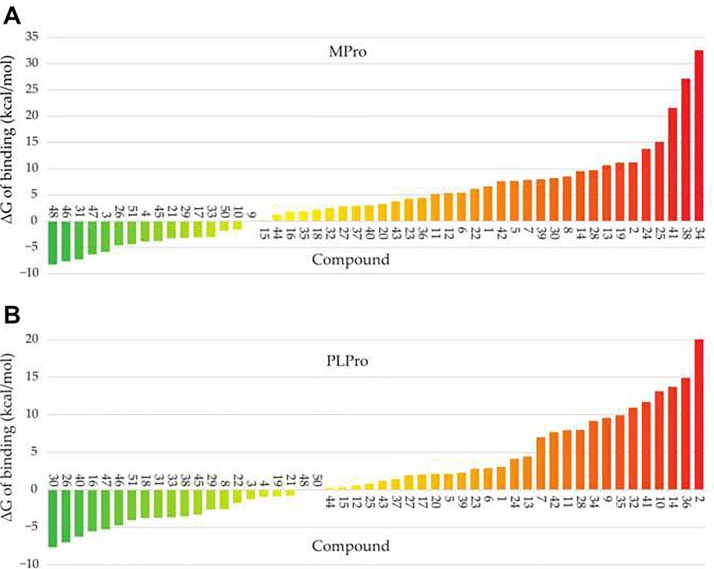
Fig. 1
Fig. 1
Predicted free energies of binding of the 50 compounds to the SARS-CoV-2 Mpro (A) and PLpro (B) enzymes. The color scale goes from green (best) to red (worst) ΔG of binding. (For interpretation of the references to color in this figure legend, the reader is referred to the web version of this article.)
Fig. 2
Fig. 2
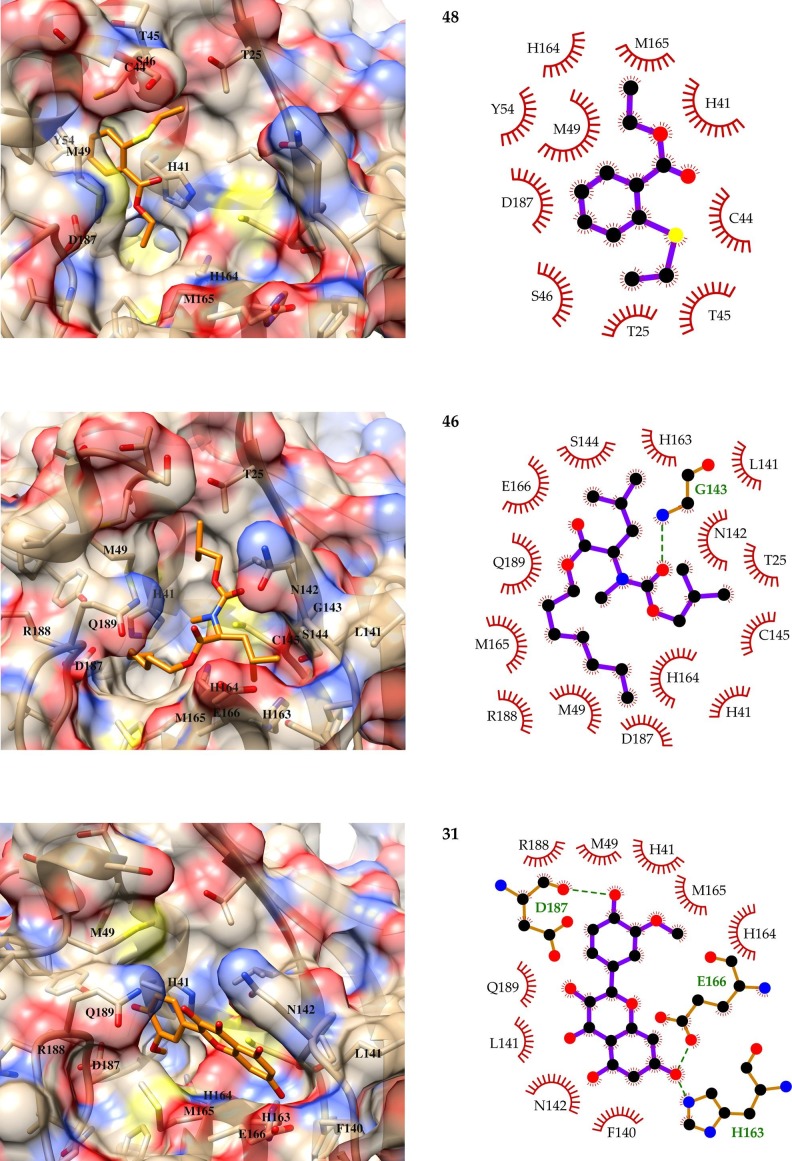
Predicted binding modes of compounds 48, 46 and 31 to the SARS-CoV-2 Mpro enzyme. ln the lefthand figures, oxygen atoms are depicted as red, nitrogen atoms blue, sulfur atoms yellow, and the carbon atoms of the ligands orange. The same coloring scheme was applied to the interaction diagrams (right), while carbon atoms are colored black on them. These diagrams depict all atoms for the receptor residues forming hydrogen bonds with the ligands. Only receptor residues interacting with the ligands in at least 50% of the analyzed MD snapshots are labeled in the lefthand figures and represented in the interaction diagrams. The compounds are: 7-Acetyl-6-ethyl-1,1,4,4-tetramethyltetralin (48), l-Leucine, N-isobutoxycarbonyl-N-methyl-, heptyl ester (46), and Isorhamnetin (31). (For interpretation of the references to color in this figure legend, the reader is referred to the web version of this article.)
Fig. 3
Fig. 3
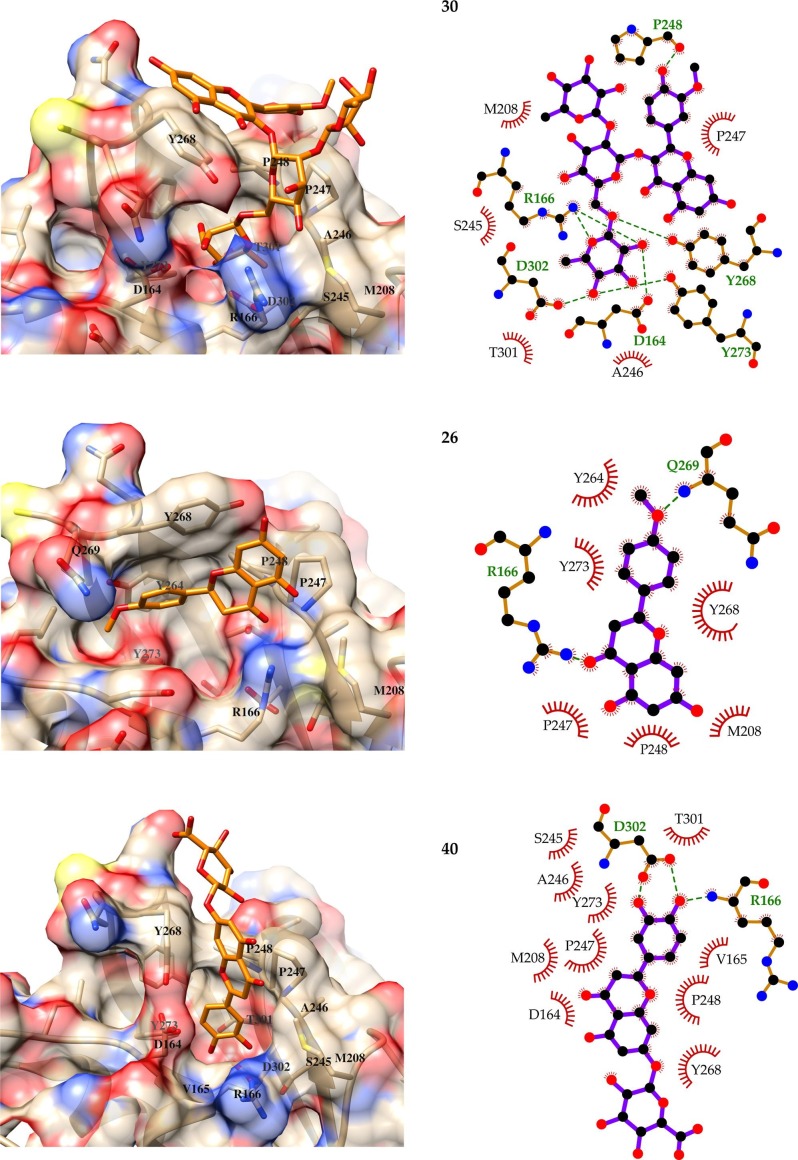
Predicted binding modes of compounds 30, 26 and 40 to the SARS-CoV-2 PLpro enzyme. In the lefthand figures, oxygen atoms are colored red, nitrogen atoms blue, sulfur atoms yellow, and the carbon atoms of the ligands orange. The same coloring scheme was applied to the interaction diagrams (right), while carbon atoms are colored black on them. These diagrams depict all atoms for the receptor residues forming hydrogen bonds with the ligands. Only receptor residues interacting with the ligands in at least 50% of the analyzed MD snapshots are labeled in the lefthand figures and represented in the interaction diagrams. The compounds are: Isorhamnetin-3-O-(6-O-rhamnosyl-galactoside) (30), 5,7-dihydroxy-4′-methoxyflavanone (26), and (2S,3S,4S,5R,6S)-6-[2-(3,4- Dihydroxyphenyl)-5- hydroxy-4-oxochromen-7- yl]oxy-3,4,5- trihydroxyoxane-2- carboxylic acid (40). (For interpretation of the references to color in this figure legend, the reader is referred to the web version of this article.)

References

    1. Araújo M.O., Pérez-Castillo Y., Oliveira L.H.G., Nunes F.C., Sousa D.P.d. Larvicidal activity of cinnamic acid derivatives: Investigating alternative products for Aedes aegypti L. control. Molecules. 2020;26(1):61. doi: 10.3390/molecules26010061. - DOI - PMC - PubMed
    1. Awale M., Reymond J.L. Polypharmacology browser PPB2: target prediction combining nearest neighbors with machine learning. Journal of Chemical Information and Modeling. 2019;59(1):10–17. doi: 10.1021/acs.jcim.8b00524. - DOI - PubMed
    1. Beltrán-García J., Osca-Verdegal R., Pallardó F.V., Ferreres J., Rodríguez M., Mulet S.…García-Giménez J.L. Oxidative stress and inflammation in covid-19-associated sepsis: The potential role of anti-oxidant therapy in avoiding disease progression. Antioxidants. 2020;9(10):936. doi: 10.3390/antiox9100936. - DOI - PMC - PubMed
    1. Carbon, S., Douglass, E., Good, B. M., Unni, D. R., Harris, N. L., Mungall, C. J., … Elser, J. (2021). The gene ontology resource: Enriching a gOld mine. Nucleic Acids Research, 49(D1), D325–D334. doi: 10.1093/nar/gkaa1113. - PMC - PubMed
    1. Case, D. A., Ben-Shalom, I. Y., Brozell, S. R., Cerutti, D. S., Cheatham III, T. E., Cruzeiro, V. W. D., … Gilson, M. K. (2018). Amber 2018; 2018. University of California, San Francisco, p. 1. Retrieved from http://ambermd.org/.

Substances