


Developing the Concept of Working Memory: The Role of Neuropsychology1
- PMID: 34312672
- PMCID: PMC11979773
- DOI: 10.1093/arclin/acab060
Developing the Concept of Working Memory: The Role of Neuropsychology1
Abstract
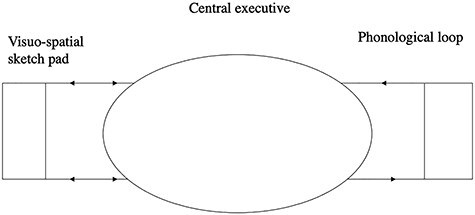
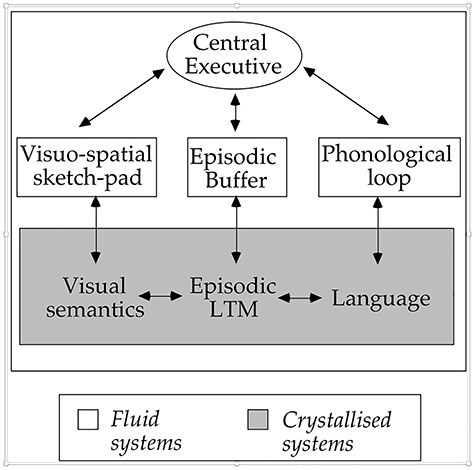
The evolution of the concept of a multicomponent working memory is described with particular reference to the contribution from neuropsychology. Early evidence from patients with the classic amnesic syndrome, together with others showing the opposite deficit of impaired short-term but preserved long-term memory argued strongly for a separation between long- and short-term memory systems. Simulation of the short-term deficit in healthy participants using a dual task approach suggested the need to assume a three component system serving as a multi-purpose working memory comprising an overall attentional control system, the Central Executive, aided by separable temporary buffer stores for phonological and visuospatial information. An account is then given of the way in which evidence from patients was combined with the study of healthy participants to test and expand the model over subsequent years. This led to the need to propose a fourth component, the Episodic Buffer, a system that combines information from multiple sources and makes it accessible to conscious awareness. I conclude with a brief account of how the multicomponent approach resembles and differs from that of other current models of working memory.
Keywords: Amnesia; Central executive; Frontal lobes; Phonological loop; Visuospatial sketchpad; Working memory.
© The Author(s) 2021. Published by Oxford University Press. All rights reserved. For permissions, please e-mail: journals.permissions@oup.com.
Figures


References
-
- Alderman, N. (1996). Central executive deficit and response to operant conditioning methods. Neuropsychological Rehabilitation, 6, 161–186.
-
- Allport, A. (1984). Auditory verbal short-term memory and conduction aphasia. In Bouma, H., & Bouwhuis, D. G. (Eds.), Attention and performance X: Control and language processes (, pp. 351–364). Hillsdale, NJ: Erlbaum.
-
- Allport, A., Styles, E. A., & Hsieh, S. (1994). Shifting attentional set: Exploring the dynamic control of tasks. In Umilta, C., & Moscovitch, M. (Eds.), Attention and performance XV (, pp. 421–462). Cambridge, MA: MIT Press.
-
- Atkinson, R. C., & Shiffrin, R. M. (1968). Human memory: A proposed system and its control processes. In Spence, K. W., & Spence, J. T. (Eds.), The psychology of learning and motivation: advances in research and theory (, Vol. 2, pp. 89–195). New York: Academic Press.
-
- Attneave, F. (1960). In defense of homunculi. In Rosenblith, W. (Ed.), Sensory communication (, pp. 777–782). Cambridge, Mass: Holt, MIT Press.
MeSH terms
LinkOut - more resources
Full Text Sources
Medical
