Static vs dinamic short nail in pertrochanteric fractures: experience of two center in Northern Italy
- PMID: 34313660
- PMCID: PMC8420836
- DOI: 10.23750/abm.v92iS3.11745
Static vs dinamic short nail in pertrochanteric fractures: experience of two center in Northern Italy
Abstract
Background: Lateral fractures of proximal femur are the most frequent to treat for the traumatologist surgeon. Intramedullary nailing is the gold standard treatment of this type of fracture. The aim of the study is to analyze the results obtained with the Elos Intrauma nail by the experience of two Departments of Orthopedics and Traumatology ("Guglielmo da Saliceto" Hospital in Piacenza and the Maggiore hospital in Bologna).
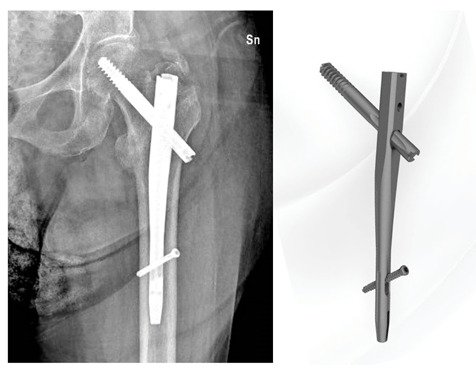
Methods: We performed a retrospective cohort study of 400 patients with lateral femoral neck fracture surgically treated with Elos Intrauma standard nail. The examined period is from 1st Jannuary 2018 to 31st Dicember 2020. In all patients we implanted Elos® - Intrauma nail, a titanium cervical diaphyseal nail, according to the standard technique.
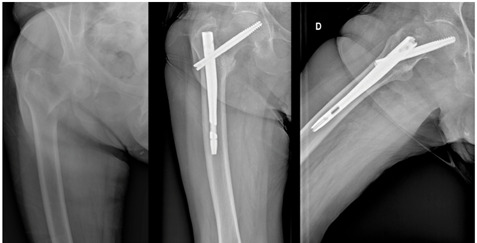
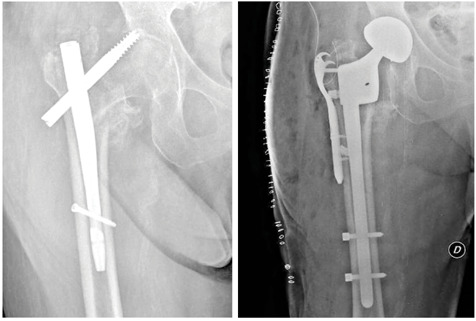
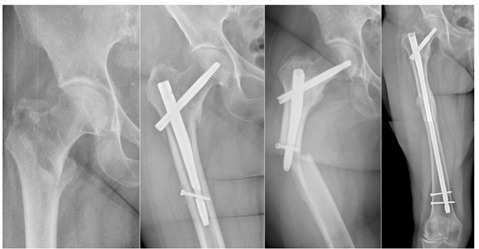
Results: We evaluate at a minumum of three months of follow up 286/400 patients. Average follow up was 3.94 months, minimum 3 months and maximum 24 months. We obtain the 96.85 % of fracture healing, recording 33 complications (11.54%). The incidence of surgical revision was 2.8% (8 cases). No mechanical complications was found in stable fractures treated with short nail and without distal locking.
Conclusions: With the use of Elos nail we obtained 95% of radiographic healings within three months with a complication rate comparable to literature report. Distal locking is absolutely recommended in complex fractures, it may be superfluous after careful evaluation of the fracture pattern and morphological characteristics of the femur to be treated; future in-depth studies may narrow the criteria to choose distal locking or non locking.
Conflict of interest statement
Each author declares that he or she has no commercial associations (e.g. consultancies, stock ownership, equity interest, patent/licensing arrangement etc.) that might pose a conflict of interest in connection with the submitted article.
Figures
References
-
- Maniscalco P, Quattrini F, Ciatti C, Gattoni S, Puma Pagliarello C, Burgio V, Di Stefano G, Cauteruccio M, Giovanelli M, Magro A, Capelli P. The Italian Covid-19 Phase 2 in Piacenza: results of the first semester of 2020 and future prospective of new orthopedics surgical procedures. Acta Biomed. 2020 Nov 10;91(4):e2020159. doi: 10.23750/abm.v91i4.10377. PMID: 33525208; PMCID: PMC7927514. - PMC - PubMed
-
- Hernigou J, Morel X, Callewier A, Bath O, Hernigou P. Staying home during “COVID-19” decreased fractures, but trauma did not quarantine in one hundred and twelve adults and twenty eight children and the “tsu-nami of recommendations” could not lockdown twelve elective operations. Int Orthop. 2020 Aug;44(8):1473–1480. doi: 10.1007/s00264-020-04619-5. Epub 2020 May 25. PMID: 32451655; PMCID: PMC7247744. - PMC - PubMed
-
- Piscitelli P, Iolascon G. Gimignano F. SIOMMS study group, CERSUM research group. Incidence and costs of hip fractures compared to acute myocardial infarction in the Italian population: a 4 year survey. Osteopo-ros Int. 2007 Feb;18(2):211–9. - PubMed
-
- Gullberg B, Duppe H, Nilsson B, Redlund-Johnell I, Sernbo I, Obrant K, Johnell O. Incidence of hip fractures in Malmö, Sweden (1950-1991. ). Bone. 1993;14(Suppl 1):S23–9. doi: 10.1016/8756-3282(93)90345-b. PMID: 8110516. - PubMed
MeSH terms
LinkOut - more resources
Full Text Sources
Medical