Review
. 2021 Oct 20;35(12):974-1015.
doi: 10.1089/ars.2021.0031. Epub 2021 Sep 17.

Aging-Induced Impairment of Vascular Function: Mitochondrial Redox Contributions and Physiological/Clinical Implications

Affiliations
Review

Aging-Induced Impairment of Vascular Function: Mitochondrial Redox Contributions and Physiological/Clinical Implications

Evan Paul Tracy et al. Antioxid Redox Signal. .

Abstract

Significance: The vasculature responds to the respiratory needs of tissue by modulating luminal diameter through smooth muscle constriction or relaxation. Coronary perfusion, diastolic function, and coronary flow reserve are drastically reduced with aging. This loss of blood flow contributes to and exacerbates pathological processes such as angina pectoris, atherosclerosis, and coronary artery and microvascular disease. Recent Advances: Increased attention has recently been given to defining mechanisms behind aging-mediated loss of vascular function and development of therapeutic strategies to restore youthful vascular responsiveness. The ultimate goal aims at providing new avenues for symptom management, reversal of tissue damage, and preventing or delaying of aging-induced vascular damage and dysfunction in the first place. Critical Issues: Our major objective is to describe how aging-associated mitochondrial dysfunction contributes to endothelial and smooth muscle dysfunction via dysregulated reactive oxygen species production, the clinical impact of this phenomenon, and to discuss emerging therapeutic strategies. Pathological changes in regulation of mitochondrial oxidative and nitrosative balance (Section 1) and mitochondrial dynamics of fission/fusion (Section 2) have widespread effects on the mechanisms underlying the ability of the vasculature to relax, leading to hyperconstriction with aging. We will focus on flow-mediated dilation, endothelial hyperpolarizing factors (Sections 3 and 4), and adrenergic receptors (Section 5), as outlined in Figure 1. The clinical implications of these changes on major adverse cardiac events and mortality are described (Section 6). Future Directions: We discuss antioxidative therapeutic strategies currently in development to restore mitochondrial redox homeostasis and subsequently vascular function and evaluate their potential clinical impact (Section 7). Antioxid. Redox Signal. 35, 974-1015.

Keywords: aging; endothelial dysfunction; mitochondrial dysfunction; oxidative stress; reactive oxygen species; vasodilation.


Conflict of interest statement

No competing financial interests exist.

Figures
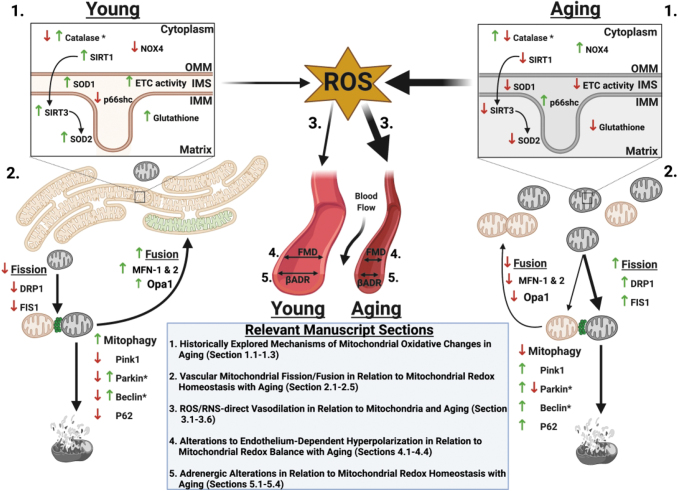
FIG. 1.
FIG. 1.
Aging-related changes in mitochondrial dynamics, pro- and antioxidant enzymes, and effect of subsequent ROS on flow and adrenergic-medicated dilation. 1. During youth, homeostatic redox balance occurs due to adequate antioxidant and limited prooxidant enzyme expression, function, and/or signaling (up or down arrows) that is reversed with aging to increase prooxidant and limit antioxidant enzyme expression, function, and signaling. *Note for catalase, expression is up- or downregulated with aging depending on vascular location (up in aging in aorta and coronary, down with aging in pulmonary arteries). Arrows between Sirt1 to Sirt3 to SOD2 refer to deacetylation that activates SOD2. 2. In youth, redox homeostasis allows for elongated and networked mitochondrial morphology. When mitochondrial damage occurs in youth, fusion and mitophagy are favored over fission with lower expression of fission proteins DRP-1 and FIS-1 in youth relative to aging. Aging mitochondria are characterized morphologically as fragmented and more likely to undergo fission than fusion or mitophagy. *Note that beclin and parkin expression can be increased or decreased with age depending on source. 3–5. Greater ROS generation in aging from dysfunctional mitochondria contributes to attenuation of effectiveness of flow- and β-adrenergic mediated dilation. DRP-1, dynamin-related protein-1; FIS-1, mitochondrial fission protein-1; ROS, reactive oxygen species; SIRT, sirtuin deacetylase; SOD2, manganese superoxide dismutase. Figure created with BioRender.com
FIG. 2.
FIG. 2.
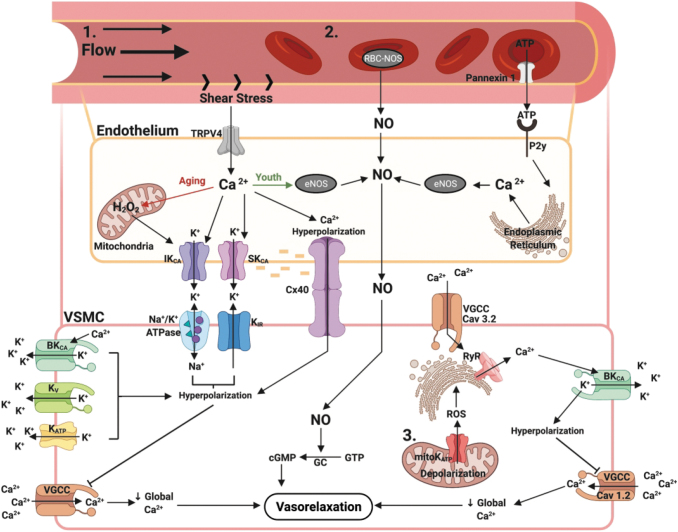
Flow-mediated dilation pathway with mitochondrial contributions and effects of aging and ROS/RNS. 1. Flow-induced shear stress activates mechanosensitive endothelial TRPV4 channels, allowing for calcium entry, which activates basal membrane SKCa and IKCa, causing potassium efflux and hyperpolarization that along with calcium can spread to the VSM cell via connexin 40 gap junctions. Potassium in the intercellular space activates the Na+/K+-ATPase and KIR, causing smooth muscle hyperpolarization. Hyperpolarization is amplified by contributions from BKCa, KV, and KATP. Taken together, the hyperpolarization signal inhibits the VGCC from transporting calcium into the cell, reducing intracellular calcium and inducing vasodilation. In youth, the initial calcium signal activates eNOS to produce nitric oxide, which causes VSM cell relaxation via production of cGMP, activation of potassium channels, and stimulation of cGMP-dependent protein kinases that activate myosin light chain kinase phosphatase. In aging, eNOS is downregulated and dysfunctional and instead shear stress induces production of hydrogen peroxide that activates potassium channels to induce hyperpolarization-mediated vasodilation. 2. RBCs contribute to hypoxic vasodilatory response by production of nitric oxide from RBC-NOS and ATP traversal through pannexin 1 to activate endothelial purinergic (P2y) receptors, increasing intracellular calcium and activation of eNOS to produce nitric oxide. In aging, reduced deformability of RBCs leads to reduced contribution of this pathway toward vasodilation. 3. Mitochondrial depolarization caused by activation of mitochondrial KATP channels induces ROS mediated alterations of ryanodine receptors on the nearby endoplasmic reticulum, which leads to the release of calcium sparks. Calcium sparks activate the BKCa channel, causing hyperpolarization, inhibition of VGCC, reduced intracellular calcium, and vasodilation. Overall, sedentary aging and oxidative stress reduce FMD efficacy. BKCa, calcium-dependent large conductance potassium channels; eNOS, endothelial nitric oxide synthase; FMD, flow-mediated dilation; IKCa, calcium sensitive intermediate conductance potassium channels; KATP, ATP sensitive potassium channels; KIR, inward rectifying potassium channels; Kv, voltage-gated potassium channels; RBC, red blood cell; RBC-NOS, red blood cell nitric oxide synthase; RNS, reactive nitrogen species; SKCa, calcium sensitive small conductance potassium channels; TRPV4, transient receptor potential vanilloid type 4 channel; VGCC, voltage-gated calcium channels; VSM, vascular smooth muscle. Figure created with BioRender.com
FIG. 3.
FIG. 3.
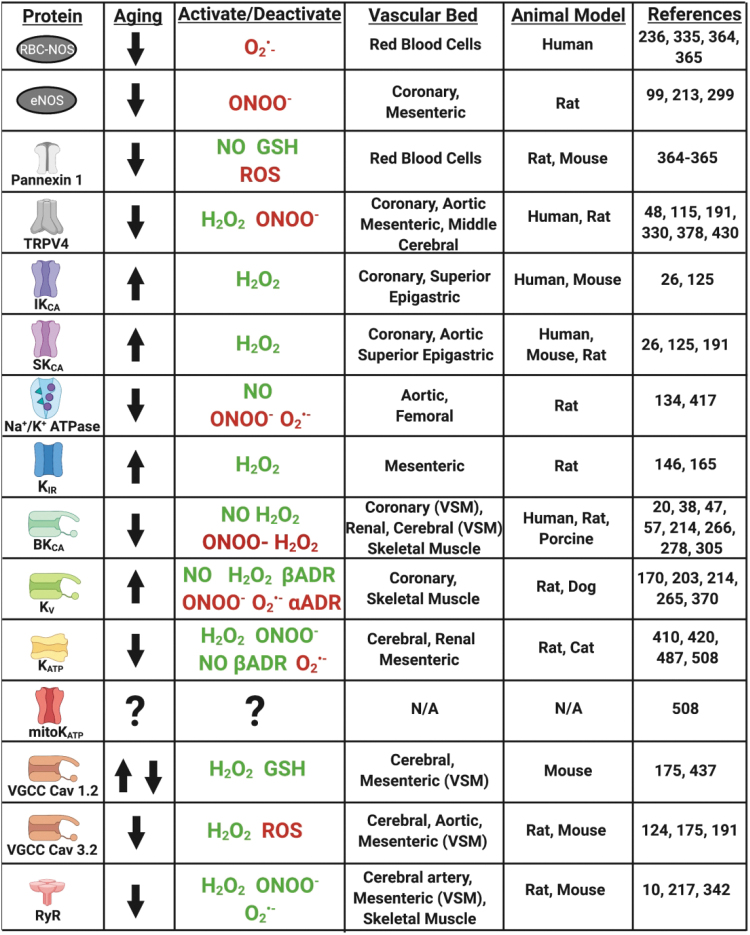
The effects of aging on the various channel expression and/or function in the FMD pathways with activating (green) or inhibitory (red) effects of ROS/RNS/adrenergic signaling. Figure created with BioRender.com
FIG. 4.
FIG. 4.
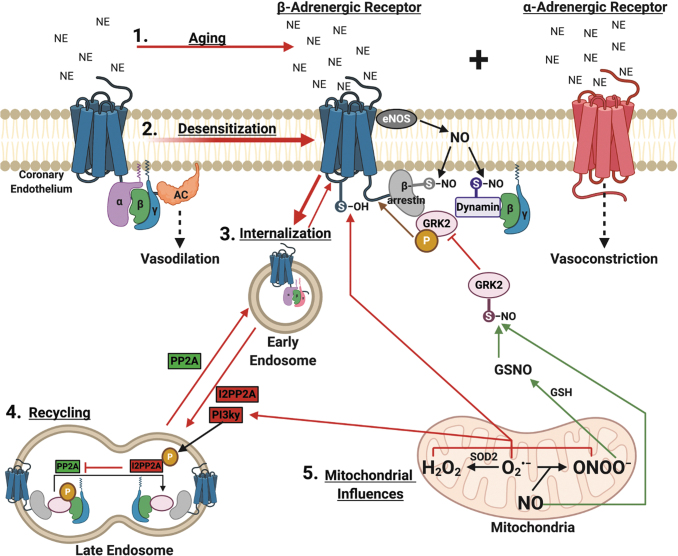
Influence of mitochondrial ROS/RNS on β-adrenergic receptor function with aging. 1. With aging, there is a sympathetic overdrive of systemic catecholamines that saturate the adrenergic receptors. 2. The βADR becomes desensitized due to GRK2 translocation to the βγ subunits and subsequent receptor phosphorylation. 3. Receptor phosphorylation recruits β-arrestin and dynamin to facilitate receptor internalization into clatherin-coated endosomes, the effect of which is enhanced by eNOS-produced NO-mediated nitrosylation of β-arrestin and dynamin. The internalized receptor can be degraded by further trafficking to lysosomes. 4. Alternatively, receptors can be recycled back to the plasma membrane on dephosphorylation mediated by PP2A. However, recycling can be inhibited by I2PP2A, activated by PI3kγ-mediated phosphorylation. 5. Mitochondrial ROS potentially encourages further desensitization and internalization by thiol-oxidation of the βADR itself and by inhibiting recycling by activating PI3kγ signaling. On the other hand, nitric oxide, plentiful in youth, provides nitrosylation of GRK2, sterically inhibiting recruitment of β-arrestin and dynamin, blocking internalization. Peroxynitrite can potentially nitrosylate GRK2 as well, as it can serve as either an oxidizing or nitrosylating agent, or it can combine with glutathione-forming nitrosoglutathione, another nitrosylating agent. These mitochondrial influences on βADR function can be described as an ROS/RNS-βADR Desensitization and Internalization Axis. AC, adenylate cyclase; ADR, adrenergic receptor; GRK2, G-protein receptor kinase 2; GSH, glutathione; GSNO, S-nitrosoglutathione; I2PP2A, endogenous inhibitor of PP2A; NE, norepinephrine; NO, nitric oxide; S-NO, thiol nitrosylation; S-OH, thiol oxidation; PP2A, protein phosphatase 2A. Figure created with BioRender.com
FIG. 5.
FIG. 5.
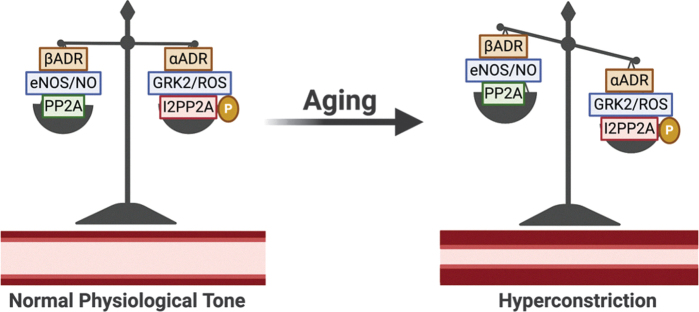
Effect of aging on vascular adrenergic signaling homeostatic balance. These effects culminate in reduced vascular βADR with aging, although αADR functional expression is unchanged, favoring hyperconstriction. Figure created with BioRender.com

References

    1. Accardi G, Aiello A, Gambino CM, Virruso C, Caruso C, and Candore G. Mediterranean nutraceutical foods: strategy to improve vascular ageing. Mech Ageing Dev 159: 63–70, 2016. - PubMed
    1. Ago T, Kitazono T, Ooboshi H, Iyama T, Han YH, Takada J, Wakisaka M, Ibayashi S, Utsumi H, and Iida M. Nox4 as the major catalytic component of an endothelial NAD(P)H oxidase. Circulation 109: 227–233, 2004. - PubMed
    1. Ago T, Kuroda J, Pain J, Fu C, Li H, and Sadoshima J. Upregulation of Nox4 by hypertrophic stimuli promotes apoptosis and mitochondrial dysfunction in cardiac myocytes. Circ Res 106: 1253–1264, 2010. - PMC - PubMed
    1. Ahn S, Maudsley S, Luttrell LM, Lefkowitz RJ, and Daaka Y. Src-mediated tyrosine phosphorylation of dynamin is required for beta2-adrenergic receptor internalization and mitogen-activated protein kinase signaling. J Biol Chem 274: 1185–1188, 1999. - PubMed
    1. Aird AL, Nevitt CD, Christian K, Williams SK, Hoying JB, and LeBlanc AJ. Adipose-derived stromal vascular fraction cells isolated from old animals exhibit reduced capacity to support the formation of microvascular networks. Exp Gerontol 63: 18–26, 2015. - PMC - PubMed

Publication types