


Sports compression garments improve resting markers of venous return and muscle blood flow in male basketball players
- PMID: 34314879
- PMCID: PMC10362518
- DOI: 10.1016/j.jshs.2021.07.010
Sports compression garments improve resting markers of venous return and muscle blood flow in male basketball players
Abstract
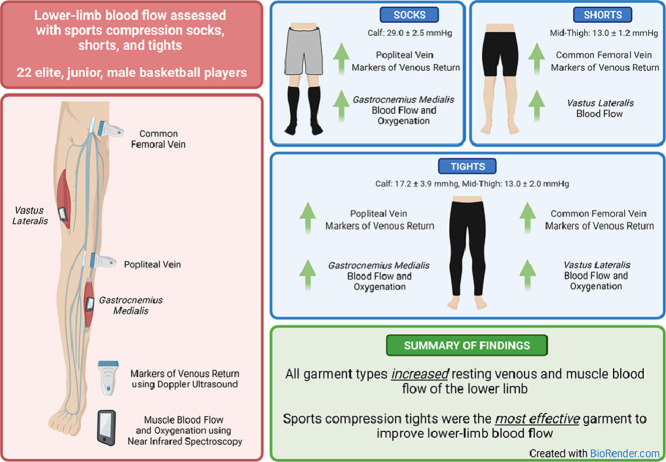
Background: The benefits associated with sports compression garments are thought to be closely related to enhanced blood flow. However, findings are equivocal, possibly due to heterogeneity in the techniques used for measuring blood flow, the garment types used, and the pressures applied. This study combined Doppler ultrasound and near-infrared spectroscopy technologies to provide the first comprehensive assessment of the effects of 3 sports compression garment types on markers of venous return and muscle blood flow at rest.
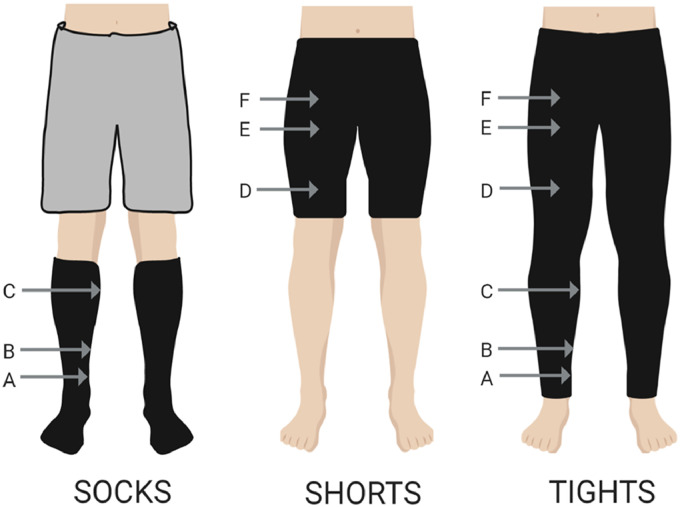
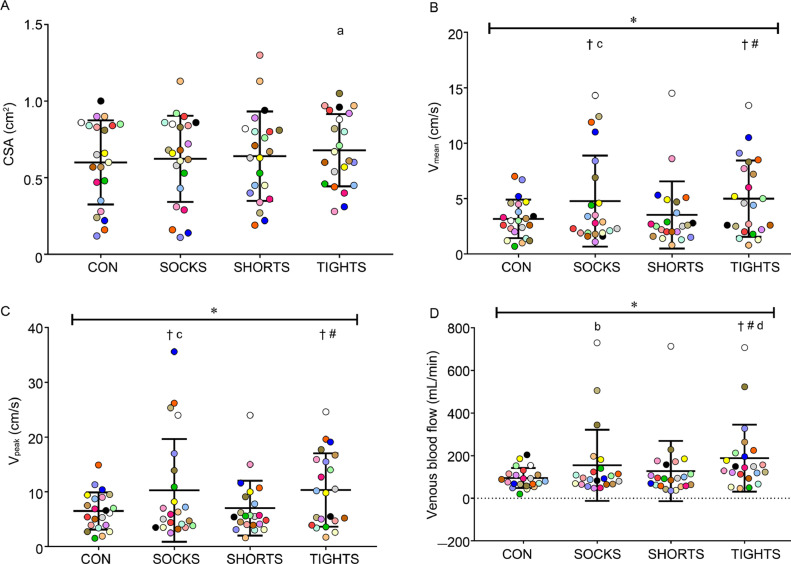
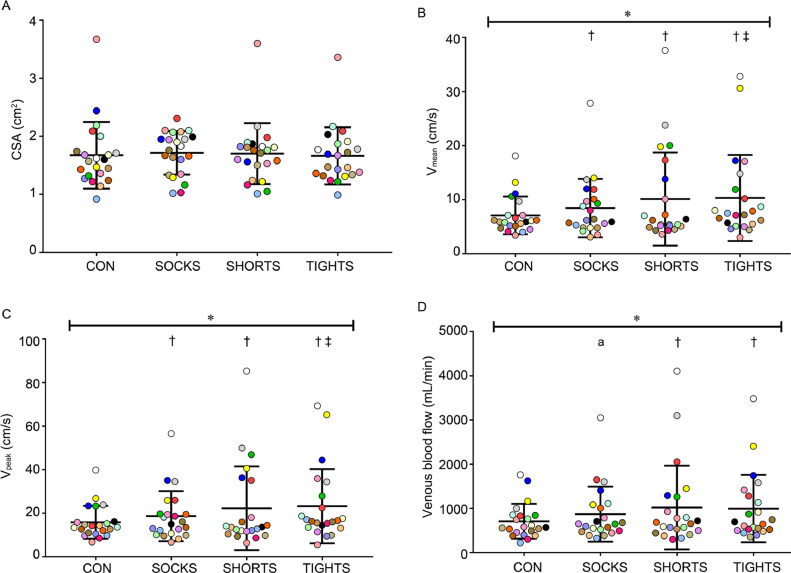
Methods: Resting lower-limb blood flow measures (markers of venous return, muscle blood flow, and muscle oxygenation) of 22 elite, junior, male basketball players (age = 17.2 ± 0.9 years, mean ± SD) were assessed in 4 separate conditions: no compression (CON), compression tights (TIGHTS), compression shorts (SHORTS), and compression socks (SOCKS). Markers of venous return (cross-sectional area, time-averaged mean and peak blood flow velocity, and venous blood flow) were measured via Doppler ultrasound at the popliteal and common femoral veins. Muscle blood flow and muscle oxygenation were measured in the gastrocnemius medialis and vastus lateralis using near-infrared spectroscopy.
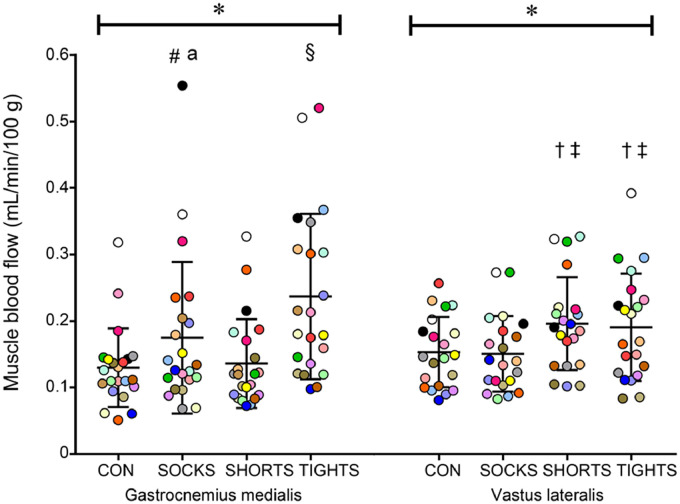
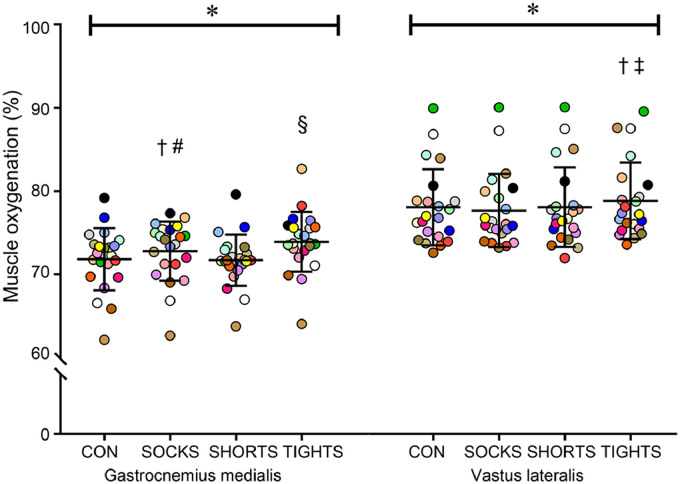
Results: Popliteal markers of venous return were higher in TIGHTS compared to CON (p < 0.01) and SHORTS (p < 0.01), with SOCKS values higher compared with CON (p < 0.05). Common femoral vein markers of venous return were higher for all conditions compared to CON (p < 0.05), with TIGHTS values also higher compared to SOCKS (p < 0.05). Gastrocnemius medialis blood flow was higher for TIGHTS compared to CON (p = 0.000), SOCKS (p = 0.012), and SHORTS (p = 0.000), with SOCKS higher compared to SHORTS (p = 0.046). Vastus lateralis blood flow was higher for TIGHTS compared to CON (p = 0.028) and SOCKS (p = 0.019), with SHORTS also higher compared to CON (p = 0.012) and SOCKS (p = 0.005). Gastrocnemius medialis oxygenation was higher for TIGHTS compared to CON (p = 0.003), SOCKS (p = 0.033), and SHORTS (p = 0.003), with SOCKS higher compared to CON (p = 0.044) and SHORTS (p = 0.032). Vastus lateralis oxygenation was higher for TIGHTS compared to CON (p = 0.020) and SOCKS (p = 0.006).
Conclusion: Markers of venous return, muscle blood flow, and muscle oxygenation are increased with sports compression garments. TIGHTS are most effective, potentially because of the larger body area compressed.
Keywords: Arterial perfusion; Lower-limb compression; Pressure; Venous flow.
Copyright © 2021. Production and hosting by Elsevier B.V.
Conflict of interest statement
Competing interests SFO, JRB, SLH, and DJB received a research grant from compression manufacturer 2XU (Melbourne, Australia), which also supported SFO and JRB. RM was externally sourced to conduct ultrasound measurement and has no conflict of interest. 2XU had no input into the study design, the collection and analysis of data, the writing of the manuscript, or the decision to submit the article for publication. None of the authors has any financial or other interest in the production and/or distribution of 2XU products.
Figures
References
-
- Hill J, Howatson G, van Someren K, Leeder J, Pedlar C. Compression garments and recovery from exercise-induced muscle damage: A meta-analysis. Br J Sports Med. 2014;48:1340–1346. - PubMed
-
- Agu O, Baker D, Seifalian AM. Effect of graduated compression stockings on limb oxygenation and venous function during exercise in patients with venous insufficiency. Vascular. 2004;12:69–76. - PubMed
-
- Lawrence D, Kakkar VV. Graduated, static, external compression of the lower limb: A physiological assessment. Br J Surg. 1980;67:119–121. - PubMed
-
- Mosti G, Partsch H. Improvement of venous pumping function by double progressive compression stockings: Higher pressure over the calf is more important than a graduated pressure profile. Eur J Vasc Endovasc Surg. 2014;47:545–549. - PubMed
-
- Brophy-Williams N, Fell JW, Halson SL, Kitic CM, Driller MW. Pressure gradient differences between medical grade and sports compression socks. J Text Inst. 2021;112:187–191.
MeSH terms
LinkOut - more resources
Full Text Sources
