


Tumor-infiltrating FoxP3+ T cells are associated with poor prognosis in oral squamous cell carcinoma
- PMID: 34319010
- PMCID: PMC8874079
- DOI: 10.1002/cre2.477
Tumor-infiltrating FoxP3+ T cells are associated with poor prognosis in oral squamous cell carcinoma
Abstract
Objectives: Squamous cell carcinoma is the most common malignancy in the oral cavity. Moreover, human papillomavirus (HPV) infection has been recently implicated in the onset of oral squamous cell carcinoma (OSCC). Regulatory T cells (Tregs) are Forkhead box P3 (FoxP3) positive and are normally involved in the mechanism by which organisms escape attacks from their own immune system; however, in tumors, these cells are known to suppress antitumor immunity and block the attack against tumors. The present study evaluated the associations of the number of Tregs and HPV infection with prognoses in patients with OSCC.
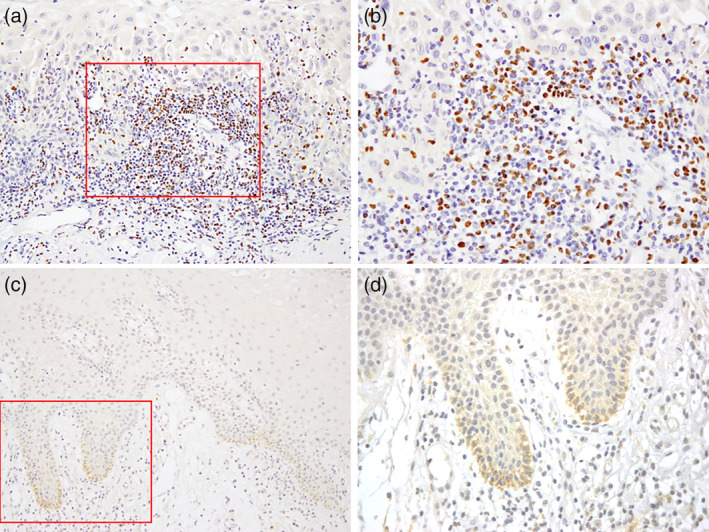
Material and methods: Samples from 106 patients diagnosed with OSCC were evaluated by immunohistochemical staining for the identification of FoxP3+ Tregs and HPV. The relationship between the observed number of Foxp3-positive cells, the presence/absence of HPV infection and associations with clinicopathological indicators were analyzed.
Results: Tissues were classified into high (High) and low (Low) Treg count groups, with 69 patients classified as High and 37 classified as Low. The prognoses were significantly better in the Low group compared with the High group (p = 0.04). FoxP3 expression may have had some effect on nodal metastases (p = 0.09). HPV antigens were detected in 65 patients, but there were no significant associations with prognosis (p = 0.34). HPV-infected tumors were more common in the gums and tongues than in the lips, cheeks, and floor of the mouth (p = 0.05).
Conclusions: These results indicate that Tregs in tumor sites are associated with worsened prognoses of patients with OSCC and suggest potential therapies targeting Tregs in OSCC.
Keywords: Forkhead box P3; human papillomavirus; oral squamous cell carcinoma; regulatory T cells.
© 2021 The Authors. Clinical and Experimental Dental Research published by John Wiley & Sons Ltd.
Conflict of interest statement
All authors declare that there is no conflict of interest.
Figures

References
-
- Andersen, A. S. , Koldjær Sølling, A. S. , Ovesen, T. , & Rusan, M. (2014). The interplay between HPV and host immunity in head and neck squamous cell carcinoma. International Journal of Cancer, 134, 2755–2763. - PubMed
-
- Badoual, C. , Hans, S. , Rodriguez, J. , Peyrard, S., Klein, C., Agueznay, N. E. H. , Mosseri, V. , Laccourreye, O. , Bruneval, P. , Fridman, W. H. , Brasnu, D. F. , & Tartour, E. (2006). Prognostic value of tumor‐infiltrating CD4+ T‐cell subpopulations in head and neck cancers. Clinical Cancer Research, 12, 465–472. - PubMed
-
- Binnewies, M. , Roberts, E. W. , Kersten, K. , Chan, V. , Fearon, D. F. , Merad, M. , Coussens, L. M. , Gabrilovich, D. I. , Ostrand‐Rosenberg, S. , Hedrick, C. C. , Vonderheide, R. H. , Pittet, M. J. , Jain, R. K. , Zou, W. , Howcroft, T. K. , Woodhouse, E. C. , Weinberg, R. A. , & Krummel, M. F. (2018). Understanding the tumor immune microenvironment (TIME) for effective therapy. Nature Medicine, 24, 541–550. - PMC - PubMed
-
- Elango, K. J. , Suresh, A. , Erode, E. M. , Subhadradevi, L. , Ravindran, H. K. , Iyer, S. K. , Iyer, S. K. R. , & Kuriakose, M. A. (2011). Role of human papilloma virus in oral tongue squamous cell carcinoma. Asian Pacific Journal of Cancer Prevention, 12, 889–896. - PubMed
-
- Fontenot, J. D. , Gavin, M. A. , & Rudensky, A. Y. (2017). Foxp3 programs the development and function of CD4+CD25+ regulatory T cells. Journal of Immunology, 198, 986–992. - PubMed
Publication types
MeSH terms
Substances
Grants and funding
LinkOut - more resources
Full Text Sources
Medical
