. 2021 Sep 3;9(1):e0043921.
doi: 10.1128/Spectrum.00439-21. Epub 2021 Jul 28.

A Novel Small Molecule Inhibits Hepatitis C Virus Propagation in Cell Culture

Affiliations

A Novel Small Molecule Inhibits Hepatitis C Virus Propagation in Cell Culture

Ahmed K Oraby et al. Microbiol Spectr. .

Abstract

Hepatitis C virus (HCV) can cause acute and chronic infection that is associated with considerable liver-related morbidity and mortality. In recent years, there has been a shift in the treatment paradigm with the discovery and approval of agents that target specific proteins vital for viral replication. We employed a cell culture-adapted strain of HCV and human hepatoma-derived cells lines to test the effects of our novel small-molecule compound (AO13) on HCV. Virus inhibition was tested by analyzing RNA replication, protein expression, and virus production in virus-infected cells treated with AO13. Treatment with AO13 inhibited virus spread in cell culture and showed a 100-fold reduction in the levels of infectious virus production. AO13 significantly reduced the level of viral RNA contained within cell culture fluids and reduced the cellular levels of HCV core protein, suggesting that the compound might act on a late step in the viral life cycle. Finally, we observed that AO13 did not affect the release of infectious virus from infected cells. Docking studies and molecular dynamics analyses suggested that AO13 might target the NS5B RNA polymerase, however, real-time RT-PCR analyses of cellular levels of HCV RNA showed only an ∼2-fold reduction in viral RNA levels in the presence of AO13. Taken together, this study revealed that AO13 showed consistent, but low-level antiviral effect against HCV, although the mechanism of action remains unclear. IMPORTANCE The discovery of curative antiviral drugs for a chronic disease such as HCV infection has encouraged drug discovery in the context of other viruses for which no curative drugs currently exist. Since we currently face a novel virus that has caused a pandemic, the need for new antiviral agents is more apparent than ever. We describe here a novel compound that shows a modest antiviral effect against HCV that could serve as a lead compound for future drug development against other important viruses such as SARS-CoV-2.

Keywords: HCVcc; JFH-1; antiviral agent; antiviral agents; hepatitis C virus; virus; virus inhibition.


Figures

FIG 1
FIG 1
Activity of compound AO13 on HCV JFH1T in cell culture. (A) Chemical structure of AO13. (B) Huh-7.5 cells were infected with JFH1T at an MOI of 0.1, and compound AO13 was added at concentrations of 0.1, 1, and 10 μM. At 2 days postinfection, supernatants were collected, and Huh 7.5 cells plated in 8-well chamber slides were infected with the supernatants, and the slides were fixed and stained for HCV core for visualization. The results shown are representative of two independent experiments. (C) Effect of AO13 on extracellular virus production measured by viral titers. Infectious virus titer was measured in the presence of 10 μM AO13, 100 pM daclatasvir (DCV), and a combination of both compounds. Viral titer was measured by limiting dilution focus-forming assay performed in triplicate and is expressed as FFU/ml. The results shown are representative of two independent experiments.
FIG 2
FIG 2
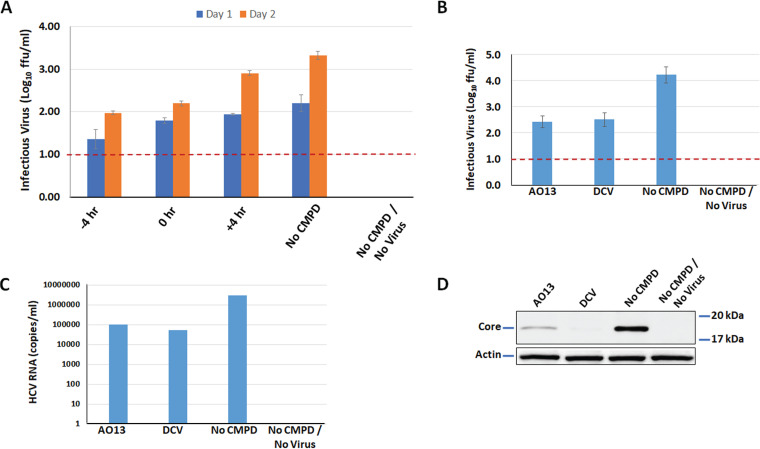
Time of addition and effects of AO13 on RNA and viral core protein expression. (A) AO13 was added at three different time points either 4 h before inoculation, at inoculation, or 4 h after virus inoculation. Extracellular culture fluids were collected on days 1 and 2 postinfection and inoculated in 8-well immunofluorescence chamber slides for infectious virus titer determination in triplicate. (B) Effect of AO13 on extracellular virus production confirmed by repeating viral titers, performed in triplicate. (C) Extracellular viral RNA levels in the presence of AO13 and DCV. (D) Effect of AO13 on intracellular HCV core expression. Concentrations of 10 μM AO13 or 100 pM DCV were used for all experiments. The results shown are representative of two independent experiments.
FIG 3
FIG 3
The effect of AO13 and DCV on virus release in cell culture was analyzed by comparing viral titers in extracellular (blue bars) versus intracellular (orange bars) in S29 cells. Concentrations of 10 μM AO13 or 100 pM DCV were used for all experiments. Virus titrations were performed in triplicate and results shown are representative of two independent experiments. CMPD, compound.
FIG 4
FIG 4
Molecular docking of AO13 to HCV viral proteins. (A) Interactions of AO13 with NS3/4A protease and NS5A (molecular docking). (A) AO13 was docked into NS3/4A (PDB 1CU1). The N of NH (diazo-phenyl) interacted with Met 1620 and O-2 of the thioxodihydropyrimidine interacted with Ser 1624 and Arg 1161 away from the active site. (B) Docking of AO13 into NS5A (PDB 3FQQ), and three hydrogen bonds are shown from that interaction. N-1 of thioxodihydropyrimidine formed a hydrogen bond with Gly 42, and O-1 formed a hydrogen bond with the amide backbone of Lys 44. Another hydrogen bond was shown by the interaction of the N of NH (diazo-phenyl) with the carbonyl group of Lys 44. (C) Interactions of AO13 at the active site of HCV NS5B polymerase. AO13 was docked into NS5B polymerase of JFH1T (PDB 4AEP). N-1 of the thioxodihydropyrimidine interacted with Cys 366 and O-2 interacted with Tyr 448. Phe 193 is not shown for figure clarity. (D) Ligand interactions represented in a two-dimensional diagram.
FIG 5
FIG 5
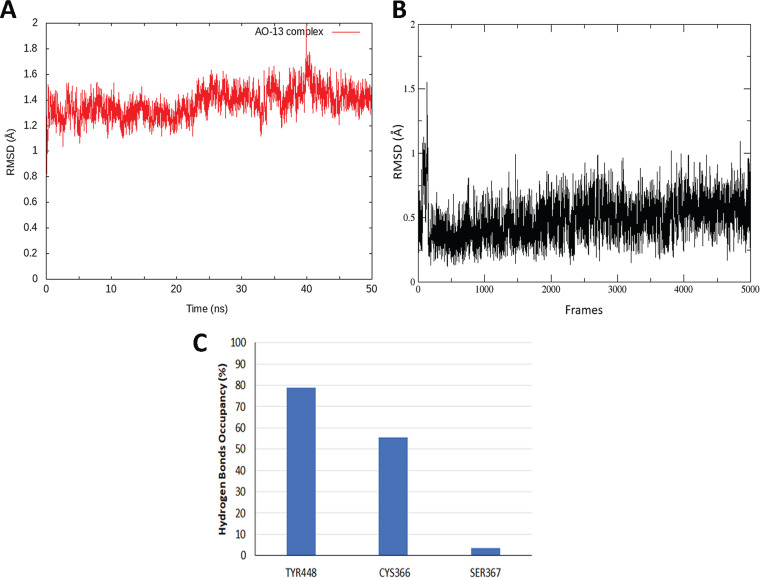
Molecular dynamics analysis of AO-13 in complex with NS5B. (A) RMSD trend of the complex backbone for AO13-NS5B complex showing stability of compound AO13 during the simulation time with an RMSD value of 1.9 Å. (B) RMSD of the ligand (AO-13) extracted from the MD trajectory showing a stable and little deviation of AO-13 during the 50-ns simulation with an RMSD of 0.48 Å. (C) Occupancy of the hydrogen bonds in the 50-ns simulation of compound AO13 in complex with HCV NS5B. Compound AO13 formed 78% occupancy with Tyr 448 and 55% occupancy with Cys 366 during the 50-ns production simulation. A hydrogen bond is assumed to exist if the donor-acceptor distance is smaller than 3.5 Å.
FIG 6
FIG 6
Effect of AO13 on intracellular HCV RNA levels. Huh-7.5 cells were infected at an MOI of 0.1 with JFH1T. Cells were treated with no compound, DMSO at a 1:1,000 dilution in complete medium, or 10 μM AO13 in complete medium. RT-qPCR was performed on cellular RNA extracts from cells harvested at day 2 (blue bars) and day 3 (orange bars) postinfection (p.i.). Cellular HCV RNA levels were quantified in triplicate relative to GAPDH RNA levels. The fold change in HCV RNA levels was calculated relative to day 3 uninfected cells. The results shown are representative of three independent experiments. Error bars represent ± the standard error. Statistical analysis was performed using analysis of variance within Microsoft Excel (****, P ≤ 0.0001).

References

    1. Thomas DL. 2013. Global control of hepatitis C: where challenge meets opportunity. Nat Med 19:850–858. doi:10.1038/nm.3184. - DOI - PMC - PubMed
    1. Bhamidimarri KR, Satapathy SK, Martin P. 2017. Hepatitis C virus and liver transplantation. Gastroenterol Hepatol 13:214–220. - PMC - PubMed
    1. Lindenbach BD, Evans MJ, Syder AJ, Wölk B, Tellinghuisen TL, Liu CC, Maruyama T, Hynes RO, Burton DR, McKeating JA, Rice CM. 2005. Complete replication of hepatitis C virus in cell culture. Science 309:623–626. doi:10.1126/science.1114016. - DOI - PubMed
    1. Scheel TKH, Rice CM. 2013. Understanding the hepatitis C virus life cycle paves the way for highly effective therapies. Nat Med 19:837–849. doi:10.1038/nm.3248. - DOI - PMC - PubMed
    1. Bartenschlager R, Cosset F-L, Lohmann V. 2010. Hepatitis C virus replication cycle. J Hepatol 53:583–585. doi:10.1016/j.jhep.2010.04.015. - DOI - PubMed

Publication types

MeSH terms

LinkOut - more resources