Review
. 2021 Oct 1;162(10):bqab152.
doi: 10.1210/endocr/bqab152.

The Src-family Kinase Lyn in Immunoreceptor Signaling

Affiliations
Review

The Src-family Kinase Lyn in Immunoreceptor Signaling

Ben F Brian 4th et al. Endocrinology. .

Abstract

Effective regulation of immune-cell activation is critical for ensuring that the immune response, and inflammation generated for the purpose of pathogen elimination, are limited in space and time to minimize tissue damage. Autoimmune disease can occur when immunoreceptor signaling is dysregulated, leading to unrestrained inflammation and organ damage. Conversely, tumors can coopt the tissue healing and immunosuppressive functions of hematopoietic cells to promote metastasis and evade therapy. The Src-family kinase Lyn is an essential regulator of immunoreceptor signaling, initiating both proinflammatory and suppressive signaling pathways in myeloid immune cells (eg, neutrophils, dendritic cells, monocytes, macrophages) and in B lymphocytes. Defects in Lyn signaling are implicated in autoimmune disease, but mechanisms by which Lyn, expressed along with a battery of other Src-family kinases, may uniquely direct both positive and negative signaling remain incompletely defined. This review describes our current understanding of the activating and inhibitory contributions of Lyn to immunoreceptor signaling and how these processes contribute to myeloid and B-cell function. We also highlight recent work suggesting that the 2 proteins generated by alternative splicing of lyn, LynA and LynB, differentially regulate both immune and cancer-cell signaling. These principles may also extend to other Lyn-expressing cells, such as neuronal and endocrine cells. Unraveling the common and cell-specific aspects of Lyn function could lead to new approaches to therapeutically target dysregulated pathways in pathologies ranging from autoimmune and neurogenerative disease to cancer.

Keywords: Lyn; SFK; Src-family kinase; autoimmunity; lupus; myeloid; signaling.


Figures

Figure 1.
Figure 1.
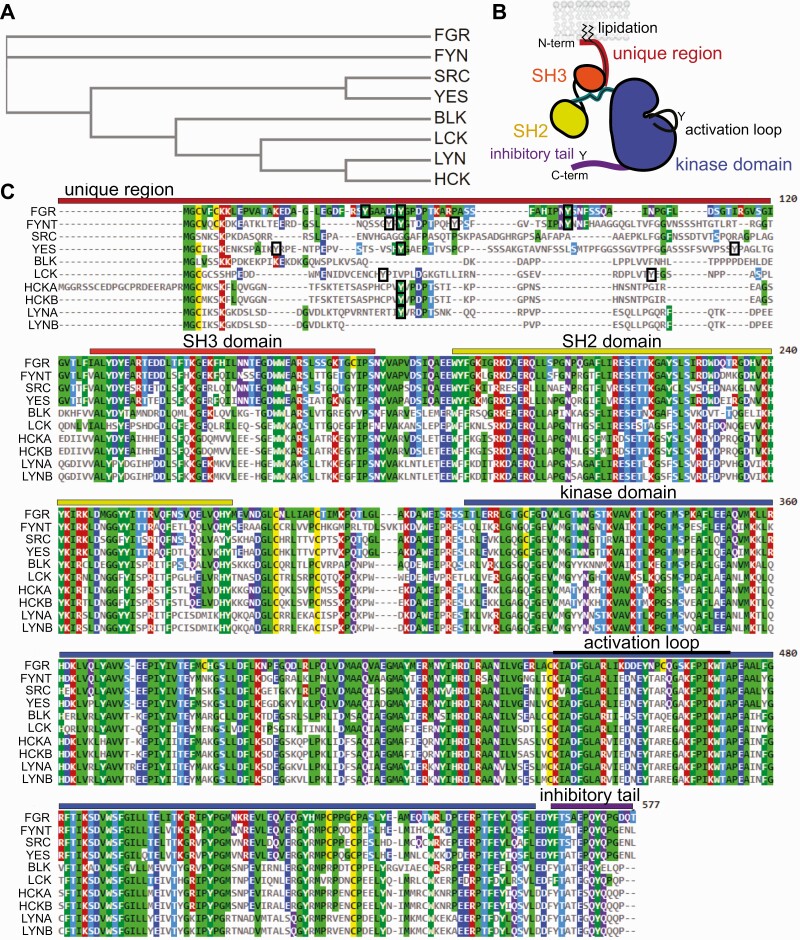
Domains and sequences of the SRC family. (A) Phylogeny of human SFKs, showing divergence of FGR and FYN. Widely expressed SRC and YES are more closely related to each other, as are LYN and HCK. The lymphocyte-specific kinases LCK and BLK occupy separate branch points. Generated with EMBL-EBI Clustal Omega and Simple Phylogeny (29). (B) All SFKs have an N-terminal (N-term) unique region, with lipidation and protein-protein interaction sites, followed by SH3 and SH2 regulatory domains and a kinase domain. Their activities are controlled via a dynamic equilibrium of phosphorylation and dephosphorylation of tyrosine (Y) residues in their kinase-domain activation loop and C-terminal (C-term) inhibitory tail. (C) Amino-acid sequence alignment of representative human SFKs, showing approximate domain boundaries. Lack of conserved (colored) residues highlights unique-region divergence, including the translation start-site variants of HCK (isoforms A and B) and the alternatively spliced variants of LYN (isoforms A and B). The immune-cell form of FYN (isoform T) is also shown. Tyrosine-residue diversity in the unique region is highlighted (boxes). Generated with EMBL-EBI Clustal Omega and MView (29).
Figure 2.
Figure 2.
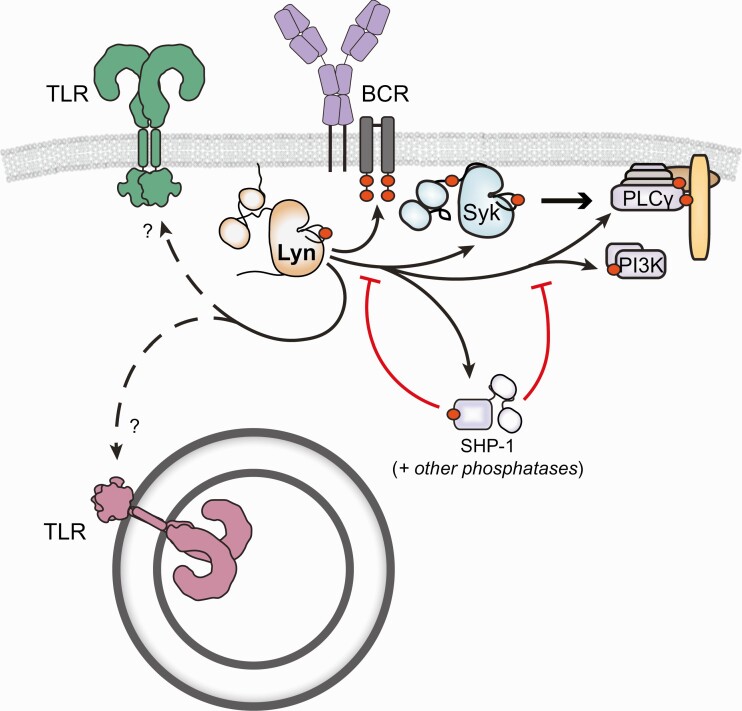
Lyn signaling in immune cells. Lyn positively regulates immunoreceptor signaling by phosphorylating and activating ITAM-coupled receptors (eg, the B-cell antigen receptor). Lyn negatively regulates immunoreceptor signaling by phosphorylating ITIMs and suppressive phosphatases (eg, Shp-1). Lyn can also modulate TLR signaling by processes less clearly defined.
Figure 3.
Figure 3.
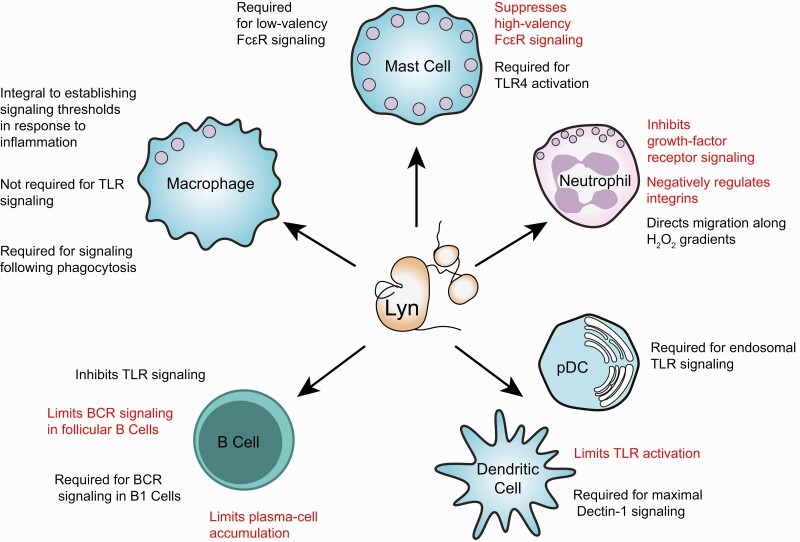
Diverse roles of Lyn in immune cells. Lyn can have positive (black) or negative (red) signaling capabilities, depending on the cell type and context of receptor activation.
Figure 4.
Figure 4.
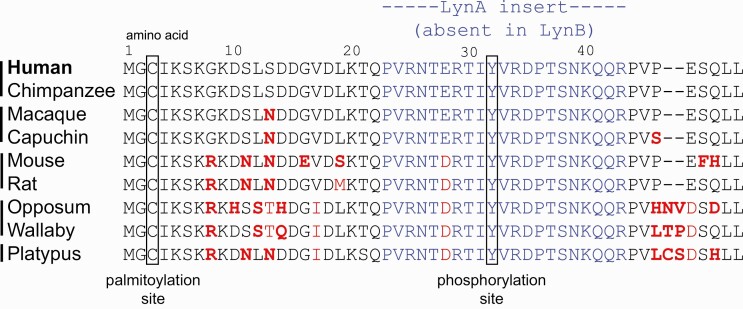
Conservation of the LynA unique region. Sequence alignment of LynA N-termini from ape (human, chimpanzee), monkey (rhesus macaque, capuchin), rodent (mouse, rat), marsupial (opossum, wallaby), and monotreme (platypus). Sequence differences (with reference to human) are in red, with the least conservative substitutions in bold. The LynA insert is shown in blue. Palmitoylation (C3) and tyrosine phosphorylation (Y32) sites are boxed. Sequences obtained from the Universal Protein Resource (UniProt entries: P07948, H2R453, F7BV42, A0A6J3JBZ6, P25911, Q07014) and Suthers and Young (116).

References

    1. Belkaid Y, Harrison OJ. Homeostatic immunity and the microbiota. Immunity. 2017;46(4):562-576. - PMC - PubMed
    1. Wang Y, Chaffee TS, LaRue RS, et al. Tissue-resident macrophages promote extracellular matrix homeostasis in the mammary gland stroma of nulliparous mice. Elife. 2020;9:e57438. - PMC - PubMed
    1. Roberts AW, Lee BL, Deguine J, John S, Shlomchik MJ, Barton GM. Tissue-resident macrophages are locally programmed for silent clearance of apoptotic cells. Immunity. 2017;47(5):913-927.e6. - PMC - PubMed
    1. Bosurgi L, Cao YG, Cabeza-Cabrerizo M, et al. Macrophage function in tissue repair and remodeling requires IL-4 or IL-13 with apoptotic cells. Science. 2017;356(6342):1072-1076. - PMC - PubMed
    1. Proto JD, Doran AC, Gusarova G, et al. Regulatory T cells promote macrophage efferocytosis during inflammation resolution. Immunity. 2018;49(4):666-677.e6. - PMC - PubMed

Publication types

Substances