


Dietary Patterns and Years Living in the United States by Hispanic/Latino Heritage in the Hispanic Community Health Study/Study of Latinos (HCHS/SOL)
- PMID: 34320207
- PMCID: PMC8417926
- DOI: 10.1093/jn/nxab165
Dietary Patterns and Years Living in the United States by Hispanic/Latino Heritage in the Hispanic Community Health Study/Study of Latinos (HCHS/SOL)
Abstract
Background: Previous diet findings in Hispanics/Latinos rarely reflect differences in commonly consumed and culturally relevant foods across heritage groups and by years lived in the United States.
Objectives: We aimed to identify and compare a posteriori heritage-specific dietary patterns (DPs) and evaluate their associations with "healthfulness" [using the Alternative Healthy Eating Index-2010 (AHEI-2010)] and years living in the United States.
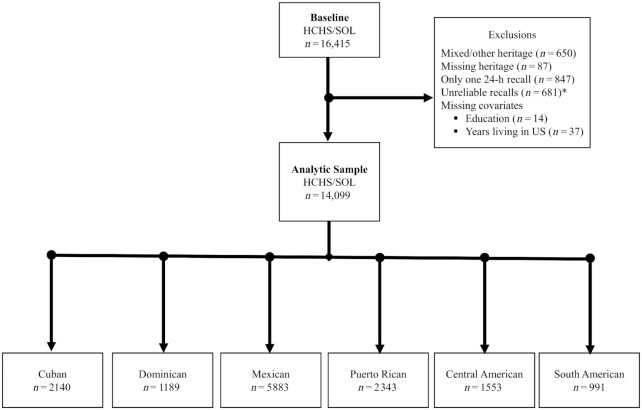
Methods: We used baseline data from a population-based cohort of 14,099 Hispanics/Latinos aged 18-74 y in the Hispanic Community Health Study/Study of Latinos. We performed principal factor analysis using two 24-h recalls to derive DPs, separately, in each heritage group (Cuban, Dominican, Mexican, Puerto Rican, Central American, and South American), and identified overarching DPs based on high-loading foods shared by ≥2 groups. We used multivariable linear regression to test associations of DPs with AHEI-2010 and years living in the United States.
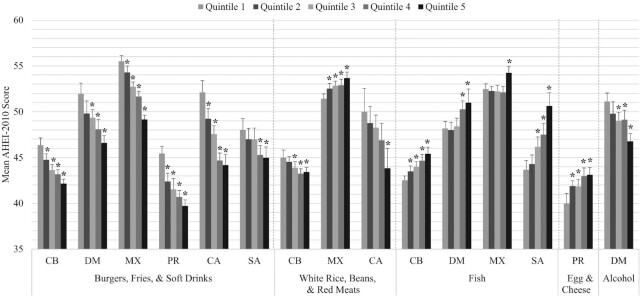
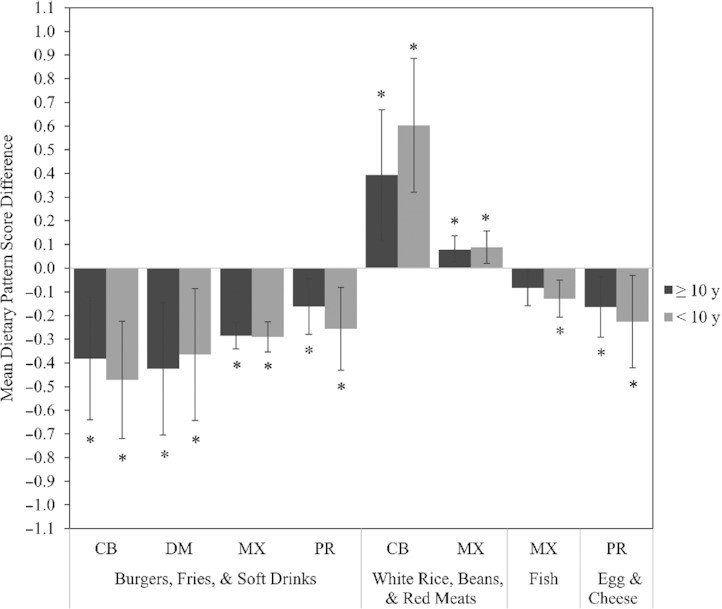
Results: We identified 5 overarching DPs (Burgers, Fries, & Soft Drinks; White Rice, Beans, & Red Meats; Fish; Egg & Cheese; and Alcohol). All Burgers, Fries, & Soft Drinks DPs were inversely associated with AHEI-2010, whereas all Fish DPs (except Dominican) were positively associated with this index (all P-trend < 0.001). White Rice, Beans, & Red Meats DPs showed inverse associations in Cuban and Central American groups and positive associations in Mexican-origin individuals (all P-trend < 0.001). Fewer years living in the United States was associated with higher scores for White Rice, Beans, & Red Meats DPs in Cuban and Mexican heritage groups and lower scores on Burgers, Fries, & Soft Drinks DPs in Cuban, Mexican, and Puerto Rican groups (all P-trend < 0.01).
Conclusions: Our findings show substantial variation in DPs across Hispanics/Latinos and adherence to DPs by time in the United States, which could inform dietary interventions targeting this diverse US population. This trial was registered at clinicaltrials.gov as NCT02060344.
Keywords: HCHS/SOL; Hispanics/Latinos; a posteriori; diet; dietary acculturation; dietary patterns; heritage; nativity; principal factor analysis.
Published by Oxford University Press on behalf of the American Society for Nutrition 2021.
Figures
Comment in
-
Dietary Patterns in Latinx Groups.J Nutr. 2021 Sep 4;151(9):2505-2506. doi: 10.1093/jn/nxab225. J Nutr. 2021. PMID: 34320184 No abstract available.
References
-
- US Census Bureau. QuickFacts: United States. 2019[Internet]. [cited 17, February 17, 2020]. Available from: https://www.census.gov/quickfacts/fact/table/US#.
-
- González Burchard E, Borrell LN, Choudhry S, Naqvi M, Tsai H-J, Rodriguez-Santana JR, Chapela R, Rogers SD, Mei R, Rodriguez-Cintron W. Latino populations: a unique opportunity for the study of race, genetics, and social environment in epidemiological research. Am J Public Health. 2005;95(12):2161–8. - PMC - PubMed
-
- Vespa J, Medina L, Armstrong DM. Demographic turning points for the United States: population projections for 2020 to 2060. Washington (DC): US Census Bureau; 2020.
Publication types
MeSH terms
Associated data
Grants and funding
LinkOut - more resources
Full Text Sources
Medical
