


Failure Rates of Autograft and Allograft ACL Reconstruction in Patients 19 Years of Age and Younger: A Systematic Review and Meta-Analysis
- PMID: 34322650
- PMCID: PMC8312832
- DOI: 10.2106/JBJS.OA.20.00106
Failure Rates of Autograft and Allograft ACL Reconstruction in Patients 19 Years of Age and Younger: A Systematic Review and Meta-Analysis
Abstract
Background: Graft choice for pediatric anterior cruciate ligament reconstruction (ACLR) is determined by several factors. There is limited information on the use and outcomes of allograft ACLR in pediatric patients. The purpose of this systematic review and meta-analysis was to quantify reported failure rates of allograft versus autograft ACLR in patients ≤19 years of age with ≥2 years of follow-up. We hypothesized that there would be higher rates of failure for allograft compared with autograft ACLR in this population.
Methods: PubMed/MEDLINE and Embase databases were systematically searched for literature regarding allograft and autograft ACLR in pediatric/adolescent patients. Articles were included if they described a cohort of patients with average age of ≤19 years, had a minimum of 2 years of follow-up, described graft failure as an outcome, and had a Level of Evidence grade of I to III. Qualitative review and quantitative meta-analysis were performed to compare graft failure rates. A random-effects model was created to compare failure events in patients receiving allograft versus autograft in a pairwise fashion. Data analysis was completed using RevMan 5.3 software (The Cochrane Collaboration).
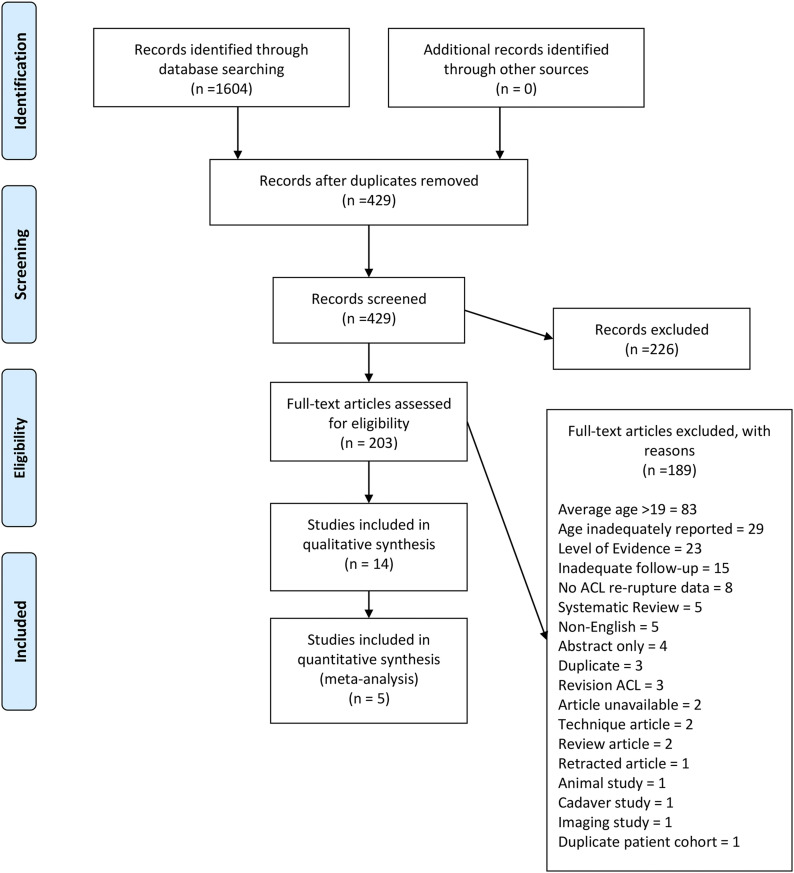
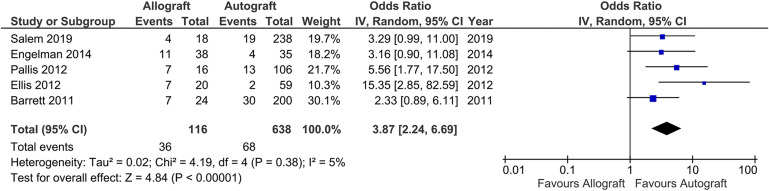
Results: The database search identified 1,604 studies; 203 full-text articles were assessed for eligibility. Fourteen studies met the inclusion criteria for qualitative review; 5 studies were included for quantitative meta-analysis. Bone-patellar tendon-bone (BTB) represented 58.2% (n = 1,012) of the autografts, and hamstring grafts represented 41.8% (n = 727). Hybrid allografts (autograft + supplemental allograft) represented 12.8% (n = 18) of all allograft ACLRs (n = 141). The unweighted, pooled failure rate for each graft type was 8.5% for BTB, 16.6% for hamstring, and 25.5% for allograft. Allografts were significantly more likely than autografts to result in graft failure (odds ratio, 3.87; 95% confidence interval, 2.24 to 6.69).
Conclusions: Allograft ACLR in pediatric and adolescent patients should be used judiciously, as existing studies revealed a significantly higher failure rate for allograft compared with autograft ACLR in this patient population. Additional studies are needed to improve the understanding of variables associated with the high ACLR failure rate among pediatric and adolescent patients.
Level of evidence: Therapeutic Level III. See Instructions for Authors for a complete description of levels of evidence.
Copyright © 2020 The Authors. Published by The Journal of Bone and Joint Surgery, Incorporated. All rights reserved.
Conflict of interest statement
Disclosure: The authors indicated that no external funding was received for any aspect of this work. On the Disclosure of Potential Conflicts of Interest forms, which are provided with the online version of the article, one or more of the authors checked “yes” to indicate that the author had a relevant financial relationship in the biomedical arena outside the submitted work (http://links.lww.com/JBJSOA/A238).
Figures
References
-
- Tepolt FA, Feldman L, Kocher MS. Trends in pediatric ACL reconstruction from the PHIS database. J Pediatr Orthop. 2018. Oct;38(9):e490-4. - PubMed
-
- Dodwell ER, Lamont LE, Green DW, Pan TJ, Marx RG, Lyman S. 20 years of pediatric anterior cruciate ligament reconstruction in New York State. Am J Sports Med. 2014. Mar;42(3):675-80. Epub 2014 Jan 29. - PubMed
-
- Jayanthi NA, LaBella CR, Fischer D, Pasulka J, Dugas LR. Sports-specialized intensive training and the risk of injury in young athletes: a clinical case-control study. Am J Sports Med. 2015. Apr;43(4):794-801. Epub 2015 Feb 2. - PubMed
-
- Frank JS, Gambacorta PL. Anterior cruciate ligament injuries in the skeletally immature athlete: diagnosis and management. J Am Acad Orthop Surg. 2013. Feb;21(2):78-87. - PubMed
LinkOut - more resources
Full Text Sources
Miscellaneous