Body size and composition and risk of site-specific cancers in the UK Biobank and large international consortia: A mendelian randomisation study
- PMID: 34324486
- PMCID: PMC8320991
- DOI: 10.1371/journal.pmed.1003706
Body size and composition and risk of site-specific cancers in the UK Biobank and large international consortia: A mendelian randomisation study
Abstract
Background: Evidence for the impact of body size and composition on cancer risk is limited. This mendelian randomisation (MR) study investigates evidence supporting causal relationships of body mass index (BMI), fat mass index (FMI), fat-free mass index (FFMI), and height with cancer risk.
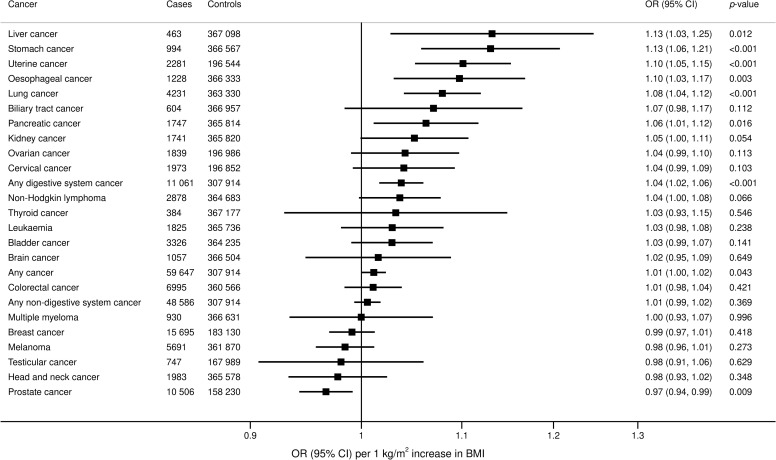
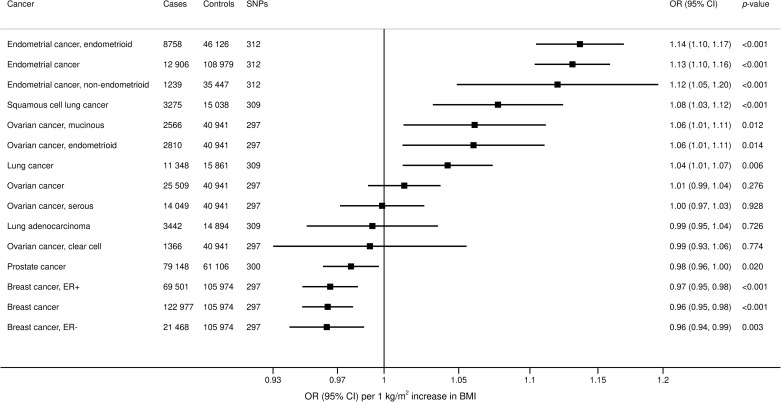
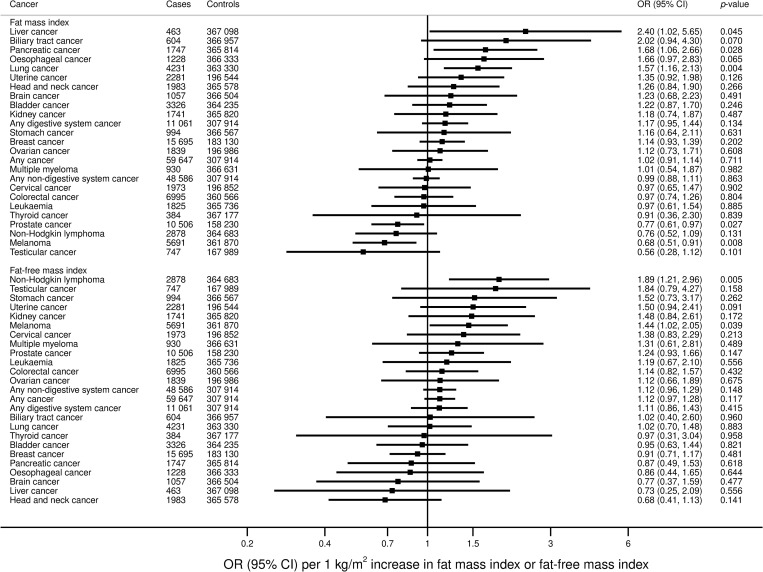
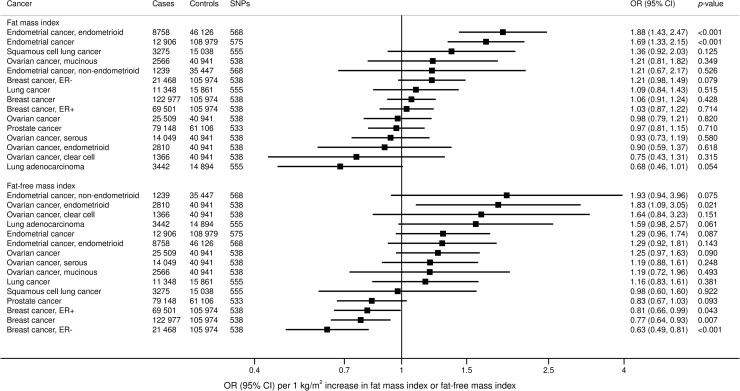
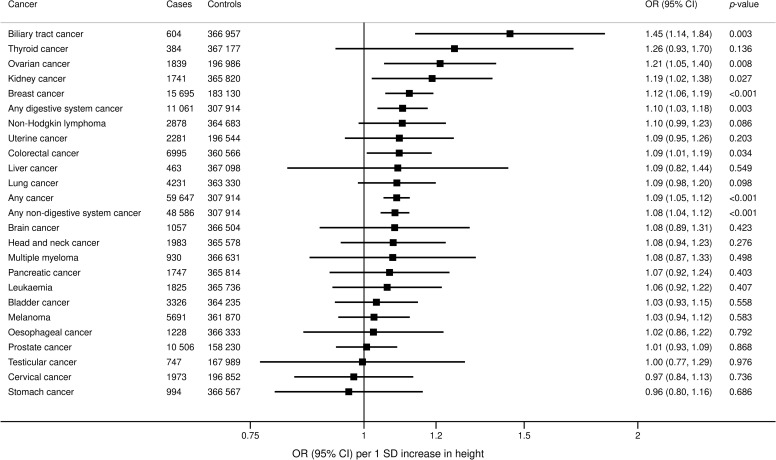
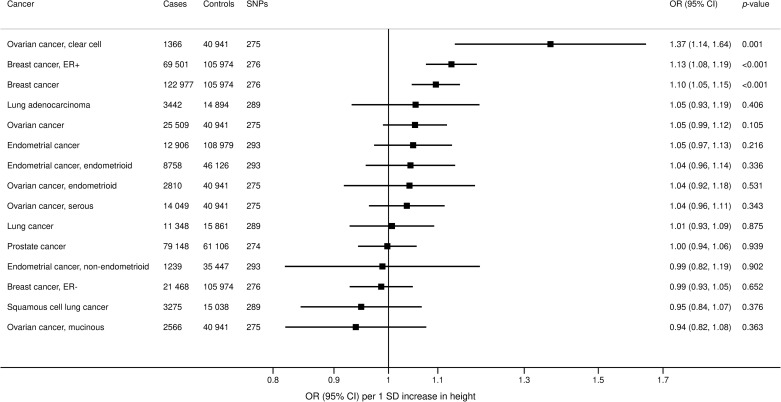
Methods and findings: Single nucleotide polymorphisms (SNPs) were used as instrumental variables for BMI (312 SNPs), FMI (577 SNPs), FFMI (577 SNPs), and height (293 SNPs). Associations of the genetic variants with 22 site-specific cancers and overall cancer were estimated in 367,561 individuals from the UK Biobank (UKBB) and with lung, breast, ovarian, uterine, and prostate cancer in large international consortia. In the UKBB, genetically predicted BMI was positively associated with overall cancer (odds ratio [OR] per 1 kg/m2 increase 1.01, 95% confidence interval [CI] 1.00-1.02; p = 0.043); several digestive system cancers: stomach (OR 1.13, 95% CI 1.06-1.21; p < 0.001), esophagus (OR 1.10, 95% CI 1.03, 1.17; p = 0.003), liver (OR 1.13, 95% CI 1.03-1.25; p = 0.012), and pancreas (OR 1.06, 95% CI 1.01-1.12; p = 0.016); and lung cancer (OR 1.08, 95% CI 1.04-1.12; p < 0.001). For sex-specific cancers, genetically predicted elevated BMI was associated with an increased risk of uterine cancer (OR 1.10, 95% CI 1.05-1.15; p < 0.001) and with a lower risk of prostate cancer (OR 0.97, 95% CI 0.94-0.99; p = 0.009). When dividing cancers into digestive system versus non-digestive system, genetically predicted BMI was positively associated with digestive system cancers (OR 1.04, 95% CI 1.02-1.06; p < 0.001) but not with non-digestive system cancers (OR 1.01, 95% CI 0.99-1.02; p = 0.369). Genetically predicted FMI was positively associated with liver, pancreatic, and lung cancer and inversely associated with melanoma and prostate cancer. Genetically predicted FFMI was positively associated with non-Hodgkin lymphoma and melanoma. Genetically predicted height was associated with increased risk of overall cancer (OR per 1 standard deviation increase 1.09; 95% CI 1.05-1.12; p < 0.001) and multiple site-specific cancers. Similar results were observed in analyses using the weighted median and MR-Egger methods. Results based on consortium data confirmed the positive associations between BMI and lung and uterine cancer risk as well as the inverse association between BMI and prostate cancer, and, additionally, showed an inverse association between genetically predicted BMI and breast cancer. The main limitations are the assumption that genetic associations with cancer outcomes are mediated via the proposed risk factors and that estimates for some lower frequency cancer types are subject to low precision.
Conclusions: Our results show that the evidence for BMI as a causal risk factor for cancer is mixed. We find that BMI has a consistent causal role in increasing risk of digestive system cancers and a role for sex-specific cancers with inconsistent directions of effect. In contrast, increased height appears to have a consistent risk-increasing effect on overall and site-specific cancers.
Conflict of interest statement
The authors have declared that no competing interests exist apart from the following: Stephen Burgess is a paid statistical reviewer for PLOS Medicine.
Figures
References
-
- Obesity: preventing and managing the global epidemic. Report of a WHO consultation. World Heal Organ—Tech Rep Ser. 2000. - PubMed
-
- Di Cesare M, Bentham J, Stevens GA, Zhou B, Danaei G, Lu Y, et al. Trends in adult body-mass index in 200 countries from 1975 to 2014: A pooled analysis of 1698 population-based measurement studies with 19.2 million participants. Lancet. 2016 (16):30054–X. doi: 10.1016/S0140-6736 - DOI - PMC - PubMed
Publication types
MeSH terms
Grants and funding
LinkOut - more resources
Full Text Sources
Medical