


Management of Obesity in Cardiovascular Practice: JACC Focus Seminar
- PMID: 34325840
- PMCID: PMC8609918
- DOI: 10.1016/j.jacc.2021.05.035
Management of Obesity in Cardiovascular Practice: JACC Focus Seminar
Abstract
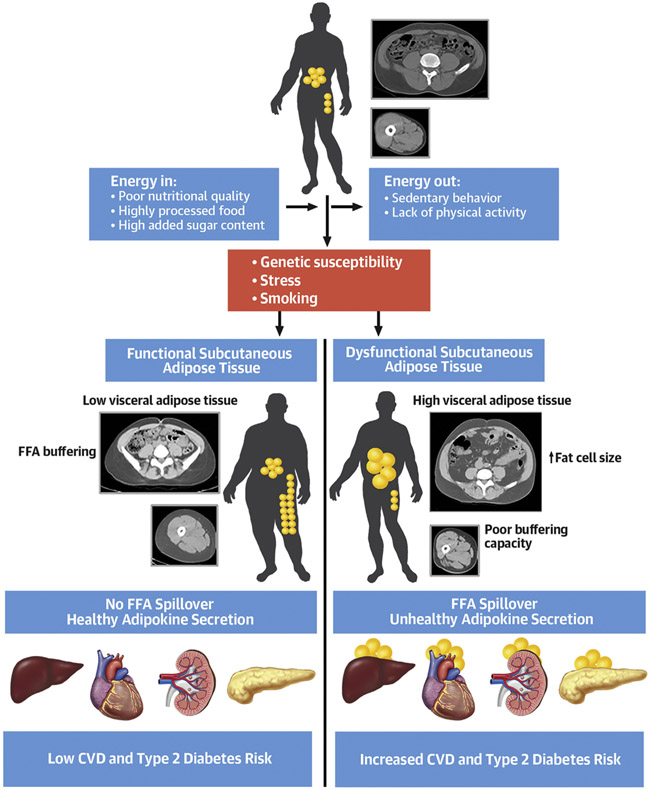
Obesity contributes to reduced life expectancy because of its link with type 2 diabetes and cardiovascular disease. Yet, targeting this poorly diagnosed, ill-defined, and underaddressed modifiable risk factor remains a challenge. In this review, we emphasize that the tendency among health care professionals to amalgam all forms of obesity altogether as a single entity may contribute to such difficulties and discrepancies. Obesity is a heterogeneous condition both in terms of causes and health consequences. Attention should be given to 2 prevalent subgroups of individuals: 1) patients who are overweight or moderately obese with excess visceral adipose tissue; and 2) patients with severe obesity, the latter group having distinct additional health issues related to their large body fat mass. The challenge of tackling high-cardiovascular-risk forms of obesity through a combination of personalized clinical approaches and population-based solutions is compounded by the current obesogenic environment and economy.
Keywords: cardiovascular disease; ectopic fat deposition; massive obesity; type 2 diabetes; visceral obesity.
Copyright © 2021 American College of Cardiology Foundation. Published by Elsevier Inc. All rights reserved.
Conflict of interest statement
Funding Support and Author Disclosures Dr Després is the Scientific Director of the International Chair on Cardiometabolic Risk supported by the Fondation de l’Université Laval. Research from Dr Després discussed in this paper has been and is currently supported by the Canadian Institutes of Health Research (Foundation grant: FDN-167278) as well as by the Fondation of the Québec Heart and Lung Institute. Dr Carpentier holds the Canada Research Chair in Molecular Imaging of Diabetes; and has received funding for consulting from Eli Lilly, HLS Therapeutics, Janssen, Novartis Pharmaceuticals Canada, and Novo Nordisk Canada. Dr Tchernof has received research funding from Johnson & Johnson Medical Companies, Medtronic, and Bodynov for studies unrelated to this work; and has received consulting fees from Bausch Health and Novo Nordisk. Dr Neeland has received a grant from National Institutes of Health/NIDDK (K23 DK106520); has received speaking and consultancy fees from Boehringer Ingelheim, Merck, and AMRA Medical; and has received a grant from Novo Nordisk. Dr Poirier has received honoraria for CME/consultant/expert events from Abbott, Amgen, AstraZeneca, Bayer, Bausch Health, Boehringer Ingelheim, Eli Lilly, HLS Therapeutics, Janssen, Merck, Novartis, Novo Nordisk, Sanofi, and Servier.
Figures
References
-
- Romero-Corral A, Somers VK, Sierra-Johnson J, et al. Diagnostic performance of body mass index to detect obesity in patients with coronary artery disease. Eur Heart J 2007;28:2087–93. - PubMed
-
- Yancy CW, Jessup M, Bozkurt B, et al. 2013 ACCF/AHA guideline for the management of heart failure: a report of the American College of Cardiology Foundation/American Heart Association Task Force on Practice Guidelines. J Am Coll Cardiol 2013;62:e147–239. - PubMed
-
- Gonzalez-Muniesa P, Martinez-Gonzalez MA, Hu FB, et al. Obesity. Nat Rev Dis Primers 2017;3:17034. - PubMed
-
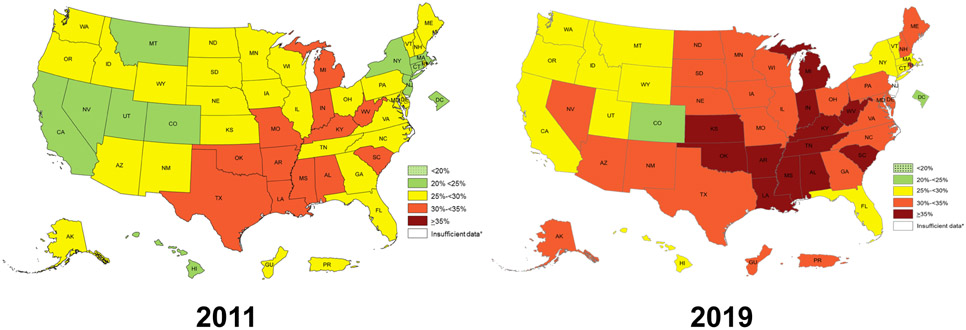
- Centers for Disease Control and Prevention. Adult obesity prevalence maps. https://www.cdc.gov/obesity/data/prevalence-maps.html#overall. Accessed September 29, 2020.
Publication types
MeSH terms
Grants and funding
LinkOut - more resources
Full Text Sources
Medical
