


Impact on patients with oral squamous cell carcinoma in different anatomical subsites: a single-center study in Taiwan
- PMID: 34326432
- PMCID: PMC8322316
- DOI: 10.1038/s41598-021-95007-5
Impact on patients with oral squamous cell carcinoma in different anatomical subsites: a single-center study in Taiwan
Abstract
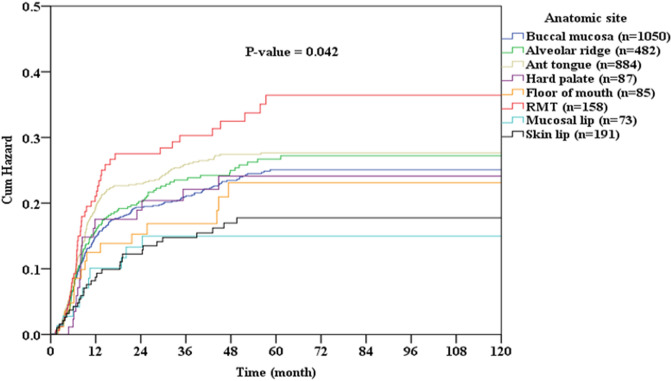
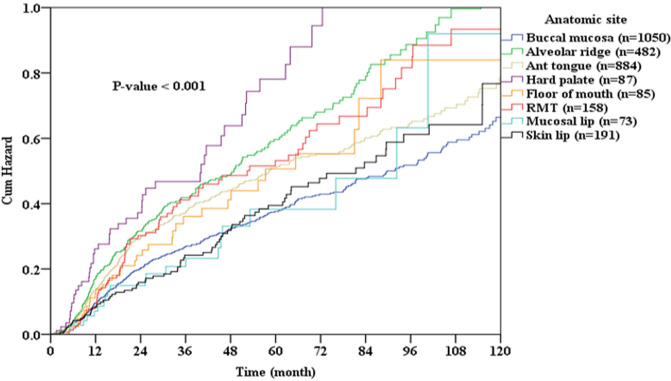
The incidence of oral cavity squamous cell carcinoma (OSCC) is particularly high in South Asia. According to the National Comprehensive Cancer Network, OSCC can arise in several subsites. We investigated survival rates and the clinical and pathological characteristics of OSCC in different anatomical subsites in the Taiwanese population. We retrospectively analyzed data for 3010 patients with OSCC treated at the Changhua Christian Hospital. Subsequently, we compared clinical and pathological features of OSCC in different subsites. Pathological T4 stage OSCCs occurred in the alveolar ridge and retromolar trigone in 56.4% and 43.7% of cases, respectively. More than 25% of patients with tongue OSCC and 23.4% of those with retromolar OSCC had lymph node metastasis. The prognosis was worst for hard palate OSCC (hazard ratio 1.848; p < 0.001) and alveolar ridge OSCC (hazard ratio 1.220; p = 0.017). Retromolar OSCC recurred most often and tongue OSCC second most often. The risk for cancer-related mortality was highest for hard palate OSCC, followed by alveolar ridge and retromolar OSCC. We found distinct differences in survival among the different subsites of OSCC. Our findings may also help prompt future investigations of OSCC in different subsites in Taiwanese patients.
© 2021. The Author(s).
Conflict of interest statement
The authors declare no competing interests.
Figures
References
MeSH terms
LinkOut - more resources
Full Text Sources
