


Exploring the motivations of research participants who chose not to learn medically actionable secondary genetic findings about themselves
- PMID: 34326490
- PMCID: PMC8633056
- DOI: 10.1038/s41436-021-01271-1
Exploring the motivations of research participants who chose not to learn medically actionable secondary genetic findings about themselves
Abstract
Purpose: Proposals to return medically actionable secondary genetic findings (SFs) in the clinical and research settings have generated controversy regarding whether to solicit individuals' preferences about their "right not to know" genetic information. This study contributes to the debate by surveying research participants who have actively decided whether to accept or refuse SFs.
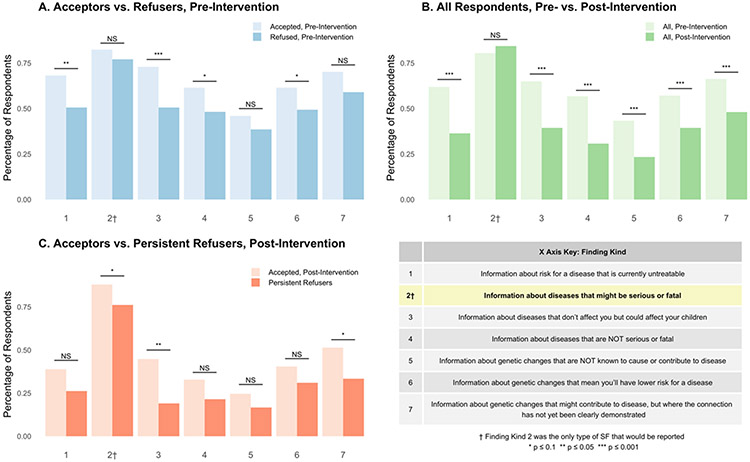
Methods: Participants were drawn from a large National Institutes of Health (NIH) environmental health study. Participants who had accepted SFs (n = 148) or refused SFs (n = 83) were given more detailed information about the types of SFs researchers could return and were given an opportunity to revise their original decision.
Results: Forty-one of 83 initial refusers (49.4%) opted to receive SFs following the informational intervention. Nearly 75% of these "reversible refusers" thought they had originally accepted SFs. The 50.6% of initial refusers who continued to refuse ("persistent refusers") demonstrated high levels of understanding of which SFs would be returned postintervention. The most prominent reason for refusing was concern about becoming worried or sad (43.8%).
Conclusion: This study demonstrates the need for a more robust informed consent process when soliciting research participants' preferences about receiving SFs. We also suggest that our data support implementing a default practice of returning SFs without actively soliciting preferences.
© 2021. This is a U.S. government work and not under copyright protection in the U.S.; foreign copyright protection may apply.
Conflict of interest statement
Figures
Comment in
-
Correspondence on "Exploring the motivations of research participants who chose not to learn medically actionable secondary findings about themselves" by Schupmann et al.Genet Med. 2022 Feb;24(2):499-500. doi: 10.1016/j.gim.2021.08.017. Epub 2021 Nov 30. Genet Med. 2022. PMID: 34906493 No abstract available.
-
Response to Clayton et al.Genet Med. 2022 Feb;24(2):501-502. doi: 10.1016/j.gim.2021.09.011. Epub 2021 Nov 30. Genet Med. 2022. PMID: 34906495 No abstract available.
References
-
- Presidential Commission for the Study of Bioethical Issues. Anticipate and Communicate: Ethical Management of Incidental and Secondary Findings in the Clinical, Research, and Direct-to-Consumer Contexts. 2013. - PubMed
-
- Miller DT, Lee K, Chung WK, et al. ACMG SF v3.0 list for reporting of secondary findings in clinical exome and genome sequencing: a policy statement of the American College of Medical Genetics and Genomics (ACMG). Genet Med. 2021. - PubMed
Publication types
MeSH terms
Grants and funding
LinkOut - more resources
Full Text Sources
