


Mapping Evidence on Early Childhood Caries Prevalence: Complexity of Worldwide Data Reporting
- PMID: 34326577
- PMCID: PMC8311757
- DOI: 10.5005/jp-journals-10005-1882
Mapping Evidence on Early Childhood Caries Prevalence: Complexity of Worldwide Data Reporting
Abstract
Objective: This review aims to identify variances and research gaps in the early childhood caries (ECC) prevalence within countries and the global community by mapping current evidence.
Materials and methods: We performed a literature search in PubMed/MEDLINE and Web of Science to identify English-language, peer-reviewed epidemiologic studies published from January 1999 to January 2019. Abstracts and full-text articles were dual-screened based on predefined eligibility criteria. We classified outcomes by children's age and countries based on economic status. Ranges of reported caries prevalence and median values by country and age were calculated and evidence-mapped.
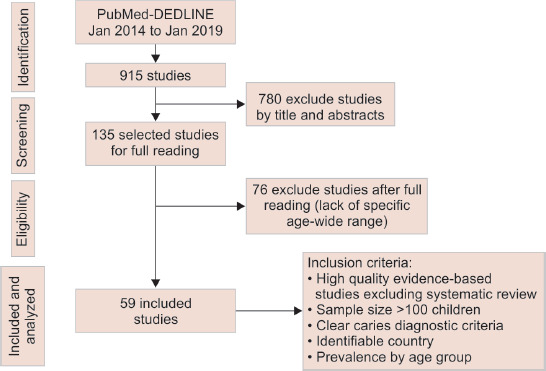
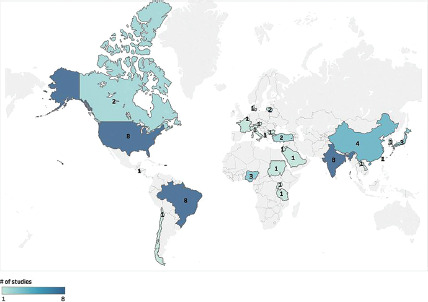
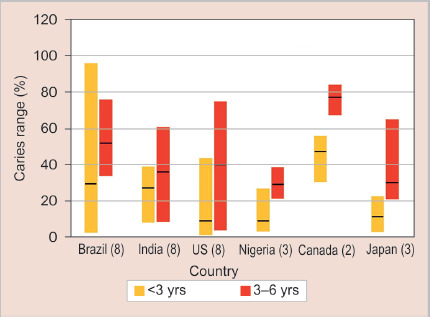
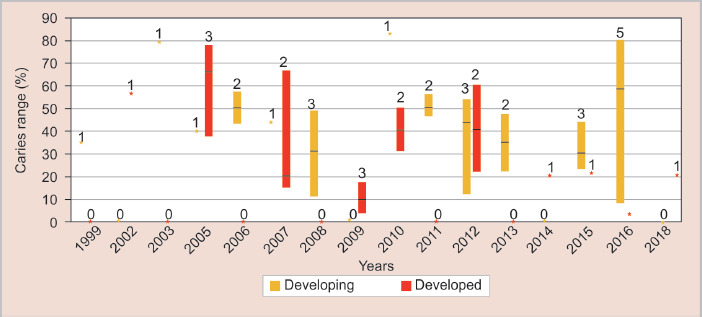
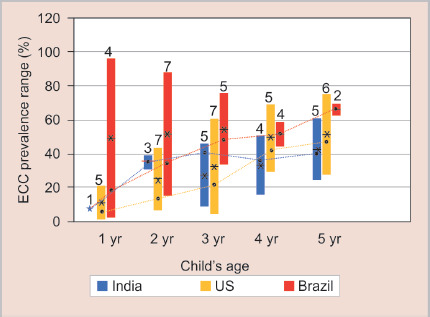
Results: Out of 915 studies, 59 studies met the inclusion criteria. The most significant number of reports were from the USA, Brazil, and India. The ranges of prevalence (1-96%) among the studies were large. The calculated median caries prevalence values may better estimate countries' prevalence than the reported ranges. Early childhood caries prevalence's highest median values were found for South Korea studies (54%) for children <3-year-old and from Bosnia (81%) for children 3-6 years old. No apparent difference was found in the prevalence of ECC from developed and developing countries.
Conclusion: This mapping review reflects the ranges and median values of ECC worldwide. Overall, the reported prevalence of ECC in most countries is very high. No apparent difference was found in the prevalence of ECC from developed and developing countries. Reported ranges of ECC, as well as heterogeneity and methodological issues, hamper comparisons across studies globally.
Clinical significance: The global ECC prevalence ranges are extreme. Median data may provide a structure for future epidemiological studies to optimizing healthcare resources for caries interventions globally.
How to cite this article: Abdelrahaman M, Hsu K-L, Melo MA, et al. Mapping Evidence on Early Childhood Caries Prevalence: Complexity of Worldwide Data Reporting. Int J Clin Pediatr Dent 2021;14(1):1-7.
Keywords: Cross-sectional studies; Dental caries; Global health; Preschool child.
Copyright © 2021; Jaypee Brothers Medical Publishers (P) Ltd.
Conflict of interest statement
Source of support: Department of Orthodontics and Pediatric Dentistry Conflict of interest: None
Figures
References
-
- Drury TF, Horowitz AM, Ismail AI, et al. Diagnosing and reporting early childhood caries for research purposes. A report of a workshop sponsored by the National Institute of Dental and Craniofacial Research, the Health Resources and Services Administration, and the Health Care Financing Administration. J Public Health Dent. 1999;59(3):192–197. doi: 10.1111/j.1752-7325.1999.tb03268.x. DOI: - DOI - PubMed
-
- Clarke M, Locker D, Berall G, et al. Malnourishment in a population of young children with severe early childhood caries. Pediatr Dent. 2006;28(3):254–259. - PubMed
Publication types
LinkOut - more resources
Full Text Sources
Miscellaneous