


Oxygen and Mortality in COVID-19 Pneumonia: A Comparative Analysis of Supplemental Oxygen Policies and Health Outcomes Across 26 Countries
- PMID: 34327182
- PMCID: PMC8313806
- DOI: 10.3389/fpubh.2021.580585
Oxygen and Mortality in COVID-19 Pneumonia: A Comparative Analysis of Supplemental Oxygen Policies and Health Outcomes Across 26 Countries
Abstract
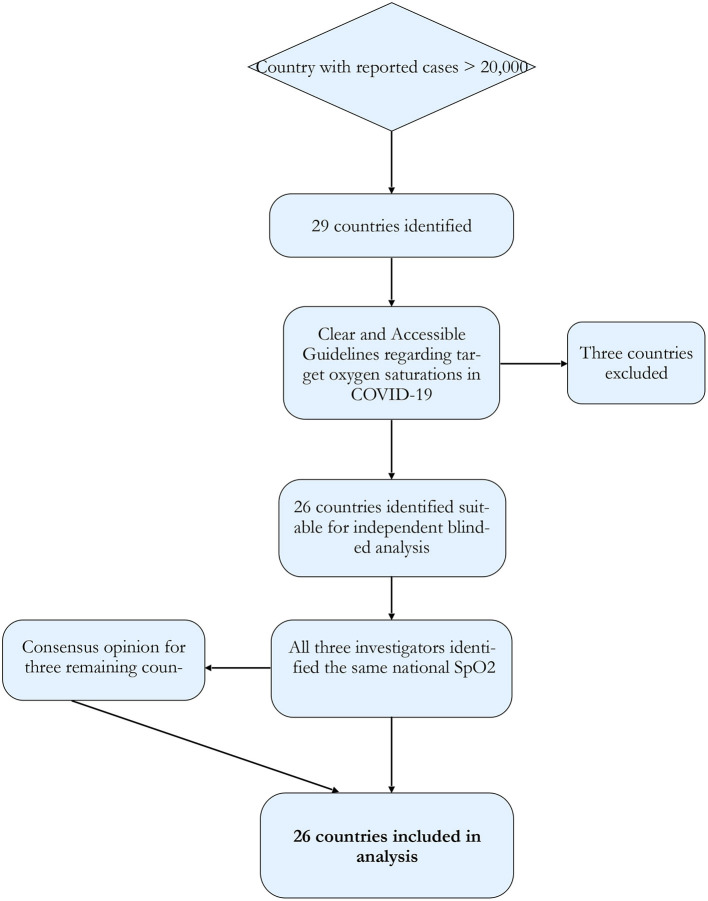
Introduction: Hypoxia is the main cause of morbidity and mortality in COVID-19. During the COVID-19 pandemic, some countries have reduced access to supplemental oxygen, whereas other nations have maintained and even improved access to supplemental oxygen. We examined whether variation in the nationally determined oxygen guidelines had any association with national mortality rates in COVID-19. Methods: Three independent investigators searched for, identified, and extracted the nationally recommended target oxygen levels for the commencement of oxygen in COVID-19 pneumonia from the 29 worst affected countries. Mortality estimates were calculated from three independent sources. We then applied both parametric (Pearson's R) and non-parametric (Kendall's Tau B) tests of bivariate association to determine the relationship between case fatality rate (CFR) and target SpO2, and also between potential confounders and CFR. Results: Of the 26 nations included, 15 had employed conservative oxygen strategies to manage COVID-19 pneumonia. Of them, Belgium, France, USA, Canada, China, Germany, Mexico, Spain, Sweden, and the UK guidelines advised commencing oxygen when oxygen saturations (SpO2) fell to 91% or less. A statistically significant correlation was found between SpO2 and CFR both parametrically (R = -0.53, P < 0.01) and non-parametrically (-0.474, P < 0.01). Conclusion: Our study highlights the disparity in oxygen provision for COVID-19 patients between the nations analysed. In those nations that pursued a conservative oxygen strategy, there was an association with higher national mortality rates. We discuss the potential reasons for such an association.
Keywords: COVID-19; SARS-CoV2; early intervention; mortality; oxygen; rationing; target oxygen saturation; treatment.
Copyright © 2021 Mansab, Donnelly, Kussner, Neil, Bhatti and Goyal.
Conflict of interest statement
The authors declare that the research was conducted in the absence of any commercial or financial relationships that could be construed as a potential conflict of interest.
Figures


References
-
- WHO Situation Report 119. (2020). Available online at: https://www.who.int/docs/default-source/coronaviruse/situation-reports/2... (accessed May 20, 2020).
MeSH terms
Substances
LinkOut - more resources
Full Text Sources
Medical
Miscellaneous
