


The Characteristics of Capnocytophaga Infection: 10 Years of Experience
- PMID: 34327254
- PMCID: PMC8314946
- DOI: 10.1093/ofid/ofab175
The Characteristics of Capnocytophaga Infection: 10 Years of Experience
Abstract
Background: Capnocytopha ga is a gram-negative, facultative anaerobe. Human infection is rare but can lead to devastating outcomes. Capnocytophaga canimorsus can cause sepsis following an animal bite, whereas human-oral-associated Capnocytophaga infections were reported in immunocompromised patients. Current data on these infections are not robust. Our goal is to provide a contemporary description of a unique characteristic of Capnocytophaga infections.
Methods: We performed a retrospective review of all patients with Capnocytophaga infection from January 2010 to August 2020 at 3 main hospitals of Mayo Clinic in Rochester, Minnesota; Scottsdale, Arizona; and Jacksonville, Florida. We collected baseline demographic data, clinical characteristics, microbiological data, and outcomes of C. canimorsus and human-oral-associated Capnocytophaga infection.
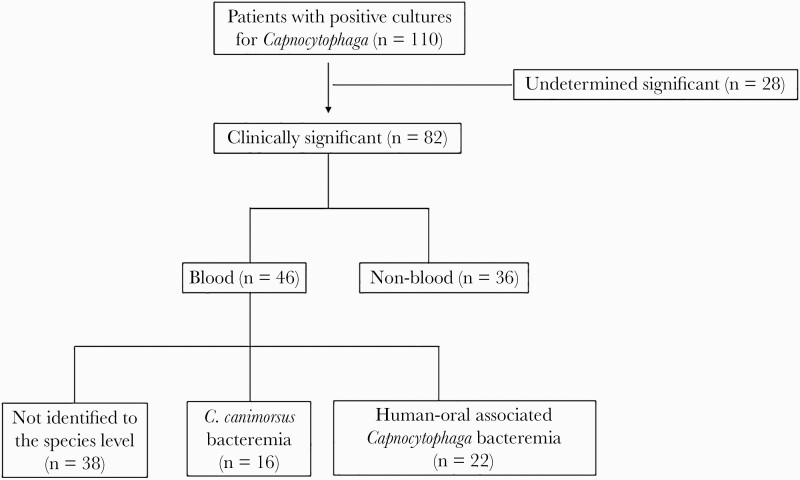
Results: Among 82 patients with Capnocytophaga infection, 46 patients (56.0%) had bacteremia. The most common species identified in this group was C. sputigena (57.9%), followed by C. canimorsus (34.8%). Patients with human-oral-associated Capnocytophaga bacteremia were often immunocompromised, presented with neutropenic fever, and had worse 6-month all-cause mortality compared to C. canimorsus bacteremia (36.4% vs 6.2%, P = .03). They also had a higher β-lactamase production rate (36.4% vs 0.0%, P = .02). Among patients without bacteremia, the main clinical syndrome was polymicrobial head and neck infections (47.2%).
Conclusions: Human-oral-associated Capnocytophaga bacteremia occurs primarily in immunocompromised patients, particularly those with hematologic malignancy. In contrast, C. canimorsus bacteremia is more likely to present with community-onset infection related to zoonotic exposure. Human-oral-associated Capnocytophaga infection without bacteremia is frequently isolated in polymicrobial infection; this phenomenon's significance is yet to be fully understood.
Keywords: Capnocytophaga; bacteremia; mortality; zoonosis.
© The Author(s) 2021. Published by Oxford University Press on behalf of Infectious Diseases Society of America.
References
-
- Suzuki M, Kimura M, Imaoka K, Yamada A. Prevalence of Capnocytophaga canimorsus and Capnocytophaga cynodegmi in dogs and cats determined by using a newly established species-specific PCR. Vet Microbiol 2010; 144:172–6. - PubMed
-
- Gaastra W, Lipman LJ. Capnocytophaga canimorsus. Vet Microbiol 2010; 140:339–46. - PubMed
-
- van Dam AP, Jansz A. Capnocytophaga canimorsus infections in the Netherlands: a nationwide survey. Clin Microbiol Infect 2011; 17:312–5. - PubMed
