Meta-Analysis
. 2021 Jul 30;25(1):268.
doi: 10.1186/s13054-021-03697-0.

Noninvasive respiratory support outside the intensive care unit for acute respiratory failure related to coronavirus-19 disease: a systematic review and meta-analysis

Affiliations
Meta-Analysis

Noninvasive respiratory support outside the intensive care unit for acute respiratory failure related to coronavirus-19 disease: a systematic review and meta-analysis

Gianmaria Cammarota et al. Crit Care. .

Abstract

Background: Noninvasive respiratory support (NIRS) has been diffusely employed outside the intensive care unit (ICU) to face the high request of ventilatory support due to the massive influx of patients with acute respiratory failure (ARF) caused by coronavirus-19 disease (COVID-19). We sought to summarize the evidence on clinically relevant outcomes in COVID-19 patients supported by NIV outside the ICU.

Methods: We searched PUBMED®, EMBASE®, and the Cochrane Controlled Clinical trials register, along with medRxiv and bioRxiv repositories for pre-prints, for observational studies and randomized controlled trials, from inception to the end of February 2021. Two authors independently selected the investigations according to the following criteria: (1) observational study or randomized clinical trials enrolling ≥ 50 hospitalized patients undergoing NIRS outside the ICU, (2) laboratory-confirmed COVID-19, and (3) at least the intra-hospital mortality reported. Preferred Reporting Items for Systematic reviews and Meta-analysis guidelines were followed. Data extraction was independently performed by two authors to assess: investigation features, demographics and clinical characteristics, treatments employed, NIRS regulations, and clinical outcomes. Methodological index for nonrandomized studies tool was applied to determine the quality of the enrolled studies. The primary outcome was to assess the overall intra-hospital mortality of patients under NIRS outside the ICU. The secondary outcomes included the proportions intra-hospital mortalities of patients who underwent invasive mechanical ventilation following NIRS failure and of those with 'do-not-intubate' (DNI) orders.

Results: Seventeen investigations (14 peer-reviewed and 3 pre-prints) were included with a low risk of bias and a high heterogeneity, for a total of 3377 patients. The overall intra-hospital mortality of patients receiving NIRS outside the ICU was 36% [30-41%]. 26% [21-30%] of the patients failed NIRS and required intubation, with an intra-hospital mortality rising to 45% [36-54%]. 23% [15-32%] of the patients received DNI orders with an intra-hospital mortality of 72% [65-78%]. Oxygenation on admission was the main source of between-study heterogeneity.

Conclusions: During COVID-19 outbreak, delivering NIRS outside the ICU revealed as a feasible strategy to cope with the massive demand of ventilatory assistance.

Registration: PROSPERO, https://www.crd.york.ac.uk/prospero/ , CRD42020224788, December 11, 2020.

Keywords: COVID-19; Intra-hospital mortality; Noninvasive ventilation.


Conflict of interest statement

The following authors declare to have no conflicts of interest: Prof Gianmaria Cammarota, Dr. Teresa Esposito, Dr. Francesco Menzella, Prof Stefano Aliberti, Dr Michele Vitacca, Prof V. Marco Ranieri, Prof Onofrio Resta, Dr Antonio Gidaro, Dr Antonella Potalivo, Dr Giuseppe Nardi, Dr Claudia Brusasco, and Prof Rosanna Vaschetto. Dr. Roberto Cosentini reports personal fees from Fisher & Paykel, outside the submitted work. Prof. Giuseppe Foti declares conference fees from DIMAR. Dr. Andrea Coppadoro has a patent and received consultancy fees from Flowmeter. Prof. Giacomo Grasselli declares personal fees (payment for lectures) from Getinge, Biotest, Draeger Medical, MSD, Fisher&Paykel; travel/accommodation/congress registration support from Biotes and Getinge; unrestricted research grant from Fisher&Paykel, MSD all outside the submitted work. Prof. Giacomo Bellani reports personal fees from Dimar and Intersurgical and is owner of a patent potentially related to this manuscript, personal fees from Draeger, Getinge, Hamilton, GE Healthcare not related to this work. Prof. Maurizio Cecconi reported personal fees from Edwards Lifesciences, Directed Systems, and Cheetah Medical outside the submitted work. Prof. Antonio Pesenti reports personal fees from Maquet, Xenios, Baxter, and Boehringer Ingelheim, outside the submitted work. Dr. Sandro Luigi Di Domenico declares relationship with Menarini group on behalf of Dynamicon education s.r.l. Dr. Tom Lawton is involved in the development of an open-source CPAP device for use in low-income countries under an EPSRC grant (no funding received). Prof. Paolo Navalesi declares to have received: grants, personal fees, and nonfinancial support from Maquet Critical Care; grants and nonfinancial support from Draeger and Intersurgical S.p.A; and personal fees from Oriopharma, Philips, Resmed, MSD, and Novartis, in each case for reasons that remain unrelated to the submitted work. Prof. Navalesi also contributed to the development of the patented ‘helmet Next,’ the royalties for which are paid to Intersurgical Spa. Prof. Navalesi contributed to the development of a device not discussed in the present study with patent application number: EP20170199831. Dr. Simonetta Tesoro received conference fees from MSD. Prof. Edoardo De Robertis received conference fees from MSD and Baxter.

Figures

Fig. 1
Fig. 1
Pooled overall intra-hospital mortality of patients assisted through noninvasive respiratory support outside the intensive care unit. The vertical dotted line refers to the summary estimate for overall intra-hospital mortality of patients assisted through noninvasive respiratory support outside intensive care unit. Red squares indicate the individual study estimates of the overall intra-hospital mortality of patients assisted through noninvasive respiratory support outside the intensive care unit, whereas the black horizontal lines indicate the 95% confidence interval of single studies. The diamond refers to the summary estimate with 95% confidence interval
Fig. 2
Fig. 2
Pooled intra-hospital mortality of patients assisted through noninvasive respiratory support outside the intensive care unit, net of the patients subjected to limitations of care. The vertical dotted line refers to the summary estimate for intra-hospital mortality of patients assisted through noninvasive respiratory support outside intensive care unit, excluding the patients subjected to limitations of care. Red squares indicate the individual study estimates of the overall intra-hospital mortality of patients assisted through noninvasive respiratory support outside the intensive care unit, excluding the patients subjected to limitations of care, whereas the black horizontal lines indicate the 95% confidence interval of single studies. The diamond refers to the summary estimate with 95% confidence interval
Fig. 3
Fig. 3
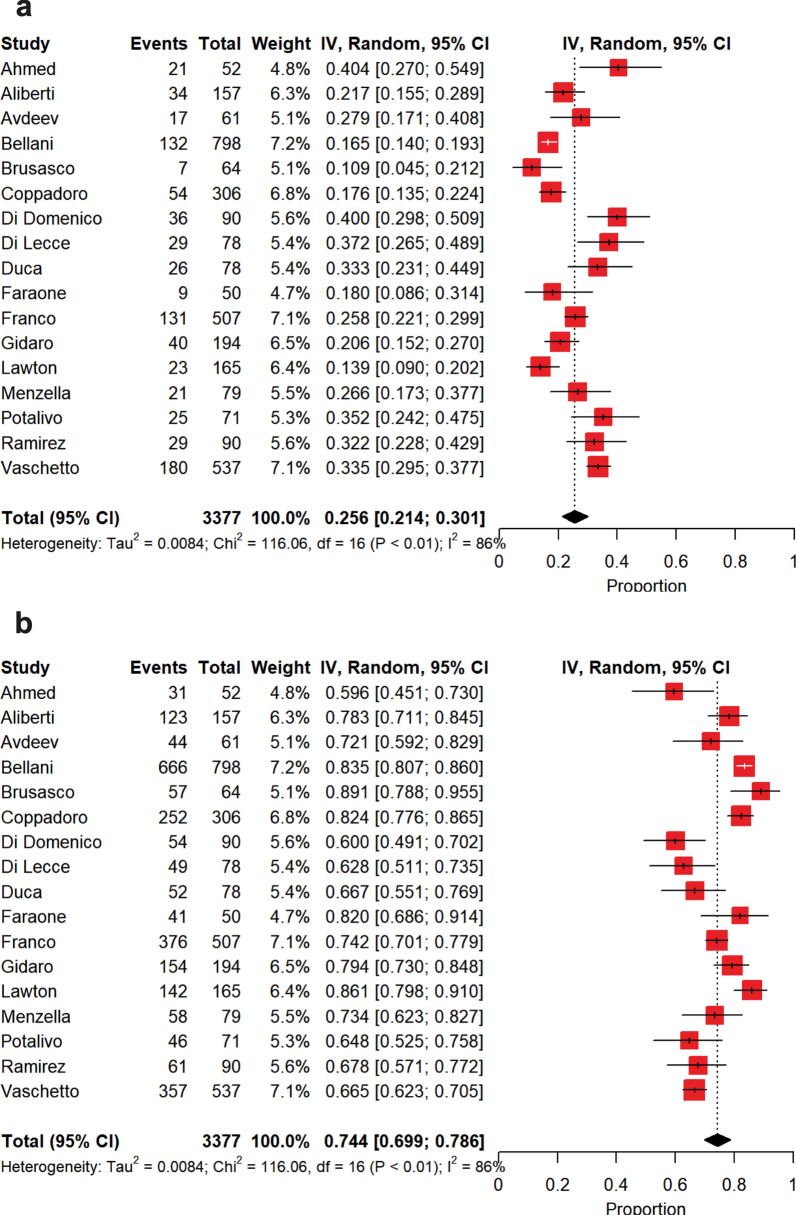
Summary estimates of intubated patients following noninvasive respiratory support failure and of those patients who continued noninvasive respiratory support and did not experience intubation. a Summary estimate of intubated patients following noninvasive respiratory support failure. The vertical dotted line refers to the summary estimate of intubation in patients who failed noninvasive respiratory support. Red squares indicate the individual study estimates of the intubated patients following noninvasive respiratory support failure, whereas the black horizontal lines indicate the 95% confidence interval of single studies. The diamond refers to the summary estimate with 95% confidence interval. b Summary estimate of patients with noninvasive respiratory support who did not experience intubation. The vertical dotted line refers to the summary estimate of patients who continued noninvasive respiratory support and were not intubated. Red squares indicate the individual study estimates of patients who continued noninvasive respiratory support and were not intubated, whereas the black horizontal lines indicate the 95% confidence interval of single studies. The diamond refers to the summary estimate with 95% confidence interval
Fig. 4
Fig. 4
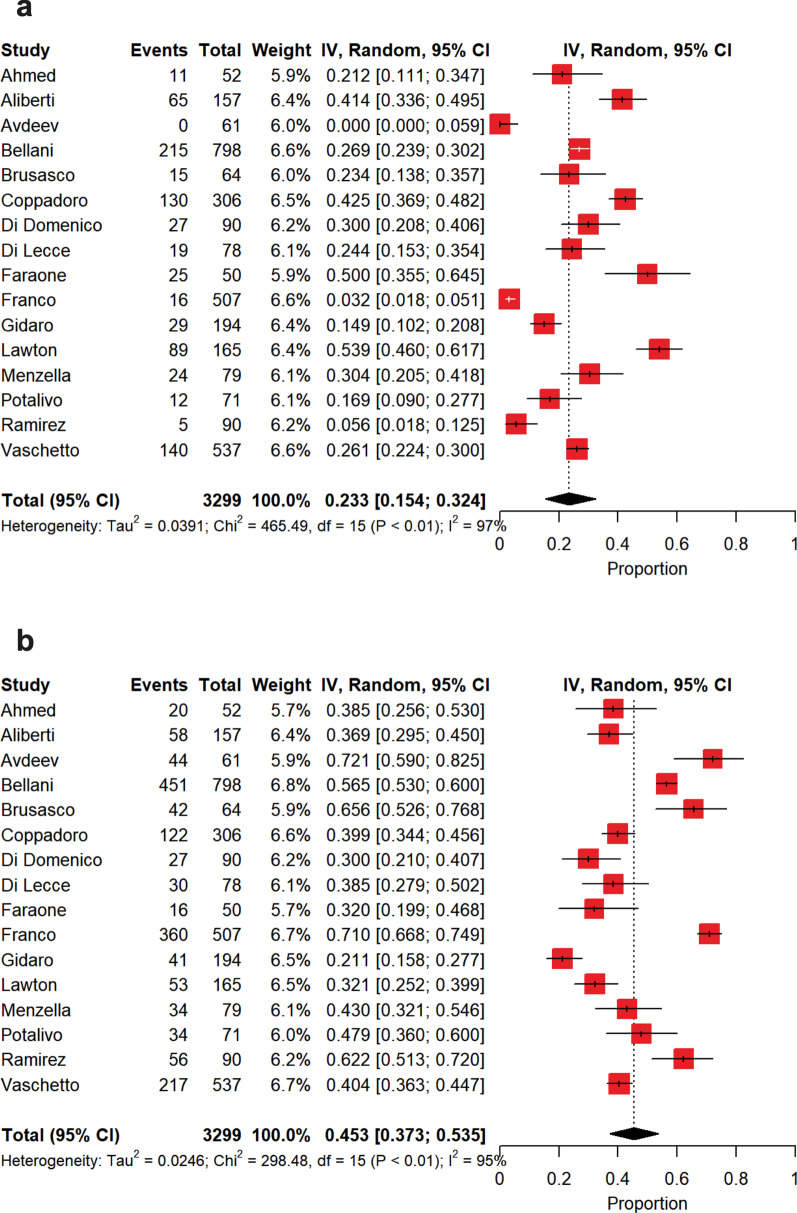
Summary estimates of patients with limitations of care and of those under ‘full treatment’ who were not intubated. a Summary estimate of nonintubated patients with limitations of care. The vertical dotted line refers to the summary estimate of patients with limitations of care. Red squares indicate the individual study estimates of the patients with limitations of care, whereas the black horizontal lines indicate the 95% confidence interval of single studies. The diamond refers to the summary estimate with 95% confidence interval. b Summary estimate of patients under ‘full treatment’ who were not intubated. The vertical dotted line refers to the summary estimate of patients under ‘full treatment’ who were not intubated. Red squares indicate the individual study estimates of patients under ‘full treatment’ who were not intubated, whereas the black horizontal lines indicate the 95% confidence interval of single studies. The diamond refers to the summary estimate with 95% confidence interval
Fig. 5
Fig. 5
Summary estimates of intra-hospital mortality observed in intubated patients following noninvasive respiratory support failure and of that reported in patients who continued noninvasive respiratory support and did not experience intubation. a Summary estimate of intra-hospital mortality observed in intubated patients following noninvasive respiratory support failure. The vertical dotted line refers to the summary estimate of intra-hospital mortality observed in intubated patients who failed noninvasive respiratory support. Red squares indicate the individual study estimates of intra-hospital mortality observed in intubated patients following noninvasive respiratory support failure, whereas the black horizontal lines indicate the 95% confidence interval of single studies. The diamond refers to the summary estimate with 95% confidence interval. b Summary estimate of intra-hospital mortality of patients with noninvasive respiratory support who did not experience intubation. The vertical dotted line refers to the summary estimate of intra-hospital mortality of patients with noninvasive ventilation who did not experience intubation. Red squares indicate the individual study estimates of intra-hospital mortality of patients with noninvasive respiratory support who did not experience intubation, whereas the black horizontal lines indicate the 95% confidence interval of single studies. The diamond refers to the summary estimate with 95% confidence interval
Fig. 6
Fig. 6
Summary estimates of intra-hospital mortality observed in patients with limitations of care and of that reported in patients under ‘full treatment’ who were not intubated. a Summary estimate of intra-hospital mortality observed in patients with limitations of care. The vertical dotted line refers to the summary estimate of intra-hospital mortality observed in patients with limitations of care. Red squares indicate the individual study estimates of intra-hospital mortality observed in patients with limitations of care, whereas the black horizontal lines indicate the 95% confidence interval of single studies. The diamond refers to the summary estimate with 95% confidence interval. b Summary estimate of intra-hospital mortality observed in patients under ‘full treatment’ who were not intubated. The vertical dotted line refers to summary estimate of intra-hospital mortality observed in patients under ‘full treatment’ who were not intubated. Red squares indicate individual study estimates of intra-hospital mortality observed in patients under ‘full treatment’ who were not intubated, whereas the black horizontal lines indicate the 95% confidence interval of single studies. The diamond refers to the summary estimate with 95% confidence interval

References

    1. Zhou P, Yang X Lou, Wang XG, Hu B, Zhang L, Zhang W, et al. A pneumonia outbreak associated with a new coronavirus of probable bat origin. Nature; 2020. - PMC - PubMed
    1. Zhou F, Yu T, Du R, Fan G, Liu Y, Liu Z, et al. Clinical course and risk factors for mortality of adult inpatients with COVID-19 in Wuhan, China: a retrospective cohort study. Lancet; 2020. - PMC - PubMed
    1. Wang D, Hu B, Hu C, Zhu F, Liu X, Zhang J, et al. Clinical characteristics of 138 hospitalized patients with 2019 novel coronavirus-infected pneumonia in Wuhan, China. JAMA J Am Med Assoc. 2020;323:1061–1069. doi: 10.1001/jama.2020.1585. - DOI - PMC - PubMed
    1. Goyal P, Choi JJ, Pinheiro LC, Schenck EJ, Chen R, Jabri A, et al. Clinical characteristics of Covid-19 in New York City. N Engl J Med. 2020;382:2372–2374. doi: 10.1056/NEJMc2010419. - DOI - PMC - PubMed
    1. Richardson S, Hirsch JS, Narasimhan M, Crawford JM, McGinn T, Davidson KW, et al. Presenting characteristics, comorbidities, and outcomes among 5700 patients hospitalized with COVID-19 in the New York City Area. JAMA - J Am Med Assoc. 2020. - PMC - PubMed

MeSH terms