


Investigating the spectral features of the brain meso-scale structure at rest
- PMID: 34331365
- PMCID: PMC8449100
- DOI: 10.1002/hbm.25607
Investigating the spectral features of the brain meso-scale structure at rest
Abstract
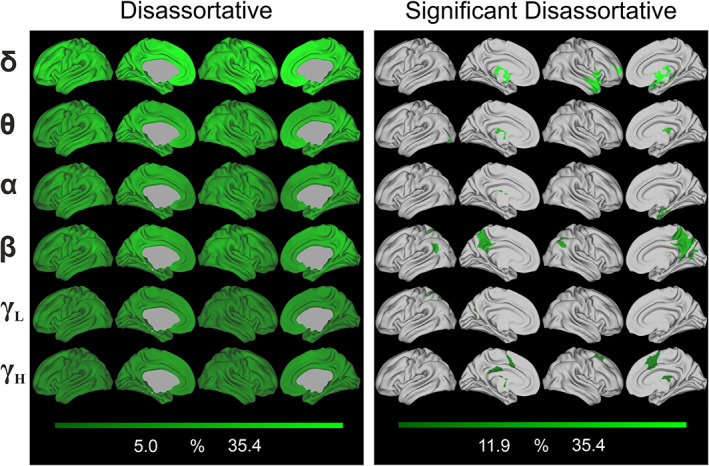
Recent studies provide novel insights into the meso-scale organization of the brain, highlighting the co-occurrence of different structures: classic assortative (modular), disassortative, and core-periphery. However, the spectral properties of the brain meso-scale remain mostly unexplored. To fill this knowledge gap, we investigated how the meso-scale structure is organized across the frequency domain. We analyzed the resting state activity of healthy participants with source-localized high-density electroencephalography signals. Then, we inferred the community structure using weighted stochastic block-model (WSBM) to capture the landscape of meso-scale structures across the frequency domain. We found that different meso-scale modalities co-exist and are diversely organized over the frequency spectrum. Specifically, we found a core-periphery structure dominance, but we also highlighted a selective increase of disassortativity in the low frequency bands (<8 Hz), and of assortativity in the high frequency band (30-50 Hz). We further described other features of the meso-scale organization by identifying those brain regions which, at the same time, (a) exhibited the highest degree of assortativity, disassortativity, and core-peripheriness (i.e., participation) and (b) were consistently assigned to the same community, irrespective from the granularity imposed by WSBM (i.e., granularity-invariance). In conclusion, we observed that the brain spontaneous activity shows frequency-specific meso-scale organization, which may support spatially distributed and local information processing.
Keywords: community detection; frequency-specificity; meso-scale; network neuroscience; resting state.
© 2021 The Authors. Human Brain Mapping published by Wiley Periodicals LLC.
Figures




References
-
- Ahmadlou, M., & Adeli, H. (2011). Functional community analysis of brain: A new approach for EEG‐based investigation of the brain pathology. NeuroImage, 58(2), 401–408. - PubMed
-
- Aicher, C., Jacobs, A. Z., & Clauset, A. (2015). Learning latent block structure in weighted networks. Journal of Complex Networks, 3(2), 221–248.
-
- Babiloni, C., Barry, R. J., Başar, E., Blinowska, K. J., Cichocki, A., Drinkenburg, W. H., … Nunez, P. (2020). International Federation of Clinical Neurophysiology (IFCN)–EEG research workgroup: Recommendations on frequency and topographic analysis of resting state EEG rhythms. Part 1: Applications in clinical research studies. Clinical Neurophysiology, 131(1), 285–307. - PubMed
Publication types
MeSH terms
LinkOut - more resources
Full Text Sources
Miscellaneous
