


Changes in Health-related Quality of Life for Hepatitis C Virus-Infected People Who Inject Drugs While on Opioid Agonist Treatment Following Sustained Virologic Response
- PMID: 34331539
- PMCID: PMC9070815
- DOI: 10.1093/cid/ciab669
Changes in Health-related Quality of Life for Hepatitis C Virus-Infected People Who Inject Drugs While on Opioid Agonist Treatment Following Sustained Virologic Response
Abstract
Background: Although efforts to treat hepatitis C virus (HCV) in people who inject drugs (PWID) yield high rates of sustained virologic response (SVR), the relationship between successful HCV treatment and health-related quality of life (HRQOL) among PWID is poorly understood. We examined HRQOL changes throughout HCV treatment and post-treatment for PWID achieving SVR.
Methods: Participants included 141 PWID who achieved SVR following HCV treatment onsite at 3 opioid agonist treatment (OAT) clinics in the Bronx, New York. EQ-5D-3L assesses 5 health dimensions (mobility, self-care, usual activities, pain/discomfort, and anxiety/depression), producing an index of HRQOL ranging from 0 to 1. EQ-5D-3L was measured at baseline; 4, 8, and 12 weeks during treatment; and 12 and 24 weeks post-treatment. Linear mixed effects regression models assessed changes in the mean EQ-5D-3L index over time.
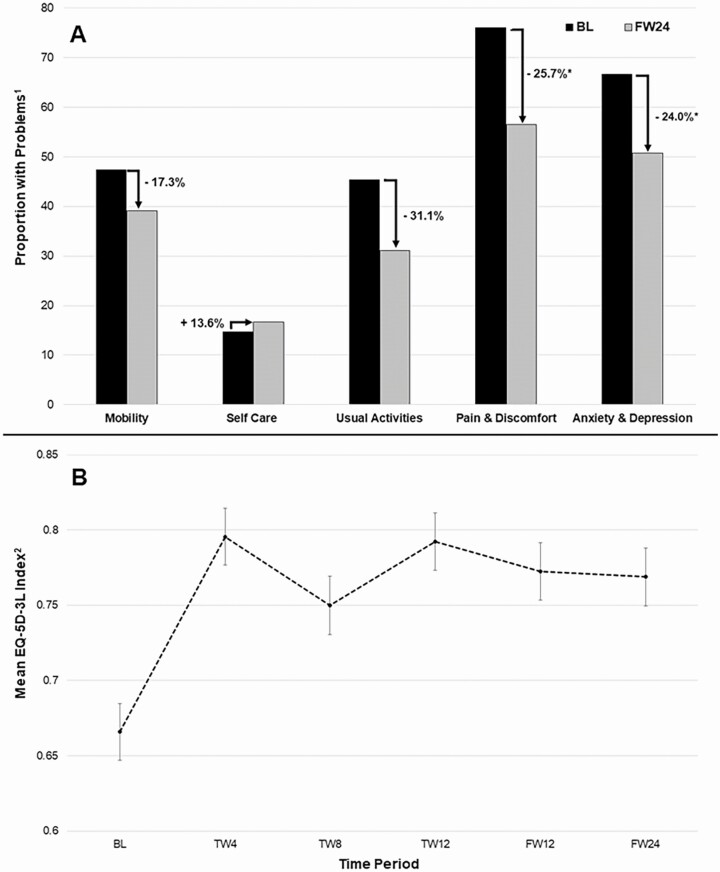
Results: Mean EQ-5D-3L index baseline was 0.66 (standard error [SE] = 0.02). While over half the population reported no baseline problems with self-care (85.1%), usual activities (56.0%), and mobility (52.5%), at least two-thirds reported problems with pain/discomfort (78.0%) and anxiety/depression (66.0%). Twenty-four weeks post-treatment, proportions reporting pain/discomfort and anxiety/depression decreased by 25.7% and 24.0%, respectively. Mean EQ-5D-3L index significantly improved during treatment (P < .0001), and improvement was sustained following treatment completion, with mean EQ-5D-3L index of 0.77 (SE = 0.02) 12 weeks post-SVR.
Conclusions: HCV treatment led to sustained improvement in HRQOL for PWID on OAT who achieved SVR. Future research is necessary to determine whether improvements in HRQOL can be sustained beyond 12 weeks post-SVR.
Keywords: direct-acting antiviral; health-related quality of life; hepatitis C virus; opioid agonist treatment; people who inject drugs.
© The Author(s) 2021. Published by Oxford University Press for the Infectious Diseases Society of America. All rights reserved. For permissions, e-mail: journals.permissions@oup.com.
Figures
References
-
- Viral Hepatitis Surveillance United States. Centers for Disease Control and Prevention. 2017. Updated November 14, 2019. https://www.cdc.gov/hepatitis/statistics/2017surveillance/index.htm. Accessed 1 July 2021.
Publication types
MeSH terms
Substances
Grants and funding
LinkOut - more resources
Full Text Sources
Medical
