


Is executive dysfunction a risk marker or consequence of psychopathology? A test of executive function as a prospective predictor and outcome of general psychopathology in the adolescent brain cognitive development study®
- PMID: 34332330
- PMCID: PMC8340137
- DOI: 10.1016/j.dcn.2021.100994
Is executive dysfunction a risk marker or consequence of psychopathology? A test of executive function as a prospective predictor and outcome of general psychopathology in the adolescent brain cognitive development study®
Abstract
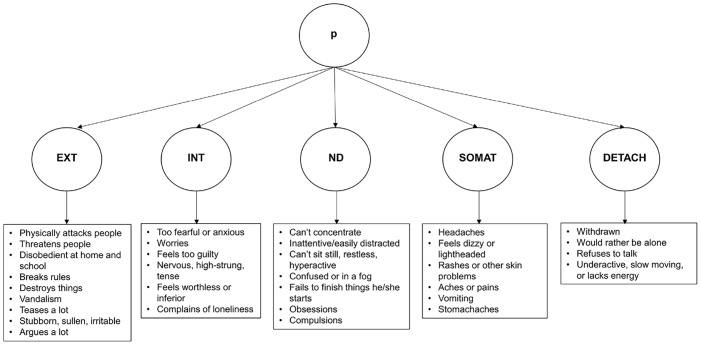
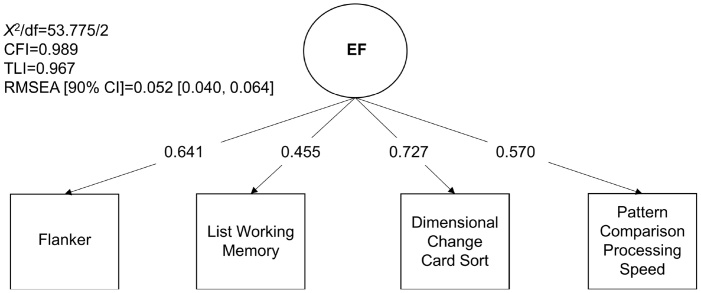
A general psychopathology ('p') factor captures shared variation across mental disorders. One hypothesis is that poor executive function (EF) contributes to p. Although EF is related to p concurrently, it is unclear whether EF predicts or is a consequence of p. For the first time, we examined prospective relations between EF and p in 9845 preadolescents (aged 9-12) from the Adolescent Brain Cognitive Development Study® longitudinally over two years. We identified higher-order factor models of psychopathology at baseline and one- and two-year follow-up waves. Consistent with previous research, a cross-sectional inverse relationship between EF and p emerged. Using residualized-change models, baseline EF prospectively predicted p factor scores two years later, controlling for prior p, sex, age, race/ethnicity, parental education, and family income. Baseline p factor scores also prospectively predicted change in EF two years later. Tests of specificity revealed that bi-directional prospective relations between EF and p were largely generalizable across externalizing, internalizing, neurodevelopmental, somatization, and detachment symptoms. EF consistently predicted change in externalizing and neurodevelopmental symptoms. These novel results suggest that executive dysfunction is both a risk marker and consequence of general psychopathology. EF may be a promising transdiagnostic intervention target to prevent the onset and maintenance of psychopathology.
Keywords: Executive function; General psychopathology; Longitudinal; Risk factor; Transdiagnostic; p Factor.
Copyright © 2021 The Authors. Published by Elsevier Ltd.. All rights reserved.
Conflict of interest statement
The authors declare the following financial interests/personal relationships which may be considered as potential competing interests: Over the past 3 years, Dr. Pizzagalli has received consulting fees from Albright Stonebridge Group, BlackThorn Therapeutics, Boehringer Ingelheim, Compass Pathway, Concert Pharmaceuticals, Engrail Therapeutics, Neurocrine Biosciences, Otsuka Pharmaceuticals, and Takeda Pharmaceuticals; one honorarium from Alkermes, and research funding from NIMH, Dana Foundation, Brain and Behavior Research Foundation, and Millennium Pharmaceuticals. In addition, he has received stock options from BlackThorn Therapeutics. Dr. Romer has no financial disclosures, and there are no conflicts of interest with the work conducted in this study. All views expressed are solely those of the authors.
Figures
References
-
- Achenbach T.M. University of Vermont Research Center for Children, Youth, and Families; Burlington, VT: 2009. The Achenbach System of Emprically Based Assessment (ASEBA): Development, Findings, Theory and Applications.
-
- Acock A.C. 4th ed. ed. Stata Press; 2014. A Gentle Introduction to Stata.
-
- Alnæs D., Kaufmann T., Doan N.T., Córdova-Palomera A., Wang Y., Bettella F., Moberget T., Andreassen O.A., Westlye L.T. Association of heritable cognitive ability and psychopathology with white matter properties in children and adolescents. JAMA Psychiatry. 2018;75:287–295. doi: 10.1001/jamapsychiatry.2017.4277. - DOI - PMC - PubMed
-
- Asparouhov T., Muthén B. 2010. Weighted Least Squares Estimation With Missing Data.
Publication types
MeSH terms
Grants and funding
- R01 MH101521/MH/NIMH NIH HHS/United States
- U24 DA041147/DA/NIDA NIH HHS/United States
- U01 DA051039/DA/NIDA NIH HHS/United States
- U01 DA041120/DA/NIDA NIH HHS/United States
- U01 DA051018/DA/NIDA NIH HHS/United States
- U01 DA041093/DA/NIDA NIH HHS/United States
- U24 DA041123/DA/NIDA NIH HHS/United States
- U01 DA051038/DA/NIDA NIH HHS/United States
- U01 DA051037/DA/NIDA NIH HHS/United States
- U01 DA051016/DA/NIDA NIH HHS/United States
- R37 MH068376/MH/NIMH NIH HHS/United States
- U01 DA041106/DA/NIDA NIH HHS/United States
- U01 DA041148/DA/NIDA NIH HHS/United States
- U01 DA041174/DA/NIDA NIH HHS/United States
- U01 DA041134/DA/NIDA NIH HHS/United States
- U01 DA041022/DA/NIDA NIH HHS/United States
- U01 DA041156/DA/NIDA NIH HHS/United States
- U01 DA050987/DA/NIDA NIH HHS/United States
- U01 DA041025/DA/NIDA NIH HHS/United States
- U01 DA050989/DA/NIDA NIH HHS/United States
- U01 DA041089/DA/NIDA NIH HHS/United States
- U01 DA050988/DA/NIDA NIH HHS/United States
- F32 MH124409/MH/NIMH NIH HHS/United States
- U01 DA041117/DA/NIDA NIH HHS/United States
- U01 DA041028/DA/NIDA NIH HHS/United States
- U01 DA041048/DA/NIDA NIH HHS/United States
LinkOut - more resources
Full Text Sources
Medical
