


Redox chemistry of lens crystallins: A system of cysteines
- PMID: 34332989
- PMCID: PMC8511183
- DOI: 10.1016/j.exer.2021.108707
Redox chemistry of lens crystallins: A system of cysteines
Abstract
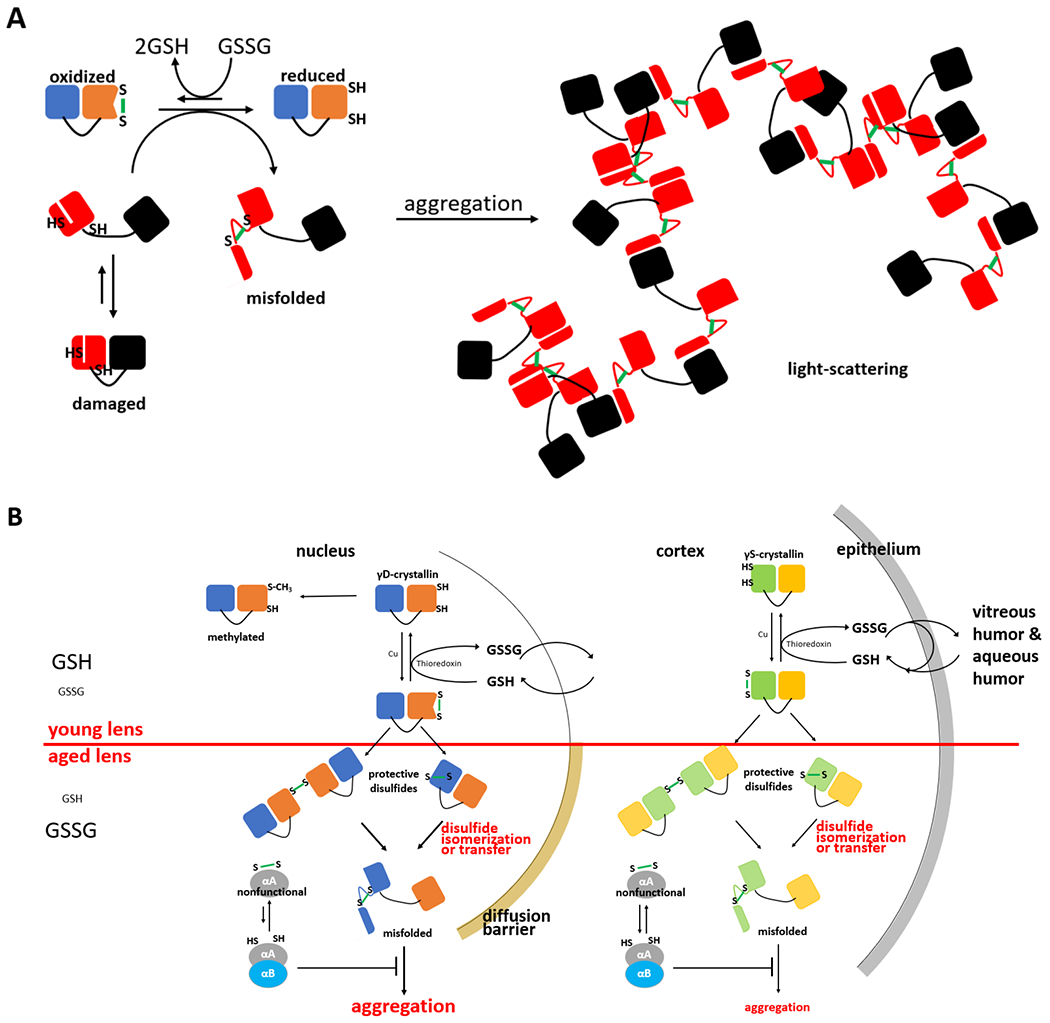
The nuclear region of the lens is metabolically quiescent, but it is far from inert chemically. Without cellular renewal and with decades of environmental exposures, the lens proteome, lipidome, and metabolome change. The lens crystallins have evolved exquisite mechanisms for resisting, slowing, adapting to, and perhaps even harnessing the effects of these cumulative chemical modifications to minimize the amount of light-scattering aggregation in the lens over a lifetime. Redox chemistry is a major factor in these damages and mitigating adaptations, and as such, it is likely to be a key component of any successful therapeutic strategy for preserving or rescuing lens transparency, and perhaps flexibility, during aging. Protein redox chemistry is typically mediated by Cys residues. This review will therefore focus primarily on the Cys-rich γ-crystallins of the human lens, taking care to extend these findings to the β- and α-crystallins where pertinent.
Keywords: Cataract; Crystallins; Disulfide exchange; Lens biochemistry; Protein aggregation.
Copyright © 2021 Elsevier Ltd. All rights reserved.
Figures
References
-
- Abkevich VI, Shakhnovich EI, 2000. What can disulfide bonds tell us about protein energetics, function and folding: simulations and bioninformatics analysis. J. Mol. Biol 300, 975–985. - PubMed
-
- Basak A, Bateman O, Slingsby C, Pande A, Asherie N, Ogun O, Benedek GB, Pande J, 2003. High-resolution X-ray crystal structures of human γD crystallin (1.25 Å) and the R58H mutant (1.15 Å) associated with aculeiform cataract. J. Mol. Biol 328, 1137–1147. - PubMed
-
- Benedek G, 1983. Protein microstructure: Why the eye lens is transparent. Nature 302, 383–384. - PubMed
Publication types
MeSH terms
Substances
Grants and funding
LinkOut - more resources
Full Text Sources
